Home
Class 12
PHYSICS
An elevator cab of mass m=500 kg is desc...

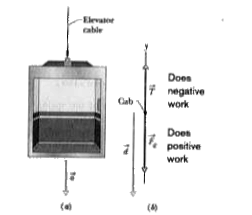
An elevator cab of mass `m=500` kg is descending with speed `v_(i)=4.0m//s` when its supporting cable begins to slip, allowing it to fall with constant acceleration `vec(a)=vec(g)//5` (Fig. 8-11a).
(b) During the 12 m fall, what is the work `W_(T)` done on the cab by the upward pull `vec(T)` of hte elevator cable?

Text Solution

Verified by Experts
KEY IDEA
We can calculate work `W_(T)` with Eq. 8-7 `(W=Fd cos phi)` by first writing `F_("net". y)=ma_(y)` for the components in Fig. 8-11b.
Calculations: We get
`T-F_(g)=ma`. (8-18)
Solving for .I., substituting mg for `F_(g)`, and then substituting the result in Eq. 8-7, we obtain
`W_(T)=Td cos phi = m (a+g)d cos phi`. (8-19)

Figure 8-11 An elevator cab, descending with speed `v_(i)`, suddenly begins to accelerate downward. (a) It moves through a displacement `vec(d)` with constant acceleration `vec(a)=g//5`. (b) A freebody diagram for the cab, displacement included.
Next, substituting `-g//5` for the (downward) acceleration a and then `180^(@)` for the angle `phi` between the direction of forces `vec(T)` and `m vec(g)`, we find
`W_(T)=m(- g/5 + g) d cos phi = 4/5 mgd cos phi`
`=4/5 (500 kg) (9.8 m//s^(2))(12m)cos 180^(@)`
`= -4.70xx10^(4) j~~-47 kJ`.
Caution: Note that `W_(T)` is not simply the negative of `W_(g)` because the cab accelerates during the fall. Thus, Eq. 8-16 (which assumes that the initial and final kinetic energies are equal) does not apply here.
Promotional Banner

Topper's Solved these Questions

  • WORK, POWER, AND ENERGY

    RESNICK AND HALLIDAY|Exercise CHECKPOINT|6 Videos
  • WORK, POWER, AND ENERGY

    RESNICK AND HALLIDAY|Exercise PROBLEMS|58 Videos
  • WAVES-I

    RESNICK AND HALLIDAY|Exercise Practice Questions (Integer Type)|4 Videos

Similar Questions

Explore conceptually related problems

An elevator cab of mass m=500 kg is descending with speed v_(i)=4.0m//s when its supporting cable begins to slip, allowing it to fall with constant acceleration vec(a)=vec(g)//5 . What is the cab's kinetic energy at the end of the 12 m fall ?

An elevator cab of mass m=500 kg is descending with speed v_(i)=4.0m//s when its supporting cable begins to slip, allowing it to fall with constant acceleration vec(a)=vec(g)//5 . During the fall through a distance d=12 m, what is the work W_(g) done on the cab by the gravitational force vec(F)_(g) ?

An elevator and its load weigh a total of 1600 kg. Find the tension T in the supporting cable when the elevator, originally moving downward at 20 m/s is brought to rest with constant acceleration in a distance of 50 m.

An elevator and its load weigh a total of 166 kg. Find the tension T in the supporting cable when the elevator, originally moving downwards at 20m//s is brought to rest with constant acceleration in a distance of 50 m.

An elevator and its load weigh a total of 800kg Find the tension T in the supporting cable when the elevator originally moving downwards at 20m//s is brought to rest with constant retardation in a distnce of 50m .

In this figure,the force (in N ) on mass 5kg that should be applied,so that it just won't slip is (Given that car is moving with constant acceleration (a=5m/s^(2),mu=0.4))

An elevator with floor to roof height 24m starts moving upwards with a constant acceleration of 2(m)/(s^(2)). At t=2s ,a bolt on the roof loosens and falls. Time the bolt takes to travel from the roof to the floor of the elevator is g=10ms^(-2)]

An elevator platform is going up at a speed of 20 m//s and during its upward motion a small ball of 50 g mass, falling in downward direction, strikes the platform at speed 5 m//s . Find the speed with which the ball rebounds.

