Text Solution
Verified by Experts



Topper's Solved these Questions
THE HUMAN EYE AND THE COLOURFUL WORLD
ZEN PUBLICATION|Exercise ZEN ADDITIONAL QUESTIONS SECTION - SHORT ANSWER TYPE QUESTIONS - II|28 VideosTHE HUMAN EYE AND THE COLOURFUL WORLD
ZEN PUBLICATION|Exercise ZEN ADDITIONAL QUESTIONS SECTION - Problem Section|36 VideosTHE HUMAN EYE AND THE COLOURFUL WORLD
ZEN PUBLICATION|Exercise ZEN ADDITIONAL QUESTIONS SECTION - VERY SHORT ANSWER TYPE QUESTIONS|97 VideosSOURCES OF ENERGY
ZEN PUBLICATION|Exercise ZEN ADDITIONAL QUESTIONS SECTION (HIGHER-ORDER THINKING SKILLS [HOTS] )|14 Videos
Similar Questions
Explore conceptually related problems
ZEN PUBLICATION-THE HUMAN EYE AND THE COLOURFUL WORLD-ZEN ADDITIONAL QUESTIONS SECTION - SHORT ANSWER TYPE QUESTIONS - I
- List the three phenomena of light responsible for the formation of rai...
Text Solution
|
- A beam of light consisting of red, blue, and yellow colours is inciden...
Text Solution
|
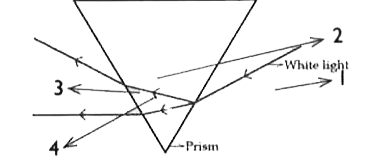
- When a beam of white light is passed through a triangular glass prism,...
Text Solution
|
- Name the phenomenon responsible for (i) advance of sunrise (ii) colour...
Text Solution
|
- A star sometimes brighter and at other times fainter. What is this eff...
Text Solution
|
- Why do we see a rainbow in the ske only after rainfall ?
Text Solution
|
- Mention any four phenomena that can be observed due to atmospheric ref...
Text Solution
|
- What is the difference in colours of the sun observed during sunrise/s...
Text Solution
|
- Sun appears red in colour during sunrise but appears white at noon. Ex...
Text Solution
|
- Why does the sun seem to rise two minutes before the actual sunrise an...
Text Solution
|
- The sun near the horizon appears flattened at sunset and sunrise. Expl...
Text Solution
|
- Is the position of a star as seen by us its true position ? Justify yo...
Text Solution
|
- "Stars appear higher than they actually are". Give reason.
Text Solution
|
- Explain how the colour of the scattered light depends on the size of t...
Text Solution
|
- What would have been the colour of the sky, in the absence of atmosphe...
Text Solution
|
- What is meant by scattering of light ? Use this phenomenon to explain ...
Text Solution
|
- Name the four parts labelled as 1,2,3 and 4 in the given figure.
Text Solution
|
- In a human eye, name the following parts. (i) A thin membrane which ...
Text Solution
|
- How are we able to see nearby and also the distant objects clearly ?
Text Solution
|
- What is meant by accomodation of the eye ?
Text Solution
|