Home
Class 10
PHYSICS
A beam of light is allowed to pass throu...

A beam of light is allowed to pass through two beakers A and B, containg a true solutionand a colloidal solution respectively. What do you observe ? Name the phenomenon responsible for your observation.

Text Solution

Verified by Experts
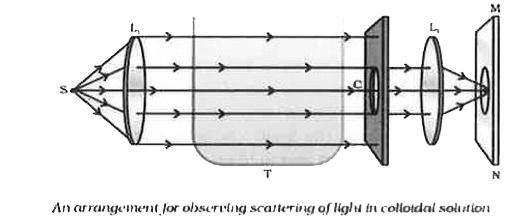
Aim of the activity: To study Tyndall effect or scattering of light by colloidal particles.

(1) Place a strong source of white light (S), a convex lens `[L_(1)]`, a transparent glass tank [T] containing clear water [about 2 litres], a cardboard [C ] with a circular hole, another convex lens `[L_(2)]` and a screen [MN] in a straight line as shown in the figure.
(2) Focus white light from S into `L_(1)` so that a parallel beam of light is obtained.
(3) This beam of light passes through T, the hole in the cardboard, `L_(1)` and finally falls on the screen.
(4) Dissolve about 200 g of sodium thiosulphate (hypo-chemical formula `Na_(2)S_(2)O_(3)`) in the tank water and later add 1-2 ml of concentrated sulphuric acid into it.
Inference : Sulphur particles starts precipitating in about 2-3 minutes and blue light starts coming from three sides of the glass tank. This is because minute sulphur particles scatter light of short wavelengths [blue colour] to a maximum extent. This helps us to understand why or sky appears blue.
We also observe that initially orange light comes out of the fourth side of the tank [the one facing the circular hole] and falls on the screen, Later the colour changes by scattering and the least scattered red light comes out of the colloidal solution. This helps us to understand why the sun appears red during sunrise or sunset.
Promotional Banner

Topper's Solved these Questions

  • THE HUMAN EYE AND THE COLOURFUL WORLD

    ZEN PUBLICATION|Exercise ZEN ADDITIONAL QUESTIONS SECTION - HIGHER ORDER THINKING SKILLS (HOTS)|26 Videos
  • THE HUMAN EYE AND THE COLOURFUL WORLD

    ZEN PUBLICATION|Exercise ZEN ADDITIONAL QUESTIONS SECTION - SHORT ANSWER TYPE QUESTIONS - II|28 Videos
  • SOURCES OF ENERGY

    ZEN PUBLICATION|Exercise ZEN ADDITIONAL QUESTIONS SECTION (HIGHER-ORDER THINKING SKILLS [HOTS] )|14 Videos

Similar Questions

Explore conceptually related problems

Two liquids A and B are mixed and the resulting solution is found to be cooler. What do you conclude about the deviation from ideal behaviour?

A silver spoon is kept immersed in an aqueous solution of copper sulphate. What change would you observe in the spoon and in the solution? Justify your answer.

In test-tubes A and B , zinc sulphate solution and silver nitrate solution are taken respectively . Copper trunings are added to both test-tubes . In which of the two test-tubes do you observe the reaction. Justify your answer with scientific reason.

Explain the following observations : (i) A beam of light passing through a colloidal solution has a visible path. (ii) Passing an electric current through a colloidal solution removes colloidal particles from it. (iii) Ferric hydroxide sol coagulates on addition of potassium sulphate,

A narrow beam PQ of white light is passing through a glass prism ABC as shown in the diagram. Trace it one your answer sheet and show the path of the emergent beam as observed on the screen DE. (i) Write the name and cause of the phenomenon observed. (ii) Where else is nature is the phenomenon observed ? (iii) Based on this observation, state the conclusion which can be drawn about the constituents of white light.

ZEN PUBLICATION-THE HUMAN EYE AND THE COLOURFUL WORLD-ZEN ADDITIONAL QUESTIONS SECTION - Problem Section
  1. What is atmospheric refraction ? Use this phenomenon to explain the fo...

    Text Solution

    |

  2. What is Tyndall effect? What is its cause ? Name two phenomena observe...

    Text Solution

    |

  3. A beam of light is allowed to pass through two beakers A and B, contai...

    Text Solution

    |

  4. Write an activity for observing scattering of light in colloidal solut...

    Text Solution

    |

  5. Mention any four differences between a glass slab and a glass prism.

    Text Solution

    |

  6. Calculate maximum power of accomodation of a person having normal visi...

    Text Solution

    |

  7. How can we determine the focal length and power of the concave lens re...

    Text Solution

    |

  8. How can we determine the focal length and power of the convex lens req...

    Text Solution

    |

  9. A person with a myopia eye cannot see objects beyond a distance of 1.5...

    Text Solution

    |

  10. A doctor prescribes a corrective lens of power -0.5 D to a person. Fin...

    Text Solution

    |

  11. Why does the power to clearly see near objects and far-off objects dim...

    Text Solution

    |

  12. The far point of a myopia eye is 60 cm. Find the focal length of the l...

    Text Solution

    |

  13. Ravi kept a book at a distance of 10 cm from the eyes of his friend Ha...

    Text Solution

    |

  14. A lens of focal length 5 cm is being used by a student in the laborato...

    Text Solution

    |

  15. A myopia person can see things clearly only when they lie between 10 c...

    Text Solution

    |

  16. A person wants to read a book placed at 20 cm whereas the near poit of...

    Text Solution

    |

  17. The far point of a myopia person is 200 cm. Calculate the power of a l...

    Text Solution

    |

  18. Explain the structure and functioning of the human eye. How are we abl...

    Text Solution

    |

  19. What is atmospheric refraction ? Use this phenomenon to explain the fo...

    Text Solution

    |

  20. What is Tyndall effect? What is its cause ? Name two phenomena observe...

    Text Solution

    |

