Home
Class 11
PHYSICS
A gas is compressed isothermally to half...

A gas is compressed isothermally to half its initial volume. The same gas is compressed seperately through an adiabatic process until its volume is again reduced to half. Then _____

A

Compressing the gas through adiabatic process will require more work to be done.

B

Compressing the gas through isothermally or adiabatically will require more work to be done.

C

Which of the case (whether compression through isothermal or through adiabatic process) requires more work will depend upon the atomicity of the gas.

D

Compressing the gas isothermally will require more work to be done.

Text Solution

Verified by Experts

The correct Answer is:
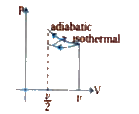
A

Promotional Banner

Topper's Solved these Questions

  • THERMODYANMICS

    KUMAR PRAKASHAN|Exercise Section-F Questions from Module|20 Videos
  • THERMODYANMICS

    KUMAR PRAKASHAN|Exercise Question Paper|11 Videos
  • THERMODYANMICS

    KUMAR PRAKASHAN|Exercise Section-D Ncert Exemplar Solution (Long Answer )|5 Videos
  • THERMAL PROPERTIES OF MATTER

    KUMAR PRAKASHAN|Exercise Question Paper (Section - D) (Answer following in brief :) Each carry 4 marks|1 Videos
  • UNITS AND MEASUREMENT

    KUMAR PRAKASHAN|Exercise Section -F (Questions from Module )|20 Videos

Similar Questions

Explore conceptually related problems

An ideal gas is compressed to half its initial volume by means of several processes. Which of the process results in the maximum work done on the gas ?

Three moles of an ideal gas (C_p=7/2R) at pressure, P_A and temperature T_A is isothermally expanded to twice its initial volume. It is then compressed at constant pressure to its original volume. Finally gas is compressed at constant volume to its original pressure P_A . (a) Sketch P-V and P-T diagrams for the complete process. (b) Calculate the net work done by the gas, and net heat supplied to the gas during the complete process.

Consider two containers A and B containing identical gases at the same pressure, volume and temperature. The gas in container A is compressed to half of its original volume isothermally while the gas in container B is compressed to half of its original value adiabatically. The ratio of final pressure of gas in B to that of gas in A is

Give the relationship between pressure and volume in an adiabatic process for an ideal gas.

Two samples of a gas initially at same temperature and pressure are compressed from a volume V to (V)/(2) . One sample is compressed isothermally and the other adiabatically . In which sample is the pressure greater?

An ideal gas expands isothermally from volume V_(1) to V_(2) and is then compressed to original volume V_(1) adiabatically. Initialy pressure is P_(1) and final pressure is P_(3) . The total work done is W . Then

Calculate the work done when one mole of a perfect gas is compressed adiabatically. The initial pressure and volume of the gas are 10^5 N//m^2 and 6 litres respectively. The final volume of the gas are 2 litre . Molar specific heat of the gas at constant volume is 3R//2 .

Two moles of helium gas ( gamma = 5 / 3 ) are initially at 27^@C and occupy a volume of 20 litres . The gas is first expanded at constant pressure until the volume is doubled. Then it undergoes an adiabatic change until the temperature returns to its initial value. (a) Sketch the process in a p_V diagram. (b) What is the final volume and pressure of the gas ? (c) What is the work done by the gas?

A hollow spherical shell is compressed to half its radius. The gravitational potential at the centre

A diatomic ideal gas is heated at constant at constant volume until the pressure is doubled and again heated of constant pressure until the volume is doubled. The average molar heat capacity for the whole process is

KUMAR PRAKASHAN-THERMODYANMICS -Section-E MCQs
  1. One mole of diatomic ideal gas undergoes a cyclic process ABC as shown...

    Text Solution

    |

  2. Figure below shows two paths that may be taken by a gas to go from a s...

    Text Solution

    |

  3. One mole of an ideal diatomic gas undergoes a transition from A to B a...

    Text Solution

    |

  4. The coefficient of performance of a refrigerator is 5. If the temperat...

    Text Solution

    |

  5. An ideal gas is compressed to half its initial volume by means of seve...

    Text Solution

    |

  6. The value of coefficient of volume expansion of glycerin is 5 xx 10^(-...

    Text Solution

    |

  7. 4.0 g of a gas occupies 22.4 litres at NTP. The specific heat capacity...

    Text Solution

    |

  8. A gas is compressed isothermally to half its initial volume. The same ...

    Text Solution

    |

  9. A refrigerator works between 4^@C and 30^@C. It is required to remove ...

    Text Solution

    |

  10. Two identical bodies are made of a material for which the heat capacit...

    Text Solution

    |

  11. One mole of an ideal monoatomic gas undergoes a process described by t...

    Text Solution

    |

  12. The temperature inside a refrigerator is t2^@C and the room temperatur...

    Text Solution

    |

  13. The volume of one mole of an ideal gas with adiabatic exponent gamma ...

    Text Solution

    |

  14. One mole of gas obey the equation of state P(V - b) = RT and changes i...

    Text Solution

    |

  15. Thermodynamic process are indicated in the following diagram. Then mat...

    Text Solution

    |

  16. A sample of 0.1 g of water at 100^@ C and normal pressure (1.013 xx 10...

    Text Solution

    |

  17. Two wires are made of the same material and have the same volume. The ...

    Text Solution

    |

  18. The volume (V) of a monoatomic gas varies with its temperature (T), as...

    Text Solution

    |

  19. The efficiency of an ideal heat engine working between the freezing po...

    Text Solution

    |

  20. Two moles of an ideal monoatomic gas occupies a volume V at 27^@ C. Th...

    Text Solution

    |

