Home
Class 12
PHYSICS
Assertion (A): For identical charges of ...

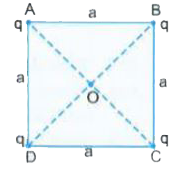
Assertion (A): For identical charges of magnitude g each are placed at the vertices of a square of side'a'. The electric field at the centre point O is zero but electric potential is non-zero and finite. Reason
(R) : Electric field is a vector quantity but electric potential is a D scalar.

A

If both assertion and reason are true and the reason is the correct explanation of the assertion.

B

If both assertion and reason are true but reason is not the correct explanation of the assertion.

C

If assertion is true but reason is false.

D

If the assertion is false but reason is true.

Text Solution

Verified by Experts

Electric fields due to diagonally opposite charges balance each other and net field at point O becomes zero. However, potentials due to all the charges are added up.
Promotional Banner

Topper's Solved these Questions

  • ELECTROSTATIC POTENTIAL AND CAPACITANCE

    U-LIKE SERIES|Exercise VERY SHORT ANSWER QUESTIONS|40 Videos
  • ELECTROSTATIC POTENTIAL AND CAPACITANCE

    U-LIKE SERIES|Exercise SHORT ANSWER QUESTIONS|48 Videos
  • ELECTROSTATIC POTENTIAL AND CAPACITANCE

    U-LIKE SERIES|Exercise TRUE OR FALSE|7 Videos
  • ELECTROMAGNETICE INDUCTION

    U-LIKE SERIES|Exercise Self Assessment Test Section -D|1 Videos
  • EXAMINATION PAPER 2020 (SOLVED)

    U-LIKE SERIES|Exercise SECTION D|6 Videos

Similar Questions

Explore conceptually related problems

Four point charges of +1muc each are placed on the four corners of a square of side 1 m. Calculate the electric potential at the centre of the square.

Assertion: If we see along the axis of a chaged ring, the magnitudeof electric field is minimum at centre and magnitude of electridc potential is maximum. Reason: Electric field is a vector quantity while electric potential is scalar.

Equal charges q are placed at the vertices A and B of an equilatral triangle ABC of side a . The magnitude of electric field at the point C is

Four idential charges each of charge q are placed at the corners of a square .Then at the centre of the square the resultant electric intensity E and the net electric potential V are

The electric field and the potential of an electric dipole vary with distance r as

The electric field and the potential of an electric dipole vary with distance 'r' as

