Home
Class 12
PHYSICS
In a quark model of elementary particles...

In a quark model of elementary particles, a neutron is made of one up quark (charge `=2/3e`) and two down quarks (charges `=1/3e`). Assume that they have a triangle configuration with side length of the order of `10^(-15)m.` Calculate electrostatic potential energy of neutron.

Text Solution

Verified by Experts
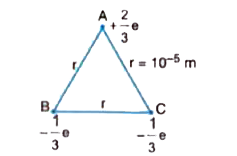
The electrostatic potential energy of neutron
`u= 1/(4piepsi_0)[((2/3e)(-1/3e))/r + ((2/3e)(-1/3e))/r + ((-1/3e)(-1/3e))/r]`

`1/(4pi epsi_0) (-1/3 e^2/r) = (-9 xx 10^9 xx (1.6 xx 10^(-19))^2)/(3xx (10^(-15)))`
`=-7.68 xx 10^(-14) J = -(7.68 xx 10^(-14))/(1.6 xx 10^(-19)) eV = - 4.8 xx 10^5 eV = - 0.48 MeV`
Promotional Banner

Topper's Solved these Questions

  • ELECTROSTATIC POTENTIAL AND CAPACITANCE

    U-LIKE SERIES|Exercise LONG ANSWER QUESTIONS-I|64 Videos
  • ELECTROSTATIC POTENTIAL AND CAPACITANCE

    U-LIKE SERIES|Exercise LONG ANSWER QUESTIONS-II|13 Videos
  • ELECTROSTATIC POTENTIAL AND CAPACITANCE

    U-LIKE SERIES|Exercise VERY SHORT ANSWER QUESTIONS|40 Videos
  • ELECTROMAGNETICE INDUCTION

    U-LIKE SERIES|Exercise Self Assessment Test Section -D|1 Videos
  • EXAMINATION PAPER 2020 (SOLVED)

    U-LIKE SERIES|Exercise SECTION D|6 Videos

Similar Questions

Explore conceptually related problems

(a) In a quark model of elementary particles, a neutron is made of one up quarks [charge (2//3) e] and two down quarks [charges - (1//3) e]. Assume that they have a triangle configuration with side length of the order of 10^(-15) m . Calculate electrostatic potential energy of neutron and compare it with its mass 939 MeV. (b) Repeat above exercise for a proton which is made of two up and one down quark.

Three charges +q, 2 q and -4q are placed on the three vertices of an equale-laterail triangle of each side 0*1m . Calculate electrostatic potential energy of the system, take q = 10^(-7) C

Three charges of 1 nC, 2 nC and 3 nC are placed at the corners of an equilateral triangle of side sqrt(3) m. Calculate electrostatic potential at a point equidistant from the three corners of the triangle.

The neutron is a particle with zero charge still it has a non-zero magnetic moment with z-component 9.66 xx 10^(-27) A-m^(2) . This can be explained by the internal structure of the neutron. The evidence indicates that a neutron is composed of three fundamental particles calleed quarks : an "up" (u) quark, of charge + (2e)/(3) , and two "down" (d) quarks, each of change - (e)/(3) . The combinations of the three quarks prodcues a net charge of (2e)/(3) - e/3 - e/3 = 0 . If the quarks are in motion they can produce a non-zero magnetic moment. As a very simple model, suppose the u quark moves in a counter clockwise circular path and the d quarks move in a clockwise circular path, all of the radius r and all with the same speed v see figure. The current due to the circular motion of the u quark :-

Three point charges 3nC, 6nC and 6nC are placed at the corners of an equilateral triangle of side 0.1 m. The potential energy of the system is

U-LIKE SERIES-ELECTROSTATIC POTENTIAL AND CAPACITANCE -SHORT ANSWER QUESTIONS
  1. Two closely spaced equipotential surfaces A and B with potentials V an...

    Text Solution

    |

  2. Derive an expression for the potential energy of an electric dipole of...

    Text Solution

    |

  3. Calculate the amount of work done to dissociate a system of three char...

    Text Solution

    |

  4. In a quark model of elementary particles, a neutron is made of one up ...

    Text Solution

    |

  5. Explain the working principle of a parallel plate capacitor.

    Text Solution

    |

  6. Define dielectric constant of a medium. Briefly explain why the capaci...

    Text Solution

    |

  7. Derive an expression for the energy stored in a charged parallel plate...

    Text Solution

    |

  8. Net capacitance of three identical capacitors in series is 1 muF. What...

    Text Solution

    |

  9. Two identical capacitors of 12 pF each are connected in series across ...

    Text Solution

    |

  10. Find the ratio of the potential differences that must be applied acros...

    Text Solution

    |

  11. Find equivalent capacitance between A and B in the combination given b...

    Text Solution

    |

  12. If a.b.c source of 7V is connected across AB, how much charge is drawn...

    Text Solution

    |

  13. Figure shows two idential capacitors, C1 and C2, each of 1mu F capacit...

    Text Solution

    |

  14. Two capacitors of capacitance of 6 muF and 12 muF are connected in ser...

    Text Solution

    |

  15. A network of four capacitors, each of capacitance 15muF,is connected a...

    Text Solution

    |

  16. Two dielectric slabs of dielectric constants K1 and K2 are filled in b...

    Text Solution

    |

  17. A parallel plate capacitor of capacitance C is charged to a potential...

    Text Solution

    |

  18. A slab of material of dielectric constant K has the same area as that ...

    Text Solution

    |

  19. Determine the potential difference across the plates of the capacitor ...

    Text Solution

    |

  20. The figure shows a network of five capacitors connected to a 100 V su...

    Text Solution

    |

