Home
Class 12
PHYSICS
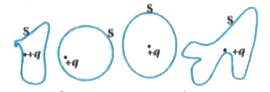
The Electric flux through the surface:...

The Electric flux through the surface:

A

(A) in figure (iv) is the largest.

B

(B) in figure (iii) is the least.

C

(C) in figure (ii) is same as figure (iii) but is smaller than figure (iv).

D

(D) is the same for all the figures.

Text Solution

Verified by Experts

The correct Answer is:

D

According to Gauss. law of electrostatic, the total electric flux out of a closed surface is equal to the charge enclosed divided by the permittivity.
`therefore phi = (sumq)/(epsilon_(0))`
`therefore phi = sumq`
Thus, electric flux through a surface doesn.t depend on the shape, size or area of a surface but it depends on the amount of charge enclosed by the surface.
In given figures, the charge enclosed are same that means the electric flux through all the surfaces should be the same. Hence, option (D) is correct.
Promotional Banner

Topper's Solved these Questions

  • ELECTRIC CHARGES AND FIELDS

    KUMAR PRAKASHAN|Exercise SECTION C NCERT EXEMPLAR SOLUTION (MULTIPLE CHOICE QUESTIONS (MORE THAN ONE OPTION))|6 Videos
  • ELECTRIC CHARGES AND FIELDS

    KUMAR PRAKASHAN|Exercise SECTION C NCERT EXEMPLAR SOLUTION (VERY SHORT ANSWER TYPE QUESTIONS)|6 Videos
  • ELECTRIC CHARGES AND FIELDS

    KUMAR PRAKASHAN|Exercise SECTION B NUMERICALS (NUMERICAL FOR .DARPAN. BASED ON TEXTBOOK)|8 Videos
  • DUAL NATURE OF RADIATION AND MATTER

    KUMAR PRAKASHAN|Exercise Section-D (MCQs asked in GUJCET/Board Exam)|1 Videos
  • ELECTROMAGNETIC INDUCTION

    KUMAR PRAKASHAN|Exercise Section D MCQs (MCQs asked in Competitive Exams )|38 Videos

Similar Questions

Explore conceptually related problems

An arbitrary surface encloses a dipole. What is the electric flux through this surface ?

A point charge of 2.0 muC is at the centre of a cubic Gaussian surface 9.0 cm on edge. What is the net electric flux through the surface ?

A point charge of 2.0 mu c is at the centre of a cubic gaussian surface 9.0 cm on edge what is the net electric flux through the surface

Electric flux through a surface of area 100 m^(2) lying in the plane in the xy plane is (in V-m) if E=hat(i)sqrt(2)hat(j)+sqrt(3)hat(k) :

A cylinder of radius r and length L is placed in a uniform electric field in such a way that its axis remains parallel to the electric field. The electric flux passing through the surface of cylinder is

A point charge + mu c is a distance 5 cm directly above the centre of a square of side 10 cm as what is the magnitude of the electric flux through the square

An infinite, uniformly charged sheet with surface charge density sigma cuts through a spherical Gaussian surface of radius R at a distance X from its center, as shown in the figure. The electric flux Phi through the Gaussian surface is .

The electric field in the region of the space is vecE = (5hati + 2hatj + 3hatk)NC^(-1) . The electric flux passing through a surface of area 50m^2 placed in X-Y plane inside the electric field is.......

Careful measurement of the electric field at the surface of a black box indicates that the net outward flux through the surface of the (a) what ist the net charge inside the box (b) if the net outward flux through the surface of the box wre zero could you conclude that there were no charges inside the box why or why not

Careful measurement of the electric field at the surface of a black box indicates that the net outward flux through the surface of the box is 8.0 xx 10^3 Nm^2//C . (a) What is the net charge inside the box ? (b) If the net outward flux through the surface of the box were zero, could you conclude that there were no charges inside the box ? Why or Why not ?
