Home
Class 12
PHYSICS
Five charges q1 q2, q3, q4, and q5 are f...

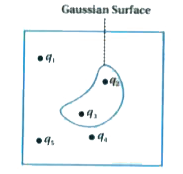
Five charges `q_1 q_2, q_3, q_4`, and `q_5` are fixed at their positions as shown in figure. S is a Gaussian surface. The Gauss's law is given by `int_(S)vecE.vec(ds) = q/epsilon_(0)`. Which of the following statements is correct?

A

`vecE` on the LHS of the above equation will have a contribution from `q_(1),q_(5)` and `q_3` while q on the RHS will have a contribution from `q_2` and `q_4` only.

B

`vecE` on the LHS of the above equation will have a contribution from all charges while q on the RHS will have a contribution from `q_2` and `q_4` only.

C

`vecE` on the LHS of the above equation will have a contribution from all charges while q on the RHS will have a contribution from `q_1 ,q_3` and `q_5` only.

D

Both `vecE` on the LHS and q on the RHS will have contributions from `q_2` and `q_4` only.

Text Solution

Verified by Experts

The correct Answer is:

B

n equation, `vecE` is electric field on closed surface by charges inside or outside it.
But, `q_1` is the charge enclosed by the closed surface, the charges outside the surface are not taken into consideration.
Promotional Banner

Topper's Solved these Questions

  • ELECTRIC CHARGES AND FIELDS

    KUMAR PRAKASHAN|Exercise SECTION C NCERT EXEMPLAR SOLUTION (MULTIPLE CHOICE QUESTIONS (MORE THAN ONE OPTION))|6 Videos
  • ELECTRIC CHARGES AND FIELDS

    KUMAR PRAKASHAN|Exercise SECTION C NCERT EXEMPLAR SOLUTION (VERY SHORT ANSWER TYPE QUESTIONS)|6 Videos
  • ELECTRIC CHARGES AND FIELDS

    KUMAR PRAKASHAN|Exercise SECTION B NUMERICALS (NUMERICAL FOR .DARPAN. BASED ON TEXTBOOK)|8 Videos
  • DUAL NATURE OF RADIATION AND MATTER

    KUMAR PRAKASHAN|Exercise Section-D (MCQs asked in GUJCET/Board Exam)|1 Videos
  • ELECTROMAGNETIC INDUCTION

    KUMAR PRAKASHAN|Exercise Section D MCQs (MCQs asked in Competitive Exams )|38 Videos

Similar Questions

Explore conceptually related problems

A cube of a metal is given a positive charge Q . For the above system, which of the following statements is true ?

Refer to the arrangement of charges in shown figure and a Gaussian surface of radius R with Q at the centre. Then:

If the B-H curves of two samples of P and Q of iron are as shown below, then which one of the following statements is CORRECT?

Charges q, 2q,3q and 4q are placed at the corners A,B,C and D of a square as shown in the following figure. The directon of electric field at the centre of the square is along

Assertion:- In a given situation of arrangement of charges, an extra charge is placed outside the Gaussion surface. In the Gauss Theroem ointvecEdvecs=(Q_(in))/(epsilon_(0)).Q_(in) remains unchanged whereas electric field vecE at the site of the element is changed. Reason:- Electric field vecE at any point on the Gaussian surface is due to inside charge only.

A positive point charge is placed at P in front of an earthed metal sheet S.Q and R are two points between P and S as shown in the diagram. If the electric field strength at Q and r are respectively E_(Q) and E_(R) , which one of the following statement is // are false?

Plates a and B constitutes an isolated, charge parallel plate capacitor. The inner surface (I and IV) of A and B have charge +Q and -Q respectively. A third plate C with charge +Q is now introduced midways between A and B. Which of the following statement is not correct?

Four point charges q_(A) =2 muC, q_(B) = -5 muC, q_(C) =2 muC , and q_(D) = -5 muC are located at the corners of a square ABCD of side 10 cm. What is the force on a charge of 1 muC placed at the centre of the square ?
