Home
Class 12
PHYSICS
A point charge +q, is placed at a distan...

A point charge +q, is placed at a distance d from an isolated conducting plane. The field at a point P on the other side of the plane is

A

directed perpendicular to the plane and away from the plane.

B

directed perpendicular to the plane but towards the plane.

C

directed radially away from the point charge.

D

directed radially towards the point charge.

Text Solution

Verified by Experts

The correct Answer is:
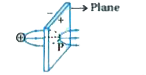
A

If a point positive charge is placed near an isolated conducting plane, free electrons are attracted towards the positive charge. Result of this some negative charge develops on the surface of the plane towards the positive charge side and an equal positive charge develops on opposite side of the plane.

The electric field lines are away from positive charge and perpendicular to the surface. Hence, the field at a point P on the other side of the plane is directed perpendicular to the plane and away from the plane.
Promotional Banner

Topper's Solved these Questions

  • ELECTRIC CHARGES AND FIELDS

    KUMAR PRAKASHAN|Exercise SECTION C NCERT EXEMPLAR SOLUTION (MULTIPLE CHOICE QUESTIONS (MORE THAN ONE OPTION))|6 Videos
  • ELECTRIC CHARGES AND FIELDS

    KUMAR PRAKASHAN|Exercise SECTION C NCERT EXEMPLAR SOLUTION (VERY SHORT ANSWER TYPE QUESTIONS)|6 Videos
  • ELECTRIC CHARGES AND FIELDS

    KUMAR PRAKASHAN|Exercise SECTION B NUMERICALS (NUMERICAL FOR .DARPAN. BASED ON TEXTBOOK)|8 Videos
  • DUAL NATURE OF RADIATION AND MATTER

    KUMAR PRAKASHAN|Exercise Section-D (MCQs asked in GUJCET/Board Exam)|1 Videos
  • ELECTROMAGNETIC INDUCTION

    KUMAR PRAKASHAN|Exercise Section D MCQs (MCQs asked in Competitive Exams )|38 Videos

Similar Questions

Explore conceptually related problems

The method of electrical images is used to solve the electrostatic problems, where charge distribution is not specified completely. The method consists of replacement of given charge distribution by a simplified charge distribution or a signal point charge or a number of point charges [rovided the original boundary conditions are still satisfied. For example consider a system consider a system containing a point charge q placed at a distance d of form an infinite conducting plane. The boundary conditions are : (i) Potential is zero at infinity (ii) Potential is zero at each point on the conducting plane If we replaced the conducting plane by a point charge (-q) placed at a distance 'd' opposite to conducting plane. The charge (-q) is called the electrical image. Now system consists of two charge +q an -q at seperation 2d . If charge +q moves to a distance 'y' from the boundary of conducting plane (now absent), the electrical image -q also moves to the same 'y' from the boundary of conducting plane, so that the new distance between +q and -q is 2y The work done in carrying charge q from distance d to distance y from earthed conducting plane is

The method of electrical images is used to solve the electrostatic problems, where charge distribution is not specified completely. The method consists of replacement of given charge distribution by a simplified charge distribution or a signal point charge or a number of point charges [rovided the original boundary conditions are still satisfied. For example consider a system consider a system containing a point charge q placed at a distance d of form an infinite conducting plane. The boundary conditions are : (i) Potential is zero at infinity (ii) Potential is zero at each point on the conducting plane If we replaced the conducting plane by a point charge (-q) placed at a distance 'd' opposite to conducting plane. The charge (-q) is called the electrical image. Now system consists of two charge +q an -q at seperation 2d . If charge +q moves to a distance 'y' from the boundary of conducting plane (now absent), the electrical image -q also moves to the same 'y' from the boundary of conducting plane, so that the new distance between +q and -q is 2y The potential energy of system of charge +q placed at a distance d from the earthed conducting plane is

The method of electrical images is used to solve the electrostatic problems, where charge distribution is not specified completely. The method consists of replacement of given charge distribution by a simplified charge distribution or a signal point charge or a number of point charges [rovided the original boundary conditions are still satisfied. For example consider a system consider a system containing a point charge q placed at a distance d of form an infinite conducting plane. The boundary conditions are : (i) Potential is zero at infinity (ii) Potential is zero at each point on the conducting plane If we replaced the conducting plane by a point charge (-q) placed at a distance 'd' opposite to conducting plane. The charge (-q) is called the electrical image. Now system consists of two charge +q an -q at seperation 2d . If charge +q moves to a distance 'y' from the boundary of conducting plane (now absent), the electrical image -q also moves to the same 'y' from the boundary of conducting plane, so that the new distance between +q and -q is 2y The force between point charge +q and earthed conducting plane is

Two monochromatic and coherent point sources of light are placed at a certain distance from each other in the horizontal plane. The locus of all thos points in the horizontal plane which have constructive interference will be-

Two spherical , nonconducting and very tin shells of uniformly distributed positive charge Q and radius d are located a distance 10d from each other . A positive point charge q is placed inside one of the shells at a distance d//2 from the center, on the line connecting the centers of the two shells , as shown in the figure, What is the net force on the charge q ? .

Statement-1 : If a point charge q is placed in front of an inifinite grounded conducting plane surface, the point charge will experience a force. Statement-2: This forc is due to the induced charge on the conducing surface which is at zero potential

A point object is placed at distance of 20 cm from a thin plane - convex lens of focal length 15 cm . The plane surface of the lens is now silvered . The image created by the system is :-

A point charge Q is placed at the centre of a spherical conducting shell. A total charge of -q is placed on the shell. The magnitude of the electric field at point P_1 at a distance R_1 from the centre is X. The magnitude of the electric field due to induced charges at point P_2 a distance R_2 from the centre is Y. The values of X and Y are respectively.

A point charge 4 is situated at a distance r on axis from one end of a thin conducting rod of length L having a charge Q (Uniformly distributed along its length). "The magnitude of electric force between the two is ________.

A thin spherical conducting shell of radius R has a charge q. Another charge Q is placed at the centre of the shell. The electrostatic potential at a point P a distance R/2 from the centre of the shell is

