Home
Class 12
PHYSICS
A positive charge Q is uniformly distrib...

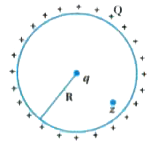
A positive charge Q is uniformly distribut along a circular ring of radius R. A small tc charge q is placed at the centre of the ring per figure, Then

A

If q gt 0 and is displaced away from th centre in the plane of the ring, it will b pushed back towards the centre.

B

If q lt 0 and is displaced away from the centr in the plane of the ring, it will never return ti the centre and will continue moving till I hits the ring.

C

If q lt 0, it will perform SHM for smai displacement along the axis.

D

q at the centre of the ring is in an unstabh equilibrium within the plane of the ring fo q gt 0

Text Solution

Verified by Experts

The correct Answer is:

A, B, C

Positive charge Q is distributed uniformly ove the outer surface of sphere, hence E inside it i, zero.
Hence, no effect on Q by q.
Two cases are possible due to attraction ano repulsion between Q and q. Case 1 : If q is positive then repulsion will be there between Q and q.
This will push q towards centre. Case 2 : If q is negative, then attraction will be there between Q and q. This will pull q towards surface and hence it will not turn back to centre.
Promotional Banner

Topper's Solved these Questions

  • ELECTRIC CHARGES AND FIELDS

    KUMAR PRAKASHAN|Exercise SECTION C NCERT EXEMPLAR SOLUTION (VERY SHORT ANSWER TYPE QUESTIONS)|6 Videos
  • ELECTRIC CHARGES AND FIELDS

    KUMAR PRAKASHAN|Exercise SECTION C NCERT EXEMPLAR SOLUTION (SHORT ANSWER TYPE QUESTIONS)|6 Videos
  • ELECTRIC CHARGES AND FIELDS

    KUMAR PRAKASHAN|Exercise SECTION C NCERT EXEMPLAR SOLUTION (MULTIPLE CHOICE QUESTIONS (MCQs))|7 Videos
  • DUAL NATURE OF RADIATION AND MATTER

    KUMAR PRAKASHAN|Exercise Section-D (MCQs asked in GUJCET/Board Exam)|1 Videos
  • ELECTROMAGNETIC INDUCTION

    KUMAR PRAKASHAN|Exercise Section D MCQs (MCQs asked in Competitive Exams )|38 Videos

Similar Questions

Explore conceptually related problems

Charges q is uniformly distributed over a thin half ring of radius R . The electric field at the centre of the ring is

Total charge - Q is uniformly spread along length of a ring of radius R. A small test charge +q of mass m is kept at the centre of the ring and is given a gentle push along the axis of the ring. (a) Show that the particle executes a simple harmonic oscillation. (b) Obtain its time period.

A thin circular wire of radius r has a charge Q. If a point charge q is placed at the centre of the ring, then find the increase in tension in the wire.

Calculate potential energy of a point charge - q placed along the axis due to a charge + Q uniformly distributed along a ring of radius-, R. Sketch P .F. as a function or axial distance z from the centre of the ring. Looking at graph, can you see what would happen if - q is displaced slightly from the centre of the ring (along the axis) ?

A positive charge Q is uniformly distributed throughout the volume of a dielectric sphere of radius R. A point mass having charge +q and mass m is fired toward the center of the sphere with velocity v from a point at distance r (r gt R) from the center of the sphere. Find the minimum velocity v so that it can penetrate (R//2) distance of the sphere. Neglect any resistance other than electric interaction. Charge on the small mass remains constant throughout the motion.

A charge +Q is uniformly distributed over a thin ring with radius R . A negative point charge -Q and mass m starts from rest at a point far away from the centre of the ring and moves towards the centre. Find the velocity of this particle at the moment it passes through the centre of the ring .

A charge Q is uniformly distributed over a rod of length l . Consider a hypothetical cube of edge l with the centre of the cube at one end of the rod. Find the minimum possible flux of the electric field through the entire surface of the cube.

A thin semi-circular ring of radius r has a positive charge q distributed uniformly over it. The net field vecE at the centre O is

Shown in the figure a spherical shell with an inner radius 'a' and an outer radius 'b' is made of conducting metarial. A charge +Q is placed at the centre of the spherical shell and a total charge -q s placed on the shell. Charge -q is districuted on the surfaces as :

A metallic spherical shell has an inner radius R j and outer radius R_2 . A charge Q is placed at the centre of the spherical cavity. What will be surface charge density on (i) the inner surface, and (ii) the outer surface ?
