Home
Class 12
PHYSICS
Two charges –q and +q are located at poi...

Two charges –q and +q are located at points (0, 0, –a) and (0, 0, a), respectively.
(a) What is the electrostatic potential at the points (0, 0, z) and (x, y, 0) ?
(b) Obtain the dependence of potential on the distance r of a point from the origin when `r//a gt gt 1` .
(c) How much work is done in moving a small test charge from the point (5,0,0) to (–7,0,0) along the x-axis? Does the answer change if the path of the test charge between the same points is not along the x-axis?

Text Solution

Verified by Experts
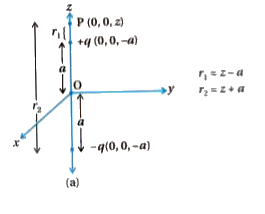
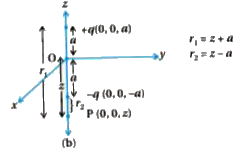
(a) When point P is near to charge + q,

Electrostatic potential at point P
`V_(+)=k[(q)/(r_(1))+((-q))/(r_(2))]`
`V_(+)=k[(q)/(z-a)+(q)/(z+a)]=kq[(r+a-r+a)/(z^(2)-a^(2))]`
`:. V_(+)=kqxx(2a)/(z^(2)-a^(2))`
`:. V_(+) = (kP)/(z^(2)-a^(2))[because` 2aq=P)
When point P is near to charge -q


Similarly ,
`:.` Potential at point P
`V_(-) = -(kq)/(z^(2)-a^(2))`
If any point (x, y, 0) is in xy-plane and hence it is at same distance from - q to + q on perpendicular bisector of z-axis then potential at such point is,
`V=k[(+q)/(r)+(-q)/(r)]=0`
(b) If point P is at distance of r from origin 0, then Putting z = r in equation (1) and (2),
`V=pmk(p)/(r^(2)-a^(2))`
If `(r)/(a) gt gt 1 = r gtgta ` then `a^(2)` is neglected compare with `r^(2)`
`V=pmk(P)/(r^(2))`
`:. Vprop(1)/(r^(2))`
(c) Points (5, 0, 0) and (-7, 0, 0) are on x-axis so they are on the perpendicular bisector of dipole (equatorial line) hence they are at the same distance from both the charges. As a result potential is zero.
Now if work done in moving a test charge `q_(0)`
from (5,0,0) to (-7,0,0) ,
W = `q_(0)(V_1)-V_(2))`
`= q_(0)(0)`
`:. ` W =0
No, because electric field is conservation field, the work done in moving a test charge between two point is independent of the path
Promotional Banner

Topper's Solved these Questions

  • ELECTROSTATIC POTENTIAL AND CAPACITANCE

    KUMAR PRAKASHAN|Exercise Section B ( Numerical From DARPAN. Based on Textbook )|19 Videos
  • ELECTROSTATIC POTENTIAL AND CAPACITANCE

    KUMAR PRAKASHAN|Exercise Section B (questions)|2 Videos
  • ELECTROSTATIC POTENTIAL AND CAPACITANCE

    KUMAR PRAKASHAN|Exercise Section B Numericals|16 Videos
  • ELECTROMAGNETIC WAVES

    KUMAR PRAKASHAN|Exercise BOARD.S QUESTION PAPER MARCH - 2020 (PART - B) SECTION - C|5 Videos
  • MAGNETISM AND MATTER

    KUMAR PRAKASHAN|Exercise SECTION D Multiple Choice Questions (MCQs) (MCQs asked in Competitive Exams) MCQs asked in Board Exam and GUJCET|7 Videos

Similar Questions

Explore conceptually related problems

How far apart are the points (2, 0, 0) and (-3, 0, 0) ?

Two charges q_(1) and q_(2) are placed at (0, 0, d) and (0, 0, - d) respectively. Find locus or points where the potential is zero.

Two charges - q and + q are located at points A(0, 0, - a) and B(0, 0, + a) respectively, work done in moving small test charge from point P(7, 0, 0) to Q(- 3, 0, 0) is ...... .

Two point charges +q and -q are held fixed at (-d,o) and (d,0) respectively of a x-y coordinate system. Then

A plane passes through the points P(4, 0, 0) and Q(0, 0, 4) and is parallel to the Y-axis. The distance of the plane from the origin is

Draw a graph for variation of potential V with distance r for a point charge Q.

Shows that how the electrostatic potential varies with r for a point charge.

Distance of the point (3, 4, 5) from the origin (0, 0, 0) is

How much work is done in moving a charge of 2 C across two points having a potential difference 12 V ?

Find the distance of the point (2,1,0) from the plane 2x+y+2z+5=0.

KUMAR PRAKASHAN-ELECTROSTATIC POTENTIAL AND CAPACITANCE-Section B ( Numerical From Textual Exercise )
  1. If one of the two electrons of a H(2) molecule is removed, we get a hy...

    Text Solution

    |

  2. Two charged conducting spheres of radii a and b are connected to each ...

    Text Solution

    |

  3. Two charges –q and +q are located at points (0, 0, –a) and (0, 0, a), ...

    Text Solution

    |

  4. Figure 2.32 shows a charge array known as an electric quadrupole. For ...

    Text Solution

    |

  5. An electrical technician requires a capacitance,of 2 muF in a circuit...

    Text Solution

    |

  6. What is the area of the plates of a 2 F parallel plate capacitor given...

    Text Solution

    |

  7. Obtain the equivalent capacitance of the network in Fig. 2.33. For a 3...

    Text Solution

    |

  8. The plates or a parallel plate capacitor have an area of 90 cm^(2) eac...

    Text Solution

    |

  9. A 4 muF capacitor is charged by a 200 V supply. It is then disconnecte...

    Text Solution

    |

  10. Show that the force on each plate of a parallel plate capacitor has a ...

    Text Solution

    |

  11. A spherical capacitor consists of two concentric spherical conductors,...

    Text Solution

    |

  12. A spherical capacitor has an inner sphere of radius 12 cm and an outer...

    Text Solution

    |

  13. Answer carefully: (a) Two large conducting spheres carrying charges ...

    Text Solution

    |

  14. Answer carefully: (a) Two large conducting spheres carrying charges ...

    Text Solution

    |

  15. Answer carefully: (a) Two large conducting spheres carrying charges ...

    Text Solution

    |

  16. Answer carefully: (a) Two large conducting spheres carrying charges ...

    Text Solution

    |

  17. Answer carefully: (a) Two large conducting spheres carrying charges ...

    Text Solution

    |

  18. Answer carefully: (a) Two large conducting spheres carrying charges ...

    Text Solution

    |

  19. Answer carefully: (a) Two large conducting spheres carrying charges ...

    Text Solution

    |

  20. A cylindrical capacitor has two co-axial cylinders of length 15 cm, an...

    Text Solution

    |