Home
Class 9
MATHS
In a quadrilateral ABCD, it is being giv...

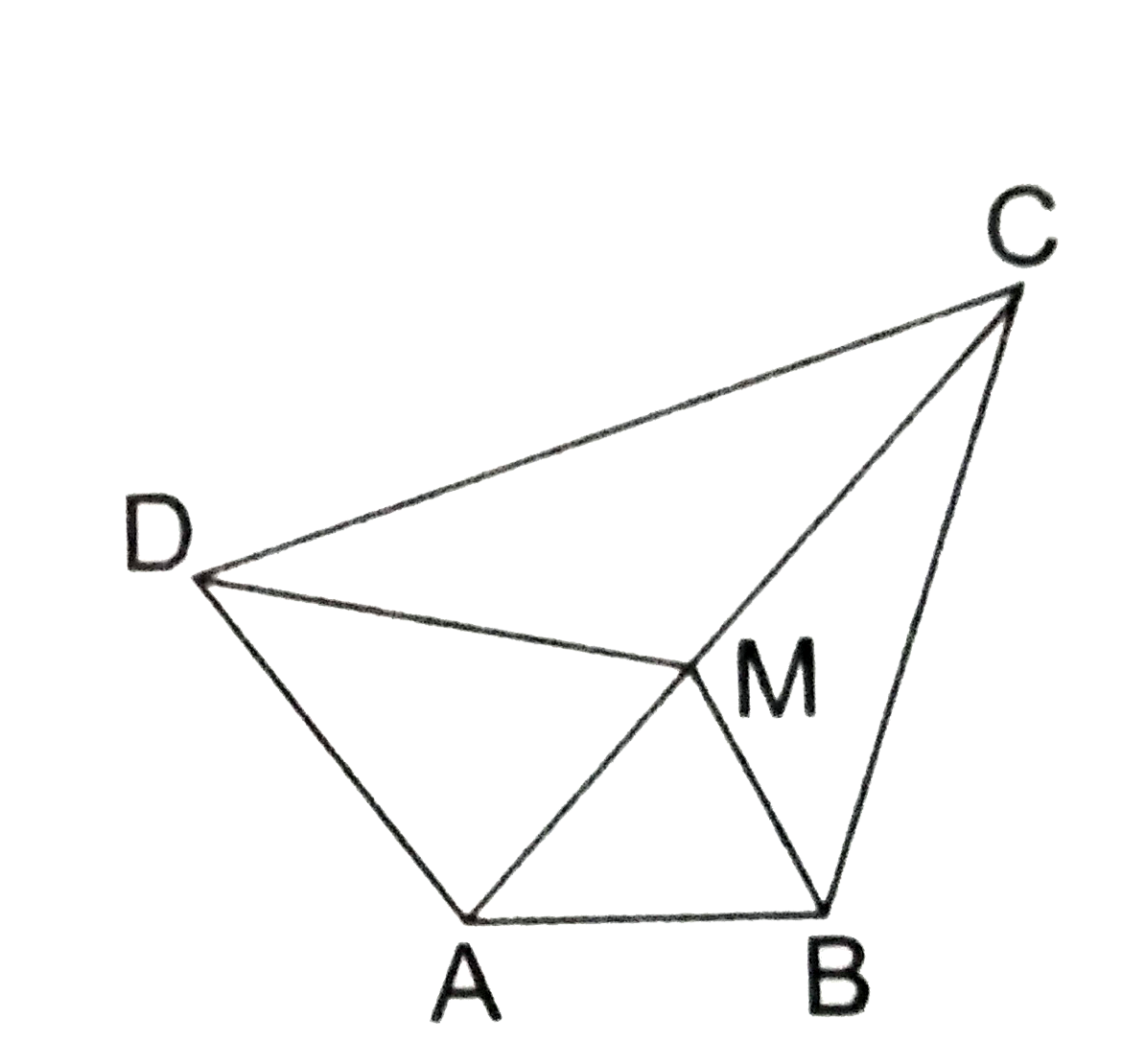
In a quadrilateral ABCD, it is being given that M is the midpoint of AC. Prove that
`ar(squareABMD)=ar(squareDMBC)`.

Text Solution

Verified by Experts

Median BM divides `triangle ABC` into two `triangle` of equal area.
`therefore ar(triangleABM)=ar(triangleDMC)`.
Median DM divides `triangle`DAC into two `triangle` of equal area.
`therefore ar(triangleAMD)=ar(triangleDMC)." "...(ii)`
From (i) and (ii) , we get
`ar(triangleABM)+ar(triangleAMD)=ar(triangleBMC)+ar(triangleDMC)`
`rArr ar(squareABMD)=ar(squareDMBC)`.
Promotional Banner

Topper's Solved these Questions

  • AREAS OF PARALLELOGRAMS AND TRIANGLES

    RS AGGARWAL|Exercise Exercise 11|38 Videos
  • AREAS OF PARALLELOGRAMS AND TRIANGLES

    RS AGGARWAL|Exercise MULTIPLE-CHOICE QUESTIONS (MCQ)|32 Videos
  • AREAS OF TRIANGLES AND QUADRILATERALS

    RS AGGARWAL|Exercise Multiple Choice Questions (Mcq)|16 Videos

Similar Questions

Explore conceptually related problems

In an equilateral Delta ABC, D is the midpoint of AB and E is the midpoint of AC. Then, ar (Delta ABC) : ar (Delta ADE)=?

ABC is a triangle in which D is the midpoint of BC and E is the midpoint of AD. Prove that ar(triangleBED)=(1)/(4)ar(triangleABC) .

In the adjoining figure, ABCD is a quadrilateral. A line through D, parallel to AC, meets BC produced in P . Prove that ar(triangleABP)=ar("qaud. ABCD") .

In triangleABC , if D is the midpoint of BC and E is the midpoint of AD then ar(triangleBED) = ?

Diagonals AC and BD of a quadrilateral ABCD intersect at O in such a way that ar (AOD)=ar(BOC). Prove that ABCD is a trapezium.

D is the midpoint of side BC of triangleABC and E is the midpoint of BD. If O is the midpoint of AE, prove that ar(triangleBOE)=(1)/(8)ar(triangleABC) .

In the adjoining figure, BD||CA, E is the midpoint of CA and BD =(1)/(2) CA . Prove that ar(triangleABC)=2ar(triangleDBC) .

The vertex A of triangle ABC is joined to a point D on the side BC. The midpoint of AD is E. Prove that ar(triangleBEC)=(1)/(2)ar(triangleABC) .

In Figure,APBQCR .Prove that ar(AQC)=ar(PBR)
