Home
Class 9
MATHS
A point O inside a rectangle A B C D ...

A point `O` inside a rectangle `A B C D` is joined to the vertices. Prove that the sum of the areas of a pair of opposite triangles so formed is equal to the sum of the other pair of triangles. Given: A rectangle `A B C D\ a n d\ O` is a point inside it. `O A ,\ O B ,\ O C\ a n d\ O D` have been joined. To Prove: `a r\ (A O D)+\ a r\ ( B O C)=\ a r\ ( A O B)+\ a r( C O D)`

Text Solution

Verified by Experts
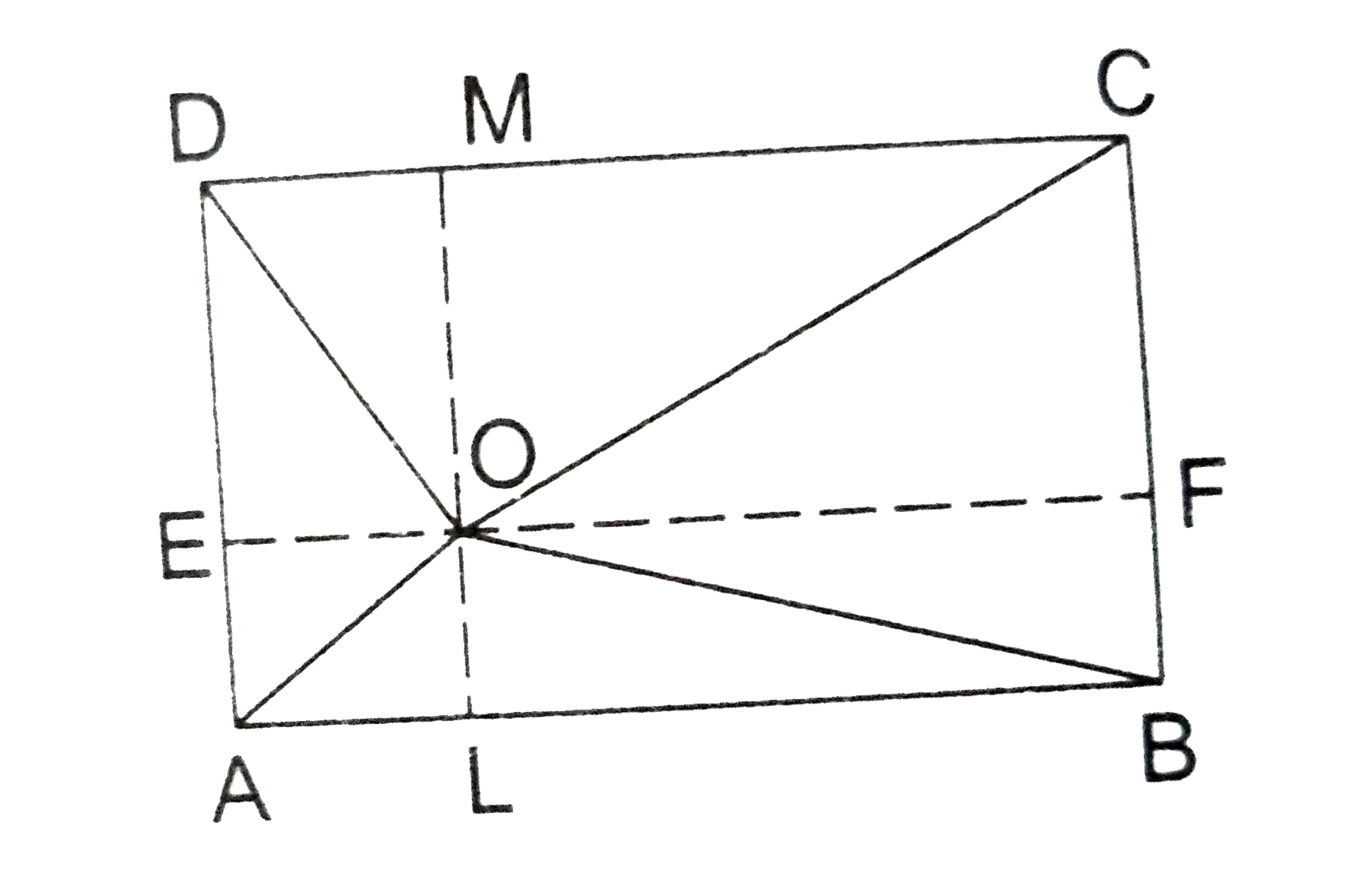
GIVEN A rect. ABCD and O is a point inside it. OA, OB, OC and OD have been joined.
TO PROVE `ar(triangleAOD)+ar(triangleBOC)=ar(triangleAOB)+ar(triangleCOD).`
CONSTRUCTION Draw EOF || AB and LOM||AD.
PROOF EOF||AB and DA cuts them.
`therefore angleDEO=angleEAB=90^(@)" "("corres". angle).`
`therefore OEbotAD.`

Similarly, `OF bot BC,OLbotAB and OM bot DC.`
`therefore ar(triangleAOB)+ar(triangleBOC)`
`=((1)/(2)xxADxxOE)+((1)/(2)xxBCxxOF)`
`=(1)/(2)ADxx(OE+OF) " "[therefore BC=AD]`
`=(1)/(2)xxADxxEF =(1)/(2)xxADxxAB" "[therefore EF=AB]`
`=(1)/(2)xxar("rec. ABCD")`.
Again, `ar(triangleAOB)+ar(triangleCOD)`
`=((1)/(2)xxABxxOL)+((1)/(2)xxDCxxOM)=(1)/(2)xxABxx(OL+OM)`
`[therefore DC=AB]`
`=((1)/(2)xxABxxOL)+((1)/(2)xxDCxxOM)=(1)/(2)xxABxx(OL+OM)`
`=(1)/(2)xxar("rect. ABCD")`.
`therefore ar(triangleAOD)+ar(triangleBOC)=ar(triangleAOB)+ar(triangleCOD)`.
Promotional Banner

Topper's Solved these Questions

  • AREAS OF PARALLELOGRAMS AND TRIANGLES

    RS AGGARWAL|Exercise Exercise 11|38 Videos
  • AREAS OF PARALLELOGRAMS AND TRIANGLES

    RS AGGARWAL|Exercise MULTIPLE-CHOICE QUESTIONS (MCQ)|32 Videos
  • AREAS OF TRIANGLES AND QUADRILATERALS

    RS AGGARWAL|Exercise Multiple Choice Questions (Mcq)|16 Videos

Similar Questions

Explore conceptually related problems

A point O inside a rectangle A B C D is joined to the vertices. Prove that the sum of the areas of a pair of opposite triangles so formed is equal to the sum of the other pair of triangles. GIVEN : A rectangle A B C D and O is a point inside it. O A ,O B ,O C and O D have been joined.. TO PROVE : a r(A O D)+a r( B O C)=a r( A O B)+a r( C O D) CONSTRUCTION : Draw E O F A B and L O M A Ddot

The vertices of a rectangle PQRS are joined from an interior point 'O'. Prove that the sum of the area of two opposite triangles so formed is equal to the sum of the areas of remaining two triangles

In a \ A B C , If L\ a n d\ M are points on A B\ a n d\ A C respectively such that L M B Cdot Prove that: a r\ (\ L O B)=a r\ (\ M O C)

In Figure, A B C D is a ^(gm)dot\ \ O is any point on A CdotP Q\ A B\ a n d\ L M A Ddot Prove that a r(^(gm)D L O P)=\ a r\ (^(gm)B M O Q)

A B C D is a parallelogram whose diagonals intersect at Odot If P is any point on B O , prove that: a r\ ( A D O)=A R\ ( C D O) a r\ (\ A B P)=\ a r\ (\ C B P)

A B C D is a parallelogram whose A C\ a n d\ B D intersect at Odot A line through O intersects A B\ a t\ P\ a n d\ D C\ at Qdot Prove that a r\ (\ P O A)=\ a r\ (\ Q O C)dot

D is the mid-point of side B C of \ A B C\ a n d\ E is the mid-point of B Ddot If O is the mid-point of A E , prove that a r\ (\ B O E)=1/8a r\ (\ A B C)

The diagonals of a rectangle A B C D\ meet at O . If /_B O C=44^0, find /_O A D

In Figure, A B C D is a trapezium in which A B||C D . Prove that: a r( A O D)=a r( B O C)dot

In Figure, A B C\ a n d\ ABD are two triangles on the base A Bdot If line segment C D is bisected by A B\ a t\ O , show that a r\ ( A B C)=a r\ (\ A B D)

