Home
Class 9
MATHS
In figure, ABCD and AEFD are two paralle...

In figure, ABCD and AEFD are two parallelograms. Prove that `ar (DeltaPEA) = ar (DeltaQFD)`.

Text Solution

Verified by Experts
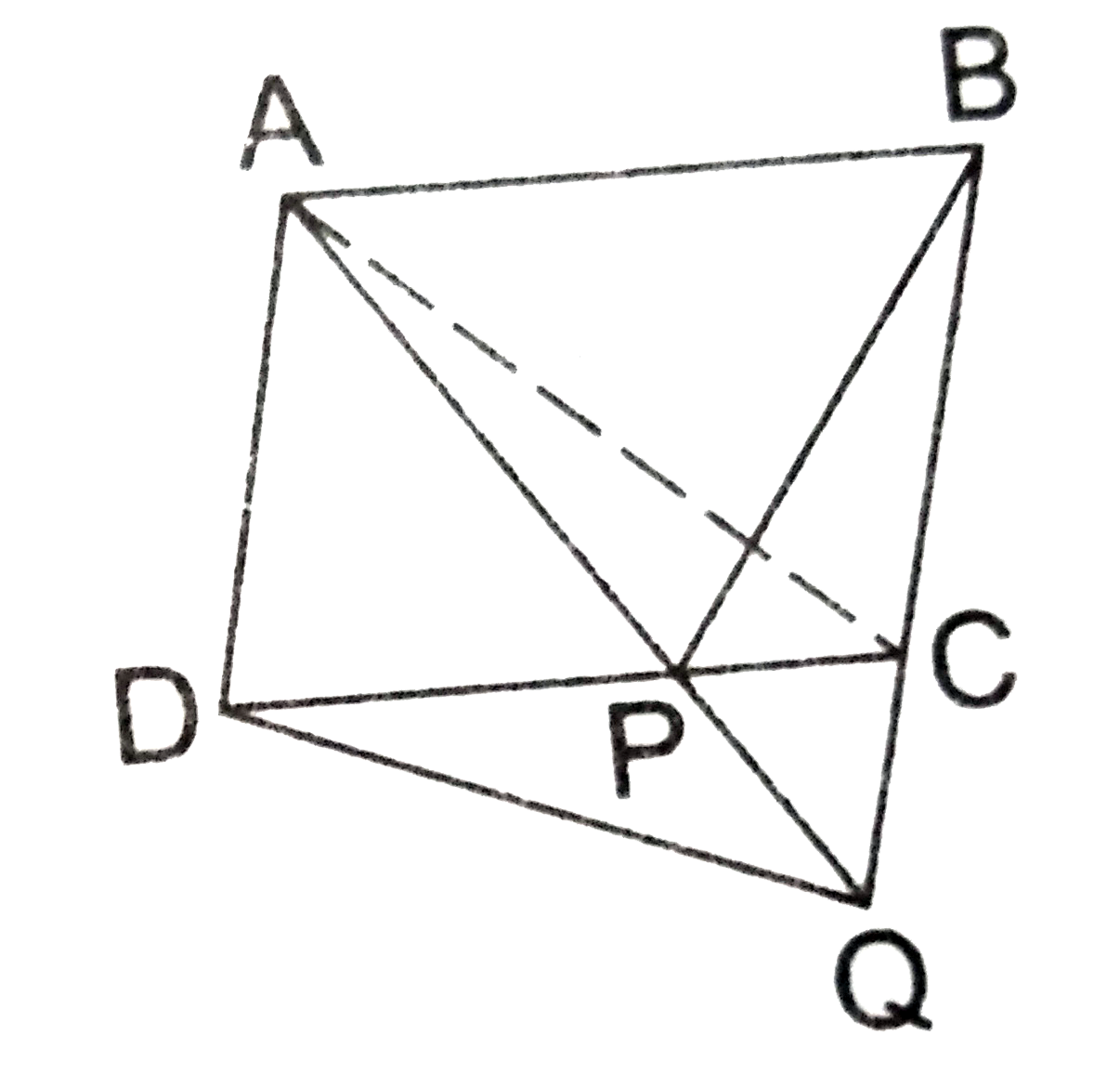
Join AC.
Now, `triangleADC and triangleADQ` being on the same base AD and between the same parallels AD and BC, are equal in area.

`therefore ar(triangleADC)=ar(triangleADQ)`
`rArr ar(triangleADC)-ar(triangleADP)=ar(triangleADQ)-ar(triangleADP)`
`rArr ar(triangleAPC)=ar(triangleDPQ)." "...(i)`
Also, `triangle APC and triangleBPC` being on the same base PC and between the same parallels PC and AB, are equal in area.
`therefore ar(triangleAPC)=ar(triangleBPC)." "...(ii)`
From (i) and (ii), we get `ar(triangleBPC)=ar(triangleDPQ)`.
Promotional Banner

Topper's Solved these Questions

  • AREAS OF PARALLELOGRAMS AND TRIANGLES

    RS AGGARWAL|Exercise Exercise 11|38 Videos
  • AREAS OF PARALLELOGRAMS AND TRIANGLES

    RS AGGARWAL|Exercise MULTIPLE-CHOICE QUESTIONS (MCQ)|32 Videos
  • AREAS OF TRIANGLES AND QUADRILATERALS

    RS AGGARWAL|Exercise Multiple Choice Questions (Mcq)|16 Videos

Similar Questions

Explore conceptually related problems

In figure,ABCD and AEFD are two parallelograms.Prove that ar (Delta PEA)=ar(Delta QFD)

In the given figure, ABCD and AEFD a re two parallelograms. ar( Delta PEA) =

In the given figure, ABCD and AEFD a re two parallelograms. PE =

In the figure, ABCD, DCFE and ABFE are parallelograms. Show that ar( Delta ADE) = ar( Delta BCF).

In the figure, ABCD and EFGD are two parallelograms and G is the mid-point of CD. Then, ar (DeltaDPC) = (1)/(2) ar (EFGD) .

In Fig.9.31, ABCD,DCFE and ABFE are parallelograms.Show that ar quad (ADE)=ar(BCF)

In the given figure, ABCD and FECG are parallelograms equal in area. If ar(Delta AQE) = 12 cm^(2) , find ar(||gm FGBQ)

In the figure ABCD and ABFE are Parallelograms then find ar (Delta BCF) . If ar (ABCE) =18 cm^(2) ar (ABCD) =25 cm^(2)

In the given figure, ABCD and ABEF are parallelograms such that ar(quad. EABC) 17 cm^(2) and ar(||gm ABCD) = 25 cm^(2) . Then ar(triangleBCF) = ?

