Home
Class 9
MATHS
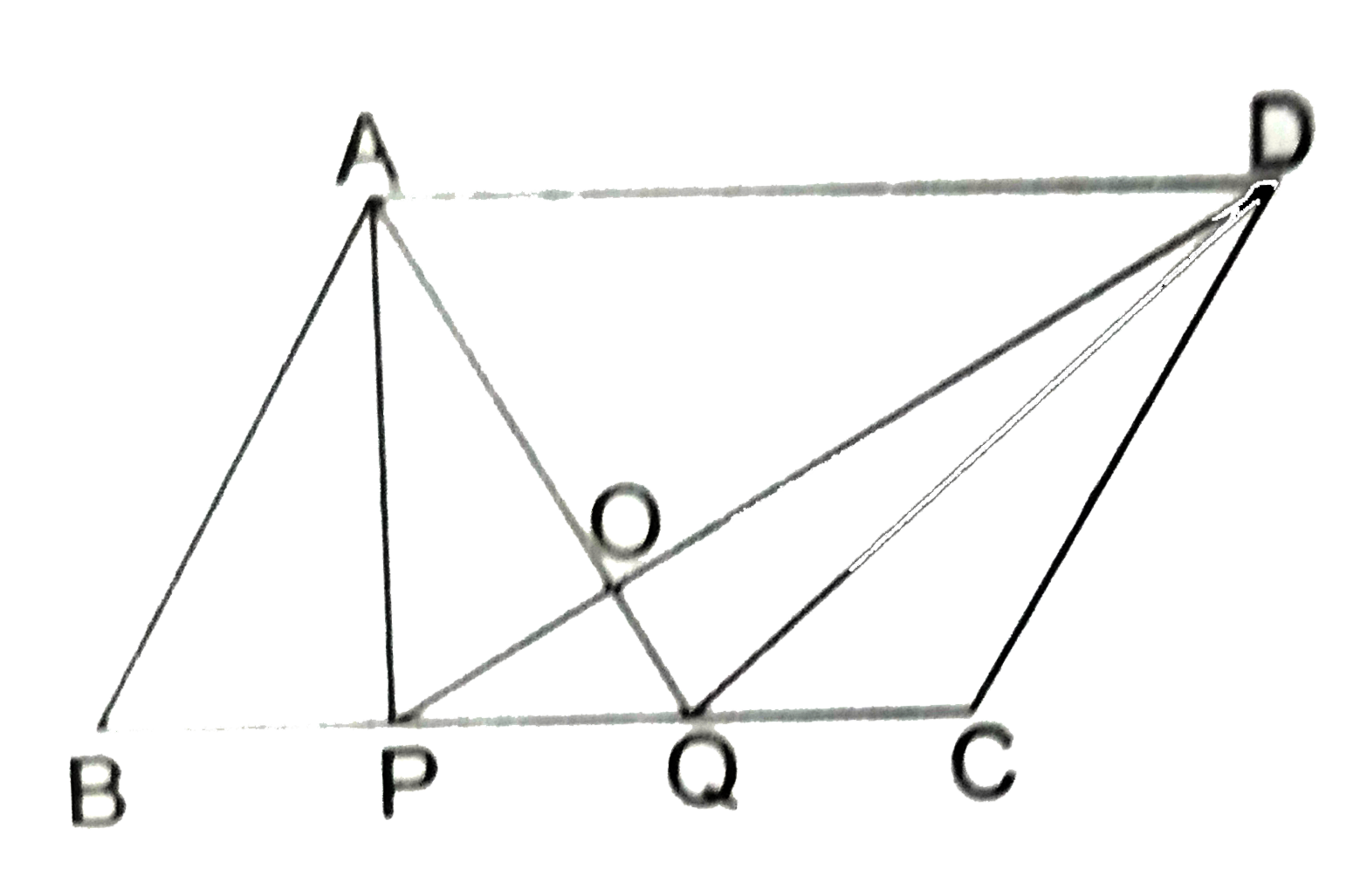
In the adjoining figure, ABCD is a paral...

In the adjoining figure, ABCD is a parallelogram. Points P and Q on BC trisect BC. Prove that
`ar(triangleAPQ)=ar(triangleDPQ)=(1)/(6)ar(triangleABCD)`.

Text Solution

Verified by Experts
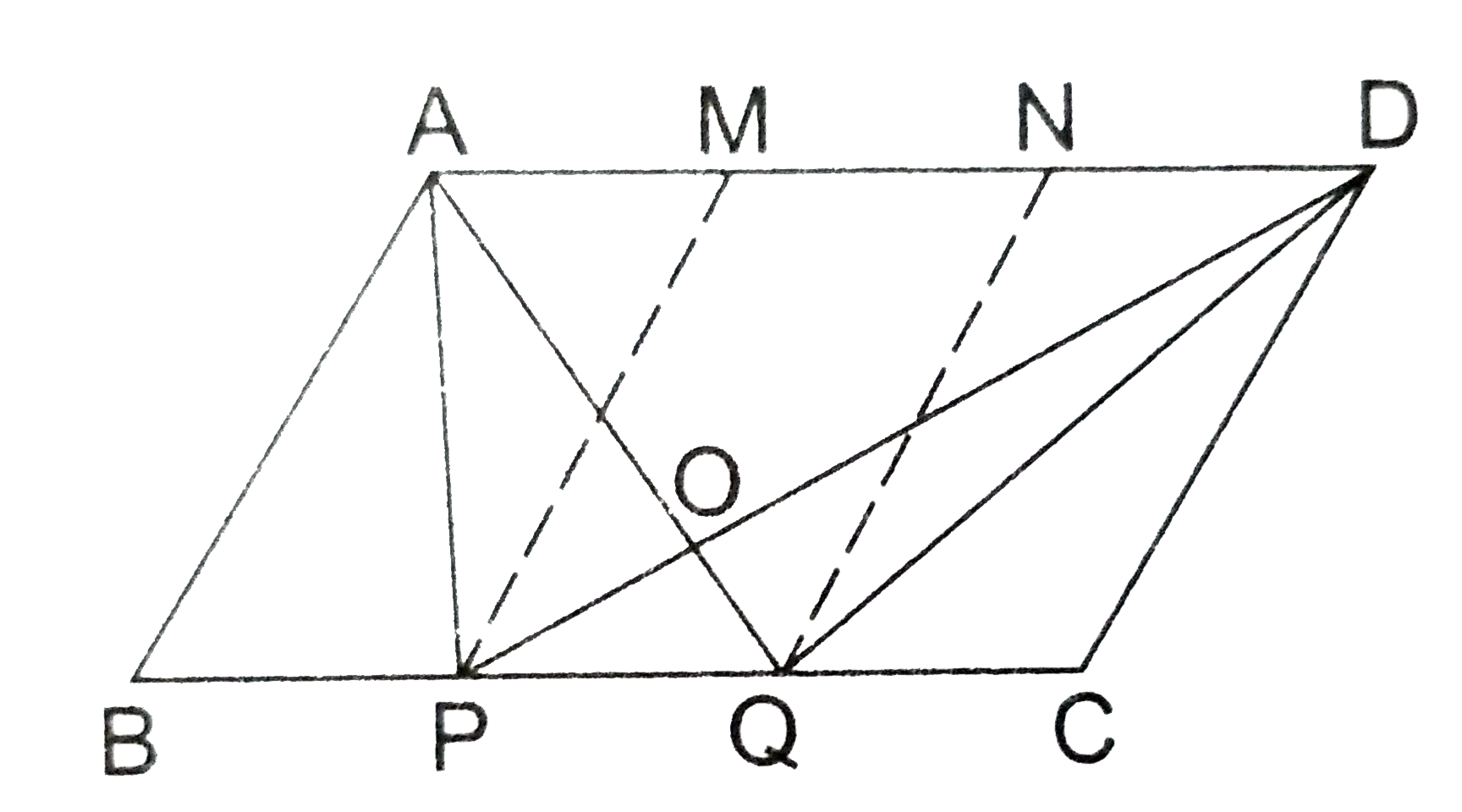
Through P and Q, we draw PM and QN parallel to AB. Parallelograms ABPM, MPQN and NQCD have equal areas since they have equal bases and lie between the same parallels [ Theorem 3].

`therefore ar("||gm ABPM")=ar("||gm MPQN")`
`=ar("||gm NQCD") = (1)/(3)ar("||gm ABCD")....(i)`
Now, `ar(triangleAPQ)=ar(triangleDPQ)`
=`(1)/(2)ar("||gm MPQN")`
[`therefore triangleAPQ, triantgleDPQ` and "||gm" MPQN have the same base PQ and lie between the same parallels AD and BC]
`rArr ar(triangleAPQ)=ar(triangleDPQ)=(1)/(2){(1)/(3)ar("||gm ABCD")}` [using (i)].
Hence, `ar(triangleAPQ)=ar(triangleDPQ)=(1)/(6)ar("||gm ABCD")`.
Promotional Banner

Topper's Solved these Questions

  • AREAS OF PARALLELOGRAMS AND TRIANGLES

    RS AGGARWAL|Exercise Exercise 11|38 Videos
  • AREAS OF PARALLELOGRAMS AND TRIANGLES

    RS AGGARWAL|Exercise MULTIPLE-CHOICE QUESTIONS (MCQ)|32 Videos
  • AREAS OF TRIANGLES AND QUADRILATERALS

    RS AGGARWAL|Exercise Multiple Choice Questions (Mcq)|16 Videos

Similar Questions

Explore conceptually related problems

In the adjoining figure, ABCD is a parallelogram and P is any points on BC. Prove that ar(triangleABP)+ar(triangleDPC)=ar(trianglePDA) .

In the given figure, ABCD is a parallelogram. E and F are any two points on AB and BC, respectively. Prove that ar (triangleADF)=ar(triangleDCE) .

In the adjoining figure, BD||CA, E is the midpoint of CA and BD =(1)/(2) CA . Prove that ar(triangleABC)=2ar(triangleDBC) .

ABCD is a parallelogram. X and Y are mid-points of BC and CD. Prove that ar(triangleAXY)=3/8ar(||^[gm] ABCD)

In the adjoining figure, MNPQ and ABPQ are parallelogram and T is any point on the side BP. Prove that (i) ar(MNPQ)=ar(ABPQ) (ii) ar(triangleATQ)=(1)/(2)ar(MNPQ) .

In the adjoining figure, ABCD is a quadrilateral. A line through D, parallel to AC, meets BC produced in P . Prove that ar(triangleABP)=ar("qaud. ABCD") .

ABCD is a parallelogram and O is a point in its interior. Prove that (i) ar(triangleAOB)+ar(triangleCOD) =(1)/(2)ar("||gm ABCD"). (ii) ar(triangleAOB)+ar(triangleCOD)=ar(triangleAOD)+ar(triangleBOC) .

In the adjoining figure, the diagonals AC and BD of a quadrilateral ABCD intersect at O. If BO = OD , prove that ar(triangleABC)=ar(triangleADC) .

P is any point on the diagonal BD of the parallelogram ABCD. Prove that ar (triangleAPD) = ar (triangleCPD) .

ABC is a triangle in which D is the midpoint of BC and E is the midpoint of AD. Prove that ar(triangleBED)=(1)/(4)ar(triangleABC) .

