Home
Class 12
CHEMISTRY
Among the isomeric alkanes of molecular ...

Among the isomeric alkanes of molecular formula `C_(5)H_(12)`, identify the one that on photochemical chlorination yields.
(i) A single monochloride
(ii) Three isomeric monochlorides
(iii) Four isomeric monochlorides

Text Solution

Verified by Experts
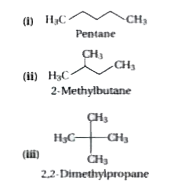
The possible isomers of alkane with molecular formula `C_(5)H_(12)` are :

In (i), there are three different hydrogen atoms and thus it will yeild three different products.

In (iii), all nine hydrogens are equivalent. So, it will yield only a sing monochloro product.

In (ii), there are four different hydrogens. So, it will yeild four different products.
Promotional Banner

Topper's Solved these Questions

  • HALOALKANES AND HALOARENES

    KUMAR PRAKASHAN|Exercise SECTION - C TEXTUAL EXERCISE|87 Videos
  • HALOALKANES AND HALOARENES

    KUMAR PRAKASHAN|Exercise SECTION - D NCERT EXEMPLAR SOLUTION (Multiple Choice Questions)|43 Videos
  • HALOALKANES AND HALOARENES

    KUMAR PRAKASHAN|Exercise SECTION - A QUESTIONS|51 Videos
  • GENERAL PRINCIPLES AND PROCESSES OF ISOLATION OF ELEMENTS

    KUMAR PRAKASHAN|Exercise SECTION - E (MCQs ASKED IN GUJET/BOARD EXAMS)|46 Videos
  • POLYMERS

    KUMAR PRAKASHAN|Exercise SECTION - E (MCQs asked in Board Exams)|51 Videos

Similar Questions

Explore conceptually related problems

An optically active compound A (assume dextrorotatory) has the molecular formula C_(7)H_(11)Br . A reacts with hydrogen bromide, in the absence of peroxides to yield isomeric products, B and C, with the molecular formula C_(7)H_(12)Br_(2) . Compound B is optically active, C is not. Treating B with 1 mol of potassium butoxide yields (+)-A . Treating C with 1 mol of potassium tert-butoxide yields (+-)-A . Treating A with potassium tert-butoxide yields D(C_(7)H_(10)) . Subjecting 1 mol of D to ozonolysis followed by treatment with zinc and acetic acid yields 2 moles of formaldehyde and 1 mole of 1,3-cyclopentanedione. The optically active compound 'A' is

An optically active compound A (assume dextrorotatory) has the molecular formula C_(7)H_(11)Br . A reacts with hydrogen bromide, in the absence of peroxides to yield isomeric products, B and C, with the molecular formula C_(7)H_(12)Br_(2) . Compound B is optically active, C is not. Treating B with 1 mol of potassium butoxide yields (+)-A . Treating C with 1 mol of potassium tert-butoxide yields (+-)-A . Treating A with potassium tert-butoxide yields D(C_(7)H_(10)) . Subjecting 1 mol of D to ozonolysis followed by treatement with zinc and acetic acid yields 2 moles of formaldehyde and 1 mole of 1,3-cyclopentanedione. The compound 'B' is:

An alkyl bromide A has molecular formula C_(8)H_(17)Br and four different structures can be drawn for it, all optically active. A on refluxing with ethanolic KOH solution yields only one elimination product B(C_(8)H_(16)) which it still enantiomeric. B on treatment with H_(2)//Pt yields C(C_(8)H_(18)) which does not rotate the plane polarized light, B on ozonolysis followed by work-up with H_(2)O_(2) yields D(C_(7)H_(14)O) as one product which it still resolvable. Deduce structures of A to D.

KUMAR PRAKASHAN-HALOALKANES AND HALOARENES-SECTION - B INTEXT QUESTIONS AND ANSWERS
  1. Write the structures of the following compounds : 2-Chloro-3-meth...

    Text Solution

    |

  2. Write the structures of the following compounds : 1-Chloro-4-ethy...

    Text Solution

    |

  3. Write the structures of the following compounds : 4-tert, Butyl-3...

    Text Solution

    |

  4. Write the structures of the following compounds : 1,4 -Dibromobut...

    Text Solution

    |

  5. Write the structures of the following compounds : 1-bromo-4-sec, ...

    Text Solution

    |

  6. Why is Sulphuric acid not used during the reaction of alcohols with KI...

    Text Solution

    |

  7. Write structures of different dihalogen derivatives of propane.

    Text Solution

    |

  8. Among the isomeric alkanes of molecular formula C(5)H(12), identify th...

    Text Solution

    |

  9. Draw the structures of major monohalo products in each of the followin...

    Text Solution

    |

  10. Draw the structures of major monohalo products in each of the followin...

    Text Solution

    |

  11. Draw the structures of major monohalo products in each of the followin...

    Text Solution

    |

  12. Draw the structures of major monohalo products in each of the followin...

    Text Solution

    |

  13. Draw the structures of major monohalo products in each of the followin...

    Text Solution

    |

  14. Draw the structures of major monohalo products in each of the followin...

    Text Solution

    |

  15. Arrange the following set of compounds in order of increasing boiling ...

    Text Solution

    |

  16. Which alkyl halide from the following pairs would you expect to react ...

    Text Solution

    |

  17. In the following pairs of halogen compounds, which compound undergoes ...

    Text Solution

    |

  18. Identify A, B, C, D, E, R and R^(1) in the following :

    Text Solution

    |

  19. Identify A, B, C, D, E, R and R^(1) in the following : R-Br+Mg ov...

    Text Solution

    |

  20. Identify A, B, C, D, E, R and R^(1) in the following :

    Text Solution

    |