Home
Class 12
CHEMISTRY
For a spontaneous reaction, the free ene...

For a spontaneous reaction, the free energy change must be negative. `DeltaG=DeltaH-TDeltaS` is the enthalpy change during the reaction. T is absolute temperature, and AS is the change in entropy during the reaction. Consider a reaction such as the formation ofan oxide .
`M+O_(2) MO`
Dloxygen is used wp in the course of this reaction. Gases have a more random structure (less ordered) than liquid or solids consequently gases have a higher entropy than liquids and solids, in this reaction (entropy or randomness) decreases, hence is negative. Thus, the temperature is raised the `DeltaS` becomes more negative. Since, `TDeltaS` is subtracted in the equation, then SG becomes less negative. Thus, the free energy changes increases with the increase in temperature.
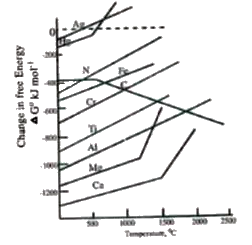
The free energy changes that occur when one mole of common reactant in this case dioxygen) is we may e plotted graphically against temperature for a number of reactions of metals to their oxides. The following plot is called an Ellingham diagram for metal oxide. Understanding of Ellingham diagram is extremely important for the efficient extraction of metals.

Free energy change of Hg and Mg for the convertion to oxides the slope of `DeltaG`. T has been changed above the boiling points of the given metal because

A

above the boiling point of the metal entropy is increased

B

above the boiling point of the metal the entropy is decreased

C

above the boiling point of the metal the entropy change is equal to zero

D

All of these

Text Solution

Verified by Experts

The correct Answer is:

A

Above the boiling point of the metal randomness increases then entropy also increases.
Promotional Banner

Topper's Solved these Questions

  • METALLURGY

    AAKASH SERIES|Exercise LEVEL-II (LECTRURE SHEET) (EXERCISE-II) (PASSAGE-III)|4 Videos
  • METALLURGY

    AAKASH SERIES|Exercise LEVEL-II (LECTRURE SHEET) (EXERCISE-II) (PASSAGE-IV)|4 Videos
  • METALLURGY

    AAKASH SERIES|Exercise LEVEL-II (LECTRURE SHEET) (EXERCISE-II) (PASSAGE-I)|5 Videos
  • IONIC EQUILLIBRIUM

    AAKASH SERIES|Exercise ADDITIONAL PRACTICE EXERCISE (PRACTICE SHEET ( ADVANCED))|11 Videos
  • NITROGEN CONTAINING COMPOUNDS

    AAKASH SERIES|Exercise Conversions|18 Videos

Similar Questions

Explore conceptually related problems

For a spontaneous reaction, the free energy change must be negative. DeltaG=DeltaH-TDeltaS is the enthalpy change during the reaction. T is absolute temperature, and AS is the change in entropy during the reaction. Consider a reaction such as the formation ofan oxide . M+O_(2) MO Dloxygen is used wp in the course of this reaction. Gases have a more random structure (less ordered) than liquid or solids consequently gases have a higher entropy than liquids and solids, in this reaction (entropy or randomness) decreases, hence is negative. Thus, the temperature is raised the DeltaS becomes more negative. Since, TDeltaS is subtracted in the equation, then SG becomes less negative. Thus, the free energy changes increases with the increase in temperature. The free energy changes that occur when one mole of common reactant in this case dioxygen) is we may e plotted graphically against temperature for a number of reactions of metals to their oxides. The following plot is called an Ellingham diagram for metal oxide. Understanding of Ellingham diagram is extremely important for the efficient extraction of metals. As per the Ellingham diagram of oxides which of the following conclusion is true?

For a spontaneous reaction, the free energy change must be negative. DeltaG=DeltaH-TDeltaS is the enthalpy change during the reaction. T is absolute temperature, and AS is the change in entropy during the reaction. Consider a reaction such as the formation ofan oxide . M+O_(2) MO Dloxygen is used wp in the course of this reaction. Gases have a more random structure (less ordered) than liquid or solids consequently gases have a higher entropy than liquids and solids, in this reaction (entropy or randomness) decreases, hence is negative. Thus, the temperature is raised the DeltaS becomes more negative. Since, TDeltaS is subtracted in the equation, then SG becomes less negative. Thus, the free energy changes increases with the increase in temperature. The free energy changes that occur when one mole of common reactant in this case dioxygen) is we may e plotted graphically against temperature for a number of reactions of metals to their oxides. The following plot is called an Ellingham diagram for metal oxide. Understanding of Ellingham diagram is extremely important for the efficient extraction of metals. Which of the following elements can be prepared by heating the oxide above 400^(@)C ?

For a spontaneous reaction, the free energy change must be negative. DeltaG=DeltaH-TDelaS is the enthalpy change during the reaction. T is absolute temperature, and AS is the change in entropy during the reaction. Consider a reaction such as the formation ofan oxide . M+O_(2) MO Dloxygen is used wp in the course of this reaction. Gases have a more random structure (less ordered) than liquid or solids consequently gases have a higher entropy than liquids and solids, in this reaction (entropy or randomness) decreases, hence is negative. Thus, the temperature is raised the DeltaS becomes more negative. Since, TDeltaS is subtracted in the equation, then SG becomes less negative. Thus, the free energy changes increases with the increase in temperature. The free energy changes that occur when one mole of common reactant in this case dioxygen) is we may e plotted graphically against temperature for a number of reactions of metals to their oxides. The following plot is called an Ellingham diagram for metal oxide. Understanding of Ellingham diagram is extremely important for the efficient extraction of metals. For the conversion of Ca(s) to CaO(s) which of the following represent the DeltaG vs T :

The enthalpy change during a chemical reaction depends upon

The substance which undergo chemica change in the reaction

For which one of the following reactions , the entropy changes is positive ?

For the above reaction what is the internal energy change, DeltaU ?

The catalyst used in a reaction can change

What are the changes observed in a chemical reaction ?
