Home
Class 11
CHEMISTRY
Tri alkyl aluminium molecules exists as ...

Tri alkyl aluminium molecules exists as dimer which contains 3 centered 2e bonds. The coordination number of bridged carbon atoms is

Text Solution

Verified by Experts

The correct Answer is:
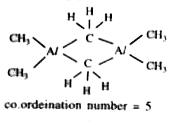
5


co.ordeination number = 5
Promotional Banner

Topper's Solved these Questions

  • ELEMENTS OF BORON FAMILY

    AAKASH SERIES|Exercise PRACTICE SHEET (EXERCISE - I) LEVEL - I (MAIN)|12 Videos
  • ELEMENTS OF BORON FAMILY

    AAKASH SERIES|Exercise PRACTICE SHEET (EXERCISE - I) LEVEL - II (ADVANCED)|30 Videos
  • ELEMENTS OF BORON FAMILY

    AAKASH SERIES|Exercise LECTURE SHEET (EXERCISE - II) LEVEL - I (MAIN)|12 Videos
  • ELECTRONIC EFFECTS AND REACTION INTERMEDIATES

    AAKASH SERIES|Exercise ADDITIONAL PRACTICE EXERCISE (LEVEL - II (PRACTICE SHEET ADVANCE)) (Integer Type Questions)|3 Videos
  • ELEMENTS OF CARBON FAMILY

    AAKASH SERIES|Exercise OBJECTIVE EXERCISE - 3 (Recent AIPMT/NEET Questions) |10 Videos

Similar Questions

Explore conceptually related problems

The organic substance which contains both the sp and sp^(3) hydridised carbon atoms is

ICl_(3) exist as dimer I_(2) Cl_(6) . In this molecule regarding this dimerization number of correct statements is // are

Al[BH_(4)]_(3) contains how many 3 centered -2e^(-) bonds.

The empirical formula an organic substance is CH_(2)O . If 3 xx 10^(22) molecules of the substance has a mass of one sixth of mass of one gram mole of water, find the hybridisation of carbon atoms in the compound.

Hydrogen bonding is said to be formed, -when sightly acidic hydrogen-atom attached to a strongly, electronegative fluorine, oxygen or nitrogen atom. is held with weak. electrostatic forces by the non-bonded pair of electrons of another atom. The co-ordination number of hydrogen in such cases is two. It acts as a bridge between two atoms, to one of which it is covalently bonded and to other attached through electrostatic forces, also called hydrogen bond. Though the hydrogen atoms in a methyl group are not polarised, if an electronegative group like chloro, carbonyl, nitro or cyano (in order to increase electronegativity) is attached to it, the C-H bond gets polarised due to the inductive effect and the hydrogen atom becomes slightly acidic resulting in the formation of weak hydrogen bonds. Though a weak bond the H-bond effects is large number of the physical properties of compounds some of which are - Boiling points of liquids - Solubility of polar compounds in polar solvents (containig H attached with strong electronegative atom) - Viscosity of liquids . Acidity Which of the following combinations can involve hydrogen bonding I) Mixture of KF and HF " " II) Mixture of CH_(3)COCH_(3) and CHCI_(3) III) Mixture of NH_(4) CI and H_(2)O" " IV) Mixture of CH_(3) and H_(2)O

Passage-III : The binary compounds of oxygen with other elements are called oxides. They are classified either depending upon their acid - base characteristics or on the basis of oxygen content. a ) Normal oxides : These oxides which contain oxygen atoms as permitted by the normal oxidation number, i.e., -2. Normal oxide may be acidic, basic, amphoteric or neutral. b) Polyoxides : The oxides which contain oxygen atoms different than those permitted by the normal oxidation number of -2. i) Peroxides : Two oxygen atoms are linked to each other and oxygen has -I oxidation number. They contain (O-O)^(2) unit. ii) Superoxides : These oxides contain (O-O)^(-1) units, i.e., each O-atom has oxidation number -1//2 . c ) Suboxides : These contain low content of oxygen than expected. d) Mixed oxides : These oxides are made of two simpler oxides. Which of the following pairs contains mixed oxides?

Passage-III : The binary compounds of oxygen with other elements are called oxides. They are classified either depending upon their acid - base characteristics or on the basis of oxygen content. a ) Normal oxides : These oxides which contain oxygen atoms as permitted by the normal oxidation number, i.e., -2. Normal oxide may be acidic, basic, amphoteric or neutral. b) Polyoxides : The oxides which contain oxygen atoms different than those permitted by the normal oxidation number of -2. i) Peroxides : Two oxygen atoms are linked to each other and oxygen has -I oxidation number. They contain (O-O)^(2) unit. ii) Superoxides : These oxides contain (O-O)^(-1) units, i.e., each O-atom has oxidation number -1//2 . c ) Suboxides : These contain low content of oxygen than expected. d) Mixed oxides : These oxides are made of two simpler oxides. Which of the following pairs contains neutral oxides ?

Passage-III : The binary compounds of oxygen with other elements are called oxides. They are classified either depending upon their acid - base characteristics or on the basis of oxygen content. a ) Normal oxides : These oxides which contain oxygen atoms as permitted by the normal oxidation number, i.e., -2. Normal oxide may be acidic, basic, amphoteric or neutral. b) Polyoxides : The oxides which contain oxygen atoms different than those permitted by the normal oxidation number of -2. i) Peroxides : Two oxygen atoms are linked to each other and oxygen has -I oxidation number. They contain (O-O)^(2) unit. ii) Superoxides : These oxides contain (O-O)^(-1) units, i.e., each O-atom has oxidation number -1//2 . c ) Suboxides : These contain low content of oxygen than expected. d) Mixed oxides : These oxides are made of two simpler oxides. Which of the following oxides is paramagnetic in nature?

Passage-III : The binary compounds of oxygen with other elements are called oxides. They are classified either depending upon their acid - base characteristics or on the basis of oxygen content. a ) Normal oxides : These oxides which contain oxygen atoms as permitted by the normal oxidation number, i.e., -2. Normal oxide may be acidic, basic, amphoteric or neutral. b) Polyoxides : The oxides which contain oxygen atoms different than those permitted by the normal oxidation number of -2. i) Peroxides : Two oxygen atoms are linked to each other and oxygen has -I oxidation number. They contain (O-O)^(2) unit. ii) Superoxides : These oxides contain (O-O)^(-1) units, i.e., each O-atom has oxidation number -1//2 . c ) Suboxides : These contain low content of oxygen than expected. d) Mixed oxides : These oxides are made of two simpler oxides. Which pair of species is referred to as suboxides?

AAKASH SERIES-ELEMENTS OF BORON FAMILY-LECTURE SHEET (EXERCISE - II) LEVEL - II (ADVANCED)
  1. Which is pure basic oxide

    Text Solution

    |

  2. The number of sigma and pi bonds present in inorganic benzene

    Text Solution

    |

  3. B(OH)(3)+NaOH hArr NaBO(2)+Na[B(OH)(4)]+H(2)O How can this reactio...

    Text Solution

    |

  4. Boric acid is prepared from borax by the action of

    Text Solution

    |

  5. Select the correct statements about diborane

    Text Solution

    |

  6. Al(2)(SO(4))(3)+NH(4)OH rarr X,X is

    Text Solution

    |

  7. Which of the following reaction(s) is/are involved in thermit process ...

    Text Solution

    |

  8. In the reaction 2X+B(2)H(6)rarr [BH(2)X(2)]^(+)[BH(4)]^(-) the ...

    Text Solution

    |

  9. Which of the following oxides are basic ?

    Text Solution

    |

  10. Alumina is

    Text Solution

    |

  11. Potash alum is used as a

    Text Solution

    |

  12. Boranes have general formula

    Text Solution

    |

  13. Hydrated AlCl(3) is used as

    Text Solution

    |

  14. Boron reacts with oxygen at 700^(@)C to give (A). Compound (A) reacts ...

    Text Solution

    |

  15. Boron reacts with oxygen at 700^(@)C to give (A). Compound (A) reacts ...

    Text Solution

    |

  16. Boron reacts with oxygen at 700^(@)C to give (A). Compound (A) reacts ...

    Text Solution

    |

  17. {:(,"Column - I",,"Column - II"),((A),H(3)BO(3),(P),"Hydrogen bonds"),...

    Text Solution

    |

  18. In solid conundrum the number of oxygen atoms coordinate to aluminium ...

    Text Solution

    |

  19. Total number of molecules having three centered two e^(-) bonds among ...

    Text Solution

    |

  20. Tri alkyl aluminium molecules exists as dimer which contains 3 centere...

    Text Solution

    |

