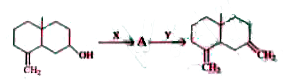
A
B
C
D
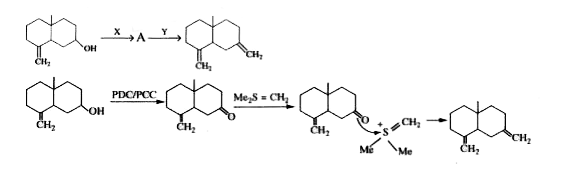
Text Solution
Verified by Experts
The correct Answer is:



Topper's Solved these Questions
ALDEHYDES AND KETONES
AAKASH SERIES|Exercise LEVEL-II LECTURE SHEET (EXERCISE-III)|11 VideosALDEHYDES AND KETONES
AAKASH SERIES|Exercise LEVEL-II LECTURE SHEET (EXERCISE-IV)|8 VideosALDEHYDES AND KETONES
AAKASH SERIES|Exercise LEVEL-II LECTURE SHEET (EXERCISE-I)|113 VideosALCOHOLS, PHENOLS AND ETHERS
AAKASH SERIES|Exercise ETHERS (OBJECTIVE EXERCISE-4)|50 VideosALKYL AND ARYL HALIDES
AAKASH SERIES|Exercise OBJECTIVE EXERCISE - 4 (ASSERTION (A) & REASON (R) TYPE QUESTIONS)|19 Videos
Similar Questions
Explore conceptually related problems
AAKASH SERIES-ALDEHYDES AND KETONES-LEVEL-II LECTURE SHEET (EXERCISE-II)
- Which of the following yield yellow precipitate on reacction wi...
Text Solution
|
- Which of the following compounds exhibit acid base reaction wi...
Text Solution
|
- in the reaction X and Y may be
Text Solution
|
- Which of the following are correct for reaction (##AKSTRGAOCHEX...
Text Solution
|
- Select the reactions involved in the above reaction
Text Solution
|
- Select the correct combination :
Text Solution
|
- which of the following reactions involve hydride ion transfer ?
Text Solution
|
- Which of the following statements are correct ?
Text Solution
|
- Which of the following pairs are not correctly matched ?
Text Solution
|
- Which of the following compounds will not show enolisation
Text Solution
|
- Which compound will be oxidised by HIO4 ?
Text Solution
|
- Which of the following reactions can produce benzaldehyde as majo...
Text Solution
|
- The suitable reagent for the following reaction are :
Text Solution
|
- Which of these carbonyl compounds on reduction with Zn -Hg //HCI ...
Text Solution
|
- X,Y and Z are
Text Solution
|
- product 'A' and 'C' are :
Text Solution
|
- Which of the following reactions will produce aldehyde ?
Text Solution
|
- Which of the following compounds will give positive Tollen's tes...
Text Solution
|
- Silver mirror test with Tollen's reagent is given by
Text Solution
|
- Which of the following form stable hemiketal ?
Text Solution
|