Home
Class 12
CHEMISTRY
Piperidine is a secondary amine, which i...

Piperidine is a secondary amine, which is subjected to Hofmann elimination. The alkene formed as a final product is

A

1, 3-butadiene

B

1,4-pentadiene

C

1, 3-butadiyne

D

1, 2-pentadiene

Text Solution

Verified by Experts

The correct Answer is:
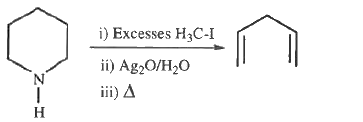
B

Promotional Banner

Topper's Solved these Questions

  • AMINES AND AZO COMPOUNDS

    AAKASH SERIES|Exercise PRACTICE SHEET - 4 (More than one correct answer questions)|6 Videos
  • AMINES AND AZO COMPOUNDS

    AAKASH SERIES|Exercise PRACTICE SHEET - 4 (Linked Comprehension type questions) Passage - I|3 Videos
  • AMINES AND AZO COMPOUNDS

    AAKASH SERIES|Exercise PRACTICE SHEET - 3 (Integer answer type Questions)|7 Videos
  • ALKYL AND ARYL HALIDES

    AAKASH SERIES|Exercise OBJECTIVE EXERCISE - 4 (ASSERTION (A) & REASON (R) TYPE QUESTIONS)|19 Videos
  • AMINES AND DIAZONIUM SLATS

    AAKASH SERIES|Exercise PRACTICE EXERCISE|25 Videos

Similar Questions

Explore conceptually related problems

Which one of the following reactions does not form gaseous product?

In which of the following process acetone is one of the final products ?

n - Propyl chloride and isopropyl chloride mixture is subjected to the Wurtz reaction, which one of the following compounds is not formed

Alkenes undergo electrophilic addition with many reagents like HX, H_2O , HOCI etc. Except in the case of addition of X_2^(-) in other additions carbocation is formed as intermediate. The rate of such reactions depends on the stability of carbocation. Rearrangements and ring expansion are also common in such reactions. 1-methylcyclohex-1-ene is subjected to hydro-boration oxidation. The product is

Amines are less reactive in substitution reactions. Their reactivity is much lesser than alcohols and alkylflourides towards substitution. Protonation of the amino group makes it a better leaving group, but not nearly as good a leaving group as a protonated alcohol. Protonated amino groups cannot be displaced by OH^(-) because it would react immediately with the acidic hydrogen which would convert it in to a poor nucleophile. The leaving group in quartenary ammonium ion has about the same leaving tendency as a protonated amino group but does not have acidic hydrogen. The reaction of a quartenary ammonium ion with hydroxide ion is known as Hoffmann elimination reaction. The leaving group is tertiary amine. Since a tertiary amine is only a moderately good leaving group, the reaction requires heat. The carbon to which the tertiary amine is attached is designated as alpha carbon. When the hydroxide ion starts to remove a beta H from a quartenary ammonium ion, the leaving group does not immediately start to leave because a tertiary amine is not a good leaving group. As a result, a partial negative charge builds up on the carbon from which the proton is removed. Which of the following statements are true regarding Hoffmann elimination ?

Amines are less reactive in substitution reactions. Their reactivity is much lesser than alcohols and alkylflourides towards substitution. Protonation of the amino group makes it a better leaving group, but not nearly as good a leaving group as a protonated alcohol. Protonated amino groups cannot be displaced by OH^(-) because it would react immediately with the acidic hydrogen which would convert it in to a poor nucleophile. The leaving group in quartenary ammonium ion has about the same leaving tendency as a protonated amino group but does not have acidic hydrogen. The reaction of a quartenary ammonium ion with hydroxide ion is known as Hoffmann elimination reaction. The leaving group is tertiary amine. Since a tertiary amine is only a moderately good leaving group, the reaction requires heat. The carbon to which the tertiary amine is attached is designated as alpha carbon. When the hydroxide ion starts to remove a beta H from a quartenary ammonium ion, the leaving group does not immediately start to leave because a tertiary amine is not a good leaving group. As a result, a partial negative charge builds up on the carbon from which the proton is removed. Which of the following statements is correct?

