Home
Class 12
CHEMISTRY
An organic compound 'A' (C(16)H(13)O(2)N...

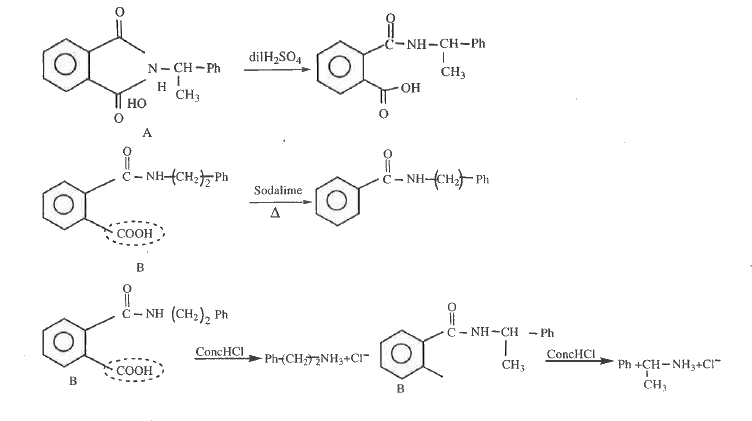
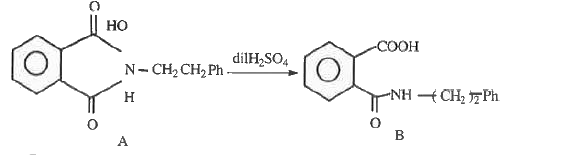
An organic compound 'A' `(C_(16)H_(13)O_(2)N)` is insoluble in dil cold aqueous alkali but on warming gives a clear solution. ‘A’ when treated with dil `H_(2)SO_(4)` gives `B(C_(16)H_(15)O_(2)N)` which when boiled with conc. HCl under reflux and cooled, a solid compound `C(C_(8)H_(6)O_(4))` is crystallized out. The mother liquor when separated and concentrated gives `D(C_(8)H_(12)NCl)`.
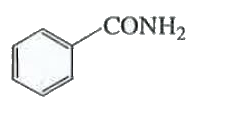
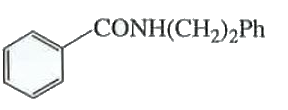
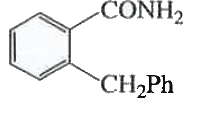
`B overset("Soda lime")underset(Delta)to` 'M' product (M) is

A

B

C

D

Text Solution

Verified by Experts

The correct Answer is:
B


Promotional Banner

Topper's Solved these Questions

  • AMINES AND AZO COMPOUNDS

    AAKASH SERIES|Exercise PRACTICE SHEET - 4 (Match the following questions)|2 Videos
  • AMINES AND AZO COMPOUNDS

    AAKASH SERIES|Exercise PRACTICE SHEET - 4 (Integer answer type Questions)|6 Videos
  • AMINES AND AZO COMPOUNDS

    AAKASH SERIES|Exercise PRACTICE SHEET - 4 (Linked Comprehension type questions) Passage - I|3 Videos
  • ALKYL AND ARYL HALIDES

    AAKASH SERIES|Exercise OBJECTIVE EXERCISE - 4 (ASSERTION (A) & REASON (R) TYPE QUESTIONS)|19 Videos
  • AMINES AND DIAZONIUM SLATS

    AAKASH SERIES|Exercise PRACTICE EXERCISE|25 Videos

Similar Questions

Explore conceptually related problems

An organic compound 'A' (C_(16)H_(13)O_(2)N) is insoluble in dil cold aqueous alkali but on warming gives a clear solution. ‘A’ when treated with dil H_(2)SO_(4) gives B(C_(16)H_(15)O_(2)N) which when boiled with conc. HCl under reflux and cooled, a solid compound C(C_(8)H_(6)O_(4)) is crystallized out. The mother liquor when separated and concentrated gives D(C_(8)H_(12)NCl) . Compound ‘D' can be

An organic compound 'A' (C_(16)H_(13)O_(2)N) is insoluble in dil cold aqueous alkali but on warming gives a clear solution. ‘A’ when treated with dil H_(2)SO_(4) gives B(C_(16)H_(15)O_(2)N) which when boiled with conc. HCl under reflux and cooled, a solid compound C(C_(8)H_(6)O_(4)) is crystallized out. The mother liquor when separated and concentrated gives D(C_(8)H_(12)NCl) . Structure of compound ‘A’ can be

An organic compound A(C_(6)H_(7)N) on reaction with NaNO_(2)//HCl at 273-278 K following by warming with water gives B . B reacts with conc. HNO_(3) to give C . What is C ?

An organic compound ‘A’ has molecular formula C_(9)H_(13)NO and it can be resolve into enantiomers. Adoes not decolourise bromine water solution. A on refluxing with dilute H_(2)SO_(4) , yields another revolvable compound B(C_(9)H_(14)O_(3)) which give effervescence with NaHCO_(3) . B on treatment with NaBH_(4) yields C(C_(9)H_(16)O_(3)) on heating with concentrated H_(2)SO_(4) yields ester D (C_(6)H_(14)O_(2)) . Compound A on reduction with LiAlH_(4) followed by treatment of H_(2)SO_(4) yields following compound : Find out structure of compound 'A''

An organic compound ‘A’ has molecular formula C_(9)H_(13)NO and it can be resolve into enantiomers. Adoes not decolourise bromine water solution. A on refluxing with dilute H_(2)SO_(4) , yields another revolvable compound B(C_(9)H_(14)O_(3)) which give effervescence with NaHCO_(3) . B on treatment with NaBH_(4) yields C(C_(9)H_(16)O_(3)) on heating with concentrated H_(2)SO_(4) yields ester D (C_(6)H_(14)O_(2)) . Compound A on reduction with LiAlH_(4) followed by treatment of H_(2)SO_(4) yields following compound : Due to reduction of optically pure 'B'two isomeric product 'C' form. Isomeric product 'C' are :

An organic compound ‘A’ has molecular formula C_(9)H_(13)NO and it can be resolve into enantiomers. Adoes not decolourise bromine water solution. A on refluxing with dilute H_(2)SO_(4) , yields another revolvable compound B(C_(9)H_(14)O_(3)) which give effervescence with NaHCO_(3) . B on treatment with NaBH_(4) yields C(C_(9)H_(16)O_(3)) on heating with concentrated H_(2)SO_(4) yields ester D (C_(6)H_(14)O_(2)) . Compound A on reduction with LiAlH_(4) followed by treatment of H_(2)SO_(4) yields following compound : The sweet smelling neutral compound D is

In the compound, O_(2)N-C_(6)H_(4)-N=N-C_(6)H_(4)-N(CH_(3))_(2) , the chromophore is

An organic compound with molecular formula C_(3)H_(5)N on hydrolysis gives an acid. The acid on heating with N_(3)H and conc. H_(2)SO_(4) gives

C_(6)H_(12)O_(6) + Ararr2C_(3)H_(4)O_(3)+ B . A & B in the above reaction are