Home
Class 12
CHEMISTRY
In poly nuclear metal carbonyls, the hyb...

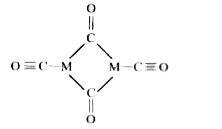
In poly nuclear metal carbonyls, the hybridisation of 'C' in terminal carbonyl is 'sp' where as that in bridged carbonyl is `'sp'^(2)`
II) In all mono nuclear metal carbonyl, the carbonyls are non bridged
III) `Fe(CO)_(5)` is diamagnetic and Fe' is `dsp^(3)` hybridised
IV) Metal carbonyls are more stable due to more nucleophilic nature of carbon monoxide The correct statements are

A

I, II, III

B

I,III, IV

C

II,III, IV

D

I, II, III are IV

Text Solution

Verified by Experts

The correct Answer is:
A


.C. atoms in bridging CO molecules have `3sigmma` bonds each `(sp^(2))`. The terminal CO molecules have C atoms with `2sigma` bonds each (sp) synergic effect in metal carbonyls is responsible for their stability.
Promotional Banner

Topper's Solved these Questions

  • CO-ORDINATION COMPOUNDS

    AAKASH SERIES|Exercise LEVEL-II LECTURE SHEET EXERCISE-II (Linked Comprehension type questions ) Passage-I|3 Videos
  • CO-ORDINATION COMPOUNDS

    AAKASH SERIES|Exercise LEVEL-II LECTURE SHEET EXERCISE-II (Linked Comprehension type questions ) Passage-II|3 Videos
  • CO-ORDINATION COMPOUNDS

    AAKASH SERIES|Exercise LEVEL-I (EXERCISE-II)|52 Videos
  • CHEMISTRY IN EVERYDAY LIFE

    AAKASH SERIES|Exercise PRACTICE SHEET - 2 (PRACTICE SHEET -2 (INTEGER ANSWER TYPE QUESTIONS))|7 Videos
  • COMPLEX COMPOUNDS

    AAKASH SERIES|Exercise PRACTICE EXERCISE|45 Videos

Similar Questions

Explore conceptually related problems

Observe the following statements regarding C_(60) . i. All carbons are sp^(2) - hybridised. ii. It contains 12 rings of five carbons each and 20 rings of six carbons each. iii. It is a non-aromatic compound. iv. It is pure form of carbon. v. C-C bond lengths in it are 143.5 and 138.5 pm. vi. It is prepared by heating graphite in an electric arc in the presence of oxygen. The correct statements are

Consider the following statements: I. In diamond, each carbon atom is sp^(3) -hybridised. II. Graphite has planar hexagonal layers of carbon atoms. III. Silicones being surrounded by non-polar alkyl groups are water repelling in nature. IV> The order of catenation in group 14 elements is Si gt C gt Sn gt Ge gt pb. The correct statements are

Hydrogen bonding is said to be formed, -when sightly acidic hydrogen-atom attached to a strongly, electronegative fluorine, oxygen or nitrogen atom. is held with weak. electrostatic forces by the non-bonded pair of electrons of another atom. The co-ordination number of hydrogen in such cases is two. It acts as a bridge between two atoms, to one of which it is covalently bonded and to other attached through electrostatic forces, also called hydrogen bond. Though the hydrogen atoms in a methyl group are not polarised, if an electronegative group like chloro, carbonyl, nitro or cyano (in order to increase electronegativity) is attached to it, the C-H bond gets polarised due to the inductive effect and the hydrogen atom becomes slightly acidic resulting in the formation of weak hydrogen bonds. Though a weak bond the H-bond effects is large number of the physical properties of compounds some of which are - Boiling points of liquids - Solubility of polar compounds in polar solvents (containig H attached with strong electronegative atom) - Viscosity of liquids . Acidity Which of the following combinations can involve hydrogen bonding I) Mixture of KF and HF " " II) Mixture of CH_(3)COCH_(3) and CHCI_(3) III) Mixture of NH_(4) CI and H_(2)O" " IV) Mixture of CH_(3) and H_(2)O

The central metal ion in the complex makes available a number of empty orbitals for the formation of co-ordinate bonds with suitable ligands. The inner d-orbitals or outer d-orbitals are involved. The empty hybrid orbitals of metal ion overlap with the filled orbitals of ligand to from metal ligand co-ordinate bonds. For co-ordination number 6 octahedral geometry and sp^(3),d^(2)ord^(2)sp^(2) hybridisation involved and for cordiantion number 4 tetrahedral geometry, square planar geometry and sp^(3).dsp^(2) hybridisation involved. Type of complex formed in [Fe(H_(2)O)_(6)]^(+3) ion

Identify the correct statements from the following (I)In [CoCl(NH_3)_5]^(2+) , the Lewis acid is Co^(3+) (II)An example for heteroleptic complex is [Co(NH_3)_6]^(3+) (III)The hybridisation of Mn in [MnBr_4]^(2-) is dsp^2 (IV)In [Ni(CO)_4] , the metal-carbon bond possesses sigma and pi character

{:("LIST-I","LIST - II"),("A) Diamond ","1) Metal electrode "),("B) Graphite ","2) sp hybridised "),("C) Silica ","3) Acheson's process "),("D) "CO_(2),"4) Tridymite"),(,"5) Cutting of glass"):} The correct match is

{:("List - I","List - II"),("Chemical property","Structure elucidation"),("of Glucose","of Glucose"),("A) Acetylation","1) Presence of"),(,"carbonyl group"),("B) Reaction with HCN","2) Six carbon atoms"),(,"straight chain."),("C) Reaction with HI/P","3) Presence of"),(,1^(@)-"alcohol group"),("D) Oxidation","4) Presence of"),("with "HNO_(3),"5 - OH groups "):} Correct match is

{:("IUPAC Name", "Formulae of ligand"),((i)"Bromo",(A)CO),((ii)"Carbonyl",(B)C_(6)H_(5)COO^(-)),((iii)"Benzoato",(C)H_(2)O),((iv)"Aquo",(D)Br^(-)):} The correct match is

AAKASH SERIES-CO-ORDINATION COMPOUNDS-LEVEL-II LECTURE SHEET EXERCISE-I (Single & One or more than One Correct Answers )
  1. Which of the following statement(s) is (are) correct?

    Text Solution

    |

  2. For [Fe(CN)(6)]^(4-).[Ni(CN)(4)]^(2-)and[Ni(CO)(4)]. Correct statement

    Text Solution

    |

  3. Which have octahedral shape (d^(2)sp^(3)) hybridisation of central ato...

    Text Solution

    |

  4. Which possesses tetrahedral shape (sp^(3)- hybridisation of central at...

    Text Solution

    |

  5. Which of the following complexes is a chelate ?

    Text Solution

    |

  6. A complex shown below can exhibit :

    Text Solution

    |

  7. Which of the following compounds can exhibit geometrical isomerism?

    Text Solution

    |

  8. Which of the following isomerisms are exhibited by [Cr(NH(3))(2)(OH)(2...

    Text Solution

    |

  9. Which of the following statements is not true about the complex ion [C...

    Text Solution

    |

  10. Which of the following statement(s) is/are incorrect?

    Text Solution

    |

  11. Which of the following statements is/are true ?

    Text Solution

    |

  12. Which of the following statement is true about the complex [CrCl(3)(OH...

    Text Solution

    |

  13. Which of the following pairs show coordination isomerism ?

    Text Solution

    |

  14. A metal comples having composition Cr(NH(3))(4)CI(2)Br has been isolat...

    Text Solution

    |

  15. In poly nuclear metal carbonyls, the hybridisation of 'C' in terminal ...

    Text Solution

    |

  16. Which is high spin complex :

    Text Solution

    |

  17. A d-block element forms octahedral complex but its magnetic moment rem...

    Text Solution

    |

  18. For which of the following d^(n) configuration of octahedral complex(e...

    Text Solution

    |

  19. Select the correct statement

    Text Solution

    |

  20. Which one of the following statement (s) is/are false ?

    Text Solution

    |

