Home
Class 12
CHEMISTRY
When degenerate d-orbitals of an isolate...

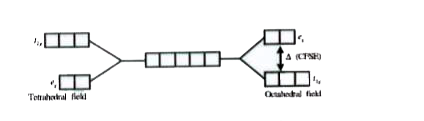
When degenerate d-orbitals of an isolated atom/ion come under influence of magnetic field of ligands, the degeneracy is lost. The two sets `t_(2g)(d_(xy),d_(yz),d_(xz))ande_(g)(d_(z^(2)),d_(x^(2)-y^(3)))` are either stabilized or destabilized depending upon the nature of magnetic field. It can be expressed diagramatically as : Value of CFS depends upon nature of ligand and a spectro-chemical series has been made experiment-ally, for tetrahedral complexes `Delta_(i)` is about 4/9 times to `Delta_(0)` (CFSE for octahedral complexes).

The energy lies in visible region and i.e., why electronic transition `t_(2_(g))hArre_(g)` are responsible for colour. Such transitions are not possible with `d^(0)` and `d^(10)` configuration.
`Cr^(3+)` form four complexes with four different ligands which are `[Cr(Cl)_(6)]^(3-),[Cr(H_(2)O)_(6)]^(3+),[Cr(NH_(3))_(6)]^(3+)` and `[Cr(CN)_(6)]^(3-)`. The order of CFSE `(Delta_(a))` in these complexes is :

A

`[Cr(Cl)_(6)]^(3-)=[Cr(H_(2)O)_(6)]^(3+)=[Cr(NH_(3))_(6)]^(3+)=[Cr(CN)_(6)]^(3-)`

B

`[Cr(Cl)_(6)]^(3-)lt[Cr(H_(2)O)_(6)]^(3+)lt[Cr(NH_(3))_(6)]^(3+)lt[Cr(CN)_(6)]^(3-)`

C

`[Cr(Cl)_(6)]^(3-)gt[Cr(H_(2)O)_(6)]^(3+)gt[Cr(NH_(3))_(6)]^(3+)gt[Cr(CN)_(6)]^(3-)`

D

`[Cr(Cl)_(6)]^(3-)lt[Cr(H_(2)O)_(6)]^(3+)=[Cr(NH_(3))_(6)]^(3+)lt[Cr(CN)_(6)]^(3-)`

Text Solution

Verified by Experts

The correct Answer is:

B

CFSE `alpha` field strength of the ligand.
Promotional Banner

Topper's Solved these Questions

  • CO-ORDINATION COMPOUNDS

    AAKASH SERIES|Exercise LEVEL-II LECTURE SHEET EXERCISE-II (Linked Comprehension type questions ) Passage-III|3 Videos
  • CO-ORDINATION COMPOUNDS

    AAKASH SERIES|Exercise LEVEL-II LECTURE SHEET EXERCISE-II (Linked Comprehension type questions ) Passage-IV|3 Videos
  • CO-ORDINATION COMPOUNDS

    AAKASH SERIES|Exercise LEVEL-II LECTURE SHEET EXERCISE-II (Linked Comprehension type questions ) Passage-I|3 Videos
  • CHEMISTRY IN EVERYDAY LIFE

    AAKASH SERIES|Exercise PRACTICE SHEET - 2 (PRACTICE SHEET -2 (INTEGER ANSWER TYPE QUESTIONS))|7 Videos
  • COMPLEX COMPOUNDS

    AAKASH SERIES|Exercise PRACTICE EXERCISE|45 Videos

Similar Questions

Explore conceptually related problems

When degenerate d-orbitals of an isolated atom/ion come under influence of magnetic field of ligands, the degeneracy is lost. The two sets t_(2g)(d_(xy),d_(yz),d_(xz))ande_(g)(d_(z^(2)),d_(x^(2)-y^(3))) are either stabilized or destabilized depending upon the nature of magnetic field. It can be expressed diagramatically as : Value of CFS depends upon nature of ligand and a spectro-chemical series has been made experiment-ally, for tetrahedral complexes Delta_(i) is about 4/9 times to Delta_(0) (CFSE for octahedral complexes). The energy lies in visible region and i.e., why electronic transition t_(2_(g))hArre_(g) are responsible for colour. Such transitions are not possible with d^(0) and d^(10) configuration. For an octahedral complex, which of the following d'-electron configuration will give maximum CFSE?

When degenerate d-orbitals of an isolated atom/ion come under influence of magnetic field of ligands, the degeneracy is lost. The two sets t_(2g)(d_(xy),d_(yz),d_(xz))ande_(g)(d_(z^(2)),d_(x^(2)-y^(3))) are either stabilized or destabilized depending upon the nature of magnetic field. It can be expressed diagramatically as : Value of CFS depends upon nature of ligand and a spectro-chemical series has been made experiment-ally, for tetrahedral complexes Delta_(i) is about 4/9 times to Delta_(0) (CFSE for octahedral complexes). The energy lies in visible region and i.e., why electronic transition t_(2_(g))hArre_(g) are responsible for colour. Such transitions are not possible with d^(0) and d^(10) configuration. The value of CFSE (Delta_(a)) for complexes given below follow the order: {:([Co(NH_(3))_(6)]^(3+),[Rh(NH_(3))_(6)]^(3+),[Ir(NH_(3))_(6)]^(3+)),("(I)","(II)","(III)"):}

The value of G depends upon

The time period of the charged particle circulating at right angles to a uniform magnetic field does not depend upon the

Apparent expansion of a liquid depends upon a) nature of liquid b) nature of vessel c) temperature rise d) scale of temperature

Rate of cooling (d theta)/(dt) depends upon
