Home
Class 12
CHEMISTRY
A compound M(p)X(q) has cubic close pack...

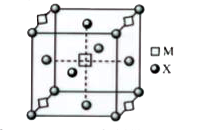
A compound `M_(p)X_(q)` has cubic close packing (ccp) arrangement of X. Its unit cell structure is shown below. The empirical formula of the compound is

A

`MX`

B

`MX_(2)`

C

`M_(2)X`

D

`M_(5)X_(14)`

Text Solution

Verified by Experts

The correct Answer is:

B
Promotional Banner

Topper's Solved these Questions

  • SOLID STATE

    AAKASH SERIES|Exercise LEVEL - II LECTURE SHEET (EXERCISE - I)|31 Videos
  • SOLID STATE

    AAKASH SERIES|Exercise LEVEL - II LECTURE SHEET (EXERCISE - II)|6 Videos
  • SOLID STATE

    AAKASH SERIES|Exercise LEVEL - I (EXERCISE - I)|68 Videos
  • REVISION EXERCISE

    AAKASH SERIES|Exercise COMPLEX COMPOUNDS|47 Videos
  • SOLIDS STATE

    AAKASH SERIES|Exercise PRACTICE EXERCISE|63 Videos

Similar Questions

Explore conceptually related problems

In a hypothetical ionic crystal, B is arranged in cubic close packing and A occupies all octahedral voids and alternative tetrahedral voids. The correct formula of the compound

An organic compound has an empirical formula CH_(2) O. Its vapour density is 45. The molecular formula of compound is

In a cubic arrangement of A and B atoms, A atoms are at corners of unit cell and B atoms at edge centres. One "A" atom is missing from one corner in each unit cell. The simplest formula of the compound is

A body centered cubic solid is made up of two elements A and B. Atoms of 'A' occupy two corners of the cube. Remaining positions of the unit cell are occupied by the atoms of 'B'. The formula of the compound is :

Atoms of an element 'A' occupy tetrahedral voids in the hexagonal close packed (hcp) unit cell lattice formed by the element 'B'. The formula of the compound formed by 'A' and 'B' is

A solid has a structure in which W atoms are located at the corners of the cubic lattice, O atoms at the centre of the edges and Na atom at the centre of the cube. The formula of the compound is

A solid has a structure in which w atoms are located at the corners of the cubic lattice, O atoms at the centre of the edges and Na atom at the centre of the cube. The formula of the compound is

A compound having elements X and Y crystallises in a cubic structure, where X is at the corneer position and Y is at the center of the cube. The correct formula of the compound is

In a face centred cubic arrangement of A and B atoms whose A atoms are at the corner of the unit cell and B atoms at the face centred. One of the A atom is missing from one corner in unit cell. The simplest formula of compound is :

Atoms of an element 'A' occupy 2/3 tetrahedral voids in the hexagonal close packed (hep) unit cell lattice formed by the element 'B'. The B' is formula of the compound formed by 'A' and

AAKASH SERIES-SOLID STATE-LEVEL - I (EXERCISE - II)
  1. A compound is formed by elements A and B. This crystallizes in the cub...

    Text Solution

    |

  2. In a compound atoms of element 'Y' form C.C.P. lattice and those of el...

    Text Solution

    |

  3. A compound M(p)X(q) has cubic close packing (ccp) arrangement of X. It...

    Text Solution

    |

  4. The intermetallic compound LiAg crystallizes in cubic lattice in which...

    Text Solution

    |

  5. In the crystals of which of the following ionic compounds would you ex...

    Text Solution

    |

  6. Gold crystallizes with a

    Text Solution

    |

  7. When molten zinc is cooled to solid state, it assumes HCP structure. T...

    Text Solution

    |

  8. Sodium crystallizes in a bcc lattice, hence the coordination number of...

    Text Solution

    |

  9. The metal having 26% void space in its crystal structure is

    Text Solution

    |

  10. The percentage of void space of a metallic element crystallising in a ...

    Text Solution

    |

  11. A metal crystallises in a simple cubic unit cell of edge length 6.22 Å...

    Text Solution

    |

  12. Sodium metal crystallises in a body-centred cubic lattice with the cel...

    Text Solution

    |

  13. Copper crystallises in a f.c.c. lattice, the length of the unit cell i...

    Text Solution

    |

  14. The radius of an atom of an element is 80 pm. If it crystallises as a ...

    Text Solution

    |

  15. A metal has bcc structure and the edge length of its unit cell is 3.04...

    Text Solution

    |

  16. If the radius of K^(+) and F^(-) are 133 pm and 136 pm respectively, t...

    Text Solution

    |

  17. Schottky defect causes

    Text Solution

    |

  18. What type of crystal defect is indicated in the diagram below  |{:(Na...

    Text Solution

    |

  19. Schottky - Wagner defects are mostly found in

    Text Solution

    |

  20. Which among the following is likely to have Schottky defect.

    Text Solution

    |
