Consider a metallic bar of length L and uniform cross section A with its two ends maintained at different temperatures.
This can be done, for example, by putting the ends in thermal contact with large reservoirs at temperatures, say `T_(C)` and `T_(D)` respectively. Let us assume the ideal condition that the sides of the bar are fully insulated so that no heat is exchanged between the sides and the surroundings.

Here, as as `T_(C)gtT_(D)`, temperatures of different parts increase with time which is shown by dashed line in temperature.
Distance graph :

After sometime, a steady state is reached , the temperature of the bar decreases uniformly with distance from `T_(C)` to `T_(D),(T_(C)gtT_(D))`.
The reservoir at C supplies heat at constant rate, which transfers through the bar and is given out at the same rate to the reservoir at D.
Now both `(dQ)/(dt)` and `(dT)/(dx)` remain constant with time. This condition of the rod is called as ..thermal steady state...
It is found experimentally that in this steady state, the rate of flow of heat (or heat current) H is proportional to the temperature difference `(T_(C)-T_(D))` and the area of cross section A and is inversely proportional to the length L :
`Hprop(A(T_(C)-T_(D)))/(L)`
The constant of proportionality K is called the thermal conductivity of the material.
The greater the value of K for a material, the more rapidly will it conduct heat.
The SI unit of K is `S^(-1)m^(-1)K^(-1)` or `"W m"^(-1)K^(-1)`.
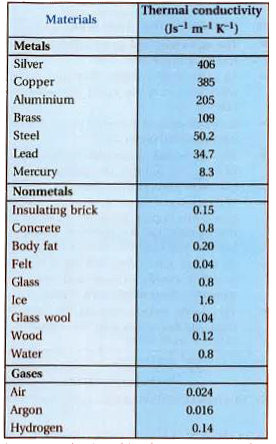
Thermal conductivity of metals is high and wood, glasswool have vergy less thermal conductivity hence they are good insulators.
Thermal conductivities of some materials :