Home
Class 11
PHYSICS
Derive equation for heat flow rate in re...

Derive equation for heat flow rate in rectangular block of solid.

Text Solution

Verified by Experts
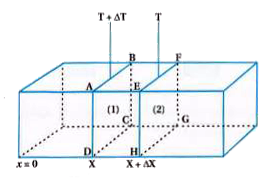
Figure shows a rectangular block of solid of cross section .A..

Let us consider two cross sections ABCD and EFGH, at a distance x and `Deltax` from one end of a block having temperature `T+DeltaT` and T respectively.
Here, the distance between two cross section is `Deltax` and temperature difference is `DeltaT`.
The ratio `DeltaT//Deltax` is called temperature gradient
Temperature gradient : The difference in temperature per unit distance between two parts of a solid is called distance between two parts of a solid is called as temperature gradient parts of a solid is called as temperature gradient. Its unit is Kelvin/meter and dimensional formula is `M^(0)L^(-1)T^(0)K^(1)`.
Experiment shown that for a small change in temperature, the amount of heat passing between these two cross sectional planes in direction perpendicular to these planes in time `Deltat` depends on the following factors :
`DeltaQprop(DeltaT)/(Deltax)" (For given "Deltat" and A)"`
`DeltaQpropDeltat" (For given "DeltaT//Deltax" and A)"`
`DeltaQpropA" For given "Deltat " and "DeltaT//Deltax")"`
`:.DeltaQ=-kA(DeltaT)/(Deltax)Deltat`
`(DeltaQ)/(Deltat)=-kA(DeltaT)/(Deltax)` . . .(1)
Here, k is constant of proportionality called thermal conductivity of the material of the block. Its value depends on the type of the material and to some extent on the temperature.
The materials with higher value of thermal consuctivity are good conductors of heat.
Normalally, if the differnces in the temperatures of different parts of solid are not very large, k can be considered a constant.
Negative sign in above equation indicates that with the increase in x the temperature decreases.
Taking limits `Deltax to 0` and `Deltat to0` in equation (1)
`(dQ)/(dt)=-kA(dT)/(dx)` . . . (2)
`:.H=-ka(dQ)/(dt)`
`(dQ)/(dt)=H` is called heat current. Heat current is the rate of flow of heat through any cross section.
Its unit is cal/s or J/s, its dimensional formula is `M^(1)L^(2)T^(-3)`.
Promotional Banner

Topper's Solved these Questions

  • THERMAL PROPERTIES OF MATTER

    KUMAR PRAKASHAN|Exercise Section - B (Numericals) Numerical From Textual Illustration|8 Videos
  • THERMAL PROPERTIES OF MATTER

    KUMAR PRAKASHAN|Exercise Section - B|10 Videos
  • THERMAL PROPERTIES OF MATTER

    KUMAR PRAKASHAN|Exercise Try Yourself (VSQs)|84 Videos
  • SYSTEMS OF PARTICLES AND ROTATIONAL MOTION

    KUMAR PRAKASHAN|Exercise SECTION-F (SECTION-D) QUESTIONS PAPER|1 Videos
  • THERMODYANMICS

    KUMAR PRAKASHAN|Exercise Question Paper|11 Videos

Similar Questions

Explore conceptually related problems

Derive equation of magnetic field inside a long straight solenoid.

Give definition of heat transfer in solids.

Obtain the equation rate of emission of heat for perfect black body by using Stefan Boltzmaan law.

Derive the equation of equivalent resistance of resistors connected in parallel.

Derive the equation of equivalent resistance of resistors connected in parallel.

Using Bohr's atomic model, derive an equation of the radius of the nth orbit of an electron.

What is parallel connection of resistors ? Derive equation of equivalent resistance in parallel connection.

Derive the equation for variation of g due to depth below the surface of earth.

