Home
Class 11
PHYSICS
Two ideal gas thermometers A and B use o...

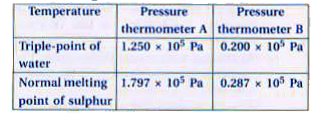
Two ideal gas thermometers A and B use oxygen and hydrogen respectively. The following observations are made :

What do you think is the reason behind the slight difference in answers of thermometers A and B ? (The thermometers are not faulty). What further procedure is needed in the experiment to reduce the discrepancy between the two readings ?

Text Solution

Verified by Experts

The reason of minor difference in answer is that in reality hydrogen and oxygen are not ideal gases.
To reduce the discrepancy, readings should be taken for lower and lower pressure and plot between temperature measured versus absolute pressure of the gas at tripple point should be extra ploted to obtain temperature in the limit pressure trends to zero, when the gases approach ideal gas behaviour.
Promotional Banner

Topper's Solved these Questions

  • THERMAL PROPERTIES OF MATTER

    KUMAR PRAKASHAN|Exercise Section - B (Numericals) Numerical From Textual Exercise (Answer the following : )|4 Videos
  • THERMAL PROPERTIES OF MATTER

    KUMAR PRAKASHAN|Exercise Section - B Numerical From .DARPAN. Based On Textbook|7 Videos
  • THERMAL PROPERTIES OF MATTER

    KUMAR PRAKASHAN|Exercise Section - B|10 Videos
  • SYSTEMS OF PARTICLES AND ROTATIONAL MOTION

    KUMAR PRAKASHAN|Exercise SECTION-F (SECTION-D) QUESTIONS PAPER|1 Videos
  • THERMODYANMICS

    KUMAR PRAKASHAN|Exercise Question Paper|11 Videos

Similar Questions

Explore conceptually related problems

Two ideal gas thermometers A and B use oxygen and hydrogen respectively. The following observations are made: {:("Temperature","Pressure","Pressure"),(,"thermometer A","thermometer B"),("Triple - point water",1.250 xx10^(5) Pa,0.200 xx 10^(5) Pa),("Normal melting point of sulphur",1.797 xx10^(5)Pa,0.287 xx10^(5)Pa):} (a) What is the absolute temperature of normal melting point of sulphur as read by thermometers A and B ? (b) What do you think is the reason behind the slight difference in answers of thermometers A and B ? (The thermometers are not faulty). What further procedure is needed in the experiment to reduce the discrepancy between the two readings ?

Two ideal gas thermometers A and B use oxygen and hydrogen respectively. The following observations are made : What is the absolute temperature of normal melting point sulphur as read by thermometers A and B ?

Two cylinders A and B of equal capacity are connected to each other via a stopcock. A contains a gas at standard temperature and pressure. B is completely evacuated. The entire system is thermally insulated. The stopcock is suddenly opened. Answer the following: (a) What is the final pressure of the gas in A and B ? (b) What is the change in internal energy of the gas ? (c) What is the change in the temperature of the gas ? (d) Do the intermediate states of the system (before settling to the final equilibrium state) lie on its P-V-T surface ?

Two coils of insulated copper wire are wound over a non - conducing cylinder as shown in figure 13.28. Coil 1 has larger number of turns . (1) Write your observation when , (a) plug key k is colsed and (b) plug key k is opend . (2) Give reason for your observation . (3) Mention the name of the phenomenon involved and define it . (4) Write the names of two coils used in this experiment . OR What are these coils called ?

Answer carefully: (a) Two large conducting spheres carrying charges Q_(1) and Q_(2) are brought close to each other. Is the magnitude of electrostatic force between them exactly given by Q_(1),Q_(2)//4pi epsilon_(0)r^(2) , where r is the distance between their centres? (b) If Coulomb’s law involved 1//r^(3) dependence (instead of would Gauss’s law be still true ? (c) A small test charge is released at rest at a point in an electrostatic field configuration. Will it travel along the field line passing through that point? (d) What is the work done by the field of a nucleus in a complete circular orbit of the electron? What if the orbit is elliptical? (e) We know that electric field is discontinuous across the surface of a charged conductor. Is electric potential also discontinuous there? (f) What meaning would you give to the capacitance of a single conductor? (g) Guess a possible reason why water has a much greater dielectric constant (= 80) than say, mica (= 6).

It is said that elemental composition of living organisms and that of inanimate objects (like earth's crust) are similar in the sense that all the major elements are present in both. Then what would be the difference between these two groups ? Choose a correct answer from among the following. (A) Living organisms have more gold in them than inanimate objects. (B) Living organisms have more water in their body than inanimate objects. (C) Living organisms have more carbon, oxygen and hydrogen per unit mass than inanimate objects. (D) Living organisms have more calcium in them than inanimate objects.

In an experiment to estimate the size of a molecule of oleic acid 1 mL of oleic acid is dissolved in 19 ml of alcohol. Then I mL of this solution is diluted to 20 mL by adding alcohol. Now 1 drop of this diluted solution is placed on water in a shallow through. The solution spreads over the surface of water forming one molecule thick layer. Now lycopodium powder is sprinkled evenly over the film and its diameter is measured. Knowing the volume of the drop and area of the film we can calculate the thickness of the film which will give us the size of oleic acid molecule. Read the passage carefully and answer the following questions. (a) Why do we dissolve oleic acid in alcohol ? (b) What is the role of lycopodium powder ? (c) What would be the volume of oleic acid in each ml of solution prepared ? (d) How will you calculate the volume of n drops of this solution of oleic acid ? (e) What will be the volume of oleic acid in one drop of this solution ?

KUMAR PRAKASHAN-THERMAL PROPERTIES OF MATTER-Section - B (Numericals) Numerical From Textual Exercise
  1. The electrical resistance in ohms of a certain thermometer varies with...

    Text Solution

    |

  2. Two ideal gas thermometers A and B use oxygen and hydrogen respectivel...

    Text Solution

    |

  3. Two ideal gas thermometers A and B use oxygen and hydrogen respectivel...

    Text Solution

    |

  4. A steel tape 1 m long is correctly calibrated for a temperature of 27....

    Text Solution

    |

  5. A large steel wheel is to be fitted on to a shaft of the same material...

    Text Solution

    |

  6. A hole is drilled in a copper sheet. The diameter of the hole is 4.24 ...

    Text Solution

    |

  7. A steel wire 0.72 m long has a mass of 5.0 xx 10 ^(-3) kg. If the wire...

    Text Solution

    |

  8. A brass rod of length 50 cm and diameter 3.0 mm is joined to a steel r...

    Text Solution

    |

  9. The coefficient of volume expansion of glycerin is 49xx10^(-5)K^(-1). ...

    Text Solution

    |

  10. A 10 kW drilling machine is used to drill a bore in a small aluminium ...

    Text Solution

    |

  11. A copper block of mass 2.5 kg is heated in a furnace to a temperature ...

    Text Solution

    |

  12. In an experiment on the specific heat of a metal, a 0.20 kg block of t...

    Text Solution

    |

  13. Given below are observations on molar specific heats at room temperatu...

    Text Solution

    |

  14. Answer the following questions based on the P-T phase diagram of carbo...

    Text Solution

    |

  15. Answer the following questions based on the P - T phase diagram of CO(...

    Text Solution

    |

  16. A child running a temperature if 101^(@)F is given an antipyrine (i.e....

    Text Solution

    |

  17. A 'thermacole' icebox is cheap and efficient method for storing small ...

    Text Solution

    |

  18. A brass boiler has a base of 0.15m^(2) and thickness 1.0 cm. It boils ...

    Text Solution

    |

  19. Explain why, a body with large reflectivity is a poor emitter.

    Text Solution

    |

  20. Explain why, a brass tumbler feels much colder than a wooden tray on...

    Text Solution

    |
