Home
Class 11
PHYSICS
Given below are observations on molar sp...

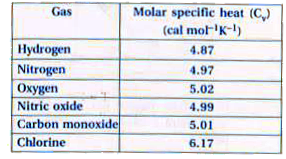
Given below are observations on molar specific heats at room temperature of some common gases.

The measured molar specific heats of these gases are markedly different from those for monatomic gases. Typically, molar specific heat of a monatomic gas is 2.92 cal/mol K. Explain this difference. What can you infer from the somewhat larger (than the rest) value for chlorine ?

Text Solution

Verified by Experts

Gases given in the question are diatomic. Their specific heat is `5/2R=5/2xx1.98=4.95`.
All the gases except chlorine gas have same specific heat as above.
Diaformic gases atoms perform vibrational and rotation motion with translational motion. And nonatomic gas atoms only perform translational motion. Hence specific heat of monoatomic gas is less than specific heat of diatomic gas.
The higher value of molar specific heat of chlorine indicats that besides rotational modes, vibrational modes are also present in chlorine at room temperature.
Promotional Banner

Topper's Solved these Questions

  • THERMAL PROPERTIES OF MATTER

    KUMAR PRAKASHAN|Exercise Section - B (Numericals) Numerical From Textual Exercise (Answer the following : )|4 Videos
  • THERMAL PROPERTIES OF MATTER

    KUMAR PRAKASHAN|Exercise Section - B Numerical From .DARPAN. Based On Textbook|7 Videos
  • THERMAL PROPERTIES OF MATTER

    KUMAR PRAKASHAN|Exercise Section - B|10 Videos
  • SYSTEMS OF PARTICLES AND ROTATIONAL MOTION

    KUMAR PRAKASHAN|Exercise SECTION-F (SECTION-D) QUESTIONS PAPER|1 Videos
  • THERMODYANMICS

    KUMAR PRAKASHAN|Exercise Question Paper|11 Videos

Similar Questions

Explore conceptually related problems

Given below are observations on molar specific heats at room temperature of some common gases. {:("Gas","Molar specific heat "(C_(v))),(,("cal mol"^(1)K^(-1))),("Hydrogen",4.87),("Nitrogen",4.97),("Oxygen",5.02),("Nitric oxide",4.99),("Carbon monoxide",5.01),("Chlorine",6.17):} The measured molar specific heats of these gases are markedly different from those for monatomic gases. Typically, molar specific heat of a monatomie gas is 2.52 cal/mol K. Explain this difference. What can you infer from the somewhat larger than the rest) value for chlorine ?

Statement - 1 : An ideal gas has infinitely many molar specific heats. Statement- 2 : Specific heat is amount of heat needed to raise the temperature of 1 mole of gas by 1K .

Explain why : (a) Two bodies at different temperatures T_1 and T_2 if brought in thermal contact do not necessarily settle to the mean temperature (T_1 + T_2 )//2 . (b) The coolant in a chemical or a nuclear plant (i.e., the liquid used to prevent the different parts of a plant from getting too hot) should have high specific heat. (c) Air pressure in a car tyre increases during driving. (d)The climate of a harbour town is more temperate than that of a town in a desert at the same latitude.

Explain why (a) Two bodies at different temperatures T_(1) and T_(2) if brought in thermal contact do not necessarily settle to the mean temperature (T_(1) + T_(2))//2 . (b) The coolant in a chemical or a nuclear plant (i.e., the liquid used to prevent the different parts of a plant from getting too hot) should have high specific heat. (c) Air pressure in a car tyre increases during driving. (d) The climate of a harbour town is more temperate than that of a town in a desert at the same latitude.

Calculate the molar specific heat at constant volume . Given : specific heat of hydrogen at constant pressure is 6.85 "cal" mol^(-1) K^(-1) and density of hydrogen = 0.0899 "g" cm^(-3) . One mole of gas = 2.016g, J=4.2xx10^(7) "erg" cal^(-1) and 1 atmosphere = 10^(6) "dyne" cm^(-2) .

A quantity of 2 mole of helium gas undergoes a thermodynamic process, in which molar specific heat capacity of the gas depends on absolute temperature T , according to relation: C=(3RT)/(4T_(0) where T_(0) is initial temperature of gas. It is observed that when temperature is increased. volume of gas first decrease then increase. The total work done on the gas until it reaches minimum volume is :-

A water cooler of storages capacity 120 liters can cool water at a constant rate of P watts. In a closed circulation system (as shown schematically in the figure), the water from the cooler is used to cool an external device that generates constantly 3kW of heat (thermal load). The temperature of water fed into the device cannot exceed 30^@C and the entire stored 120 liters of water is initially cooled to 10^@C. The entire system is thermally insulated. The minimum value of P ( in watts) for which the device can be operated for 3hours is (Specific heat of water is 4.2kJkg^-1K^-1 and the density of water is 1000kgm^-3 )

Statement - 1 : A gas is taken from state A to state B through two different paths. Molar specific heat capacity in path (A) is more as compared to (B) Statement- 2 : Specific heat C =(Q)/(nDeltaT) & Q = DeltaU + W and W is equal to area under P-V diagram.

5 mole of oxygen are heated at constant volume from 10^(@)C "to" 20^(@)C . What will be the change in internal energy of the gas? Gram molar specific heat of gas at constant pressure =8cal. "Mole"^(-1).^(@)C^(-1) and R=8.36J "mole"^(-1).^(@)C^(-1) .

Calculate the difference between the two principal specific heats of 1g of helium gas at S.T.P. Given atomic weight of helium = 4 and J = 4.186 J cal^(-1) and R = 8.31 J mol^(-1)K^(-1) .

KUMAR PRAKASHAN-THERMAL PROPERTIES OF MATTER-Section - B (Numericals) Numerical From Textual Exercise
  1. A large steel wheel is to be fitted on to a shaft of the same material...

    Text Solution

    |

  2. A hole is drilled in a copper sheet. The diameter of the hole is 4.24 ...

    Text Solution

    |

  3. A steel wire 0.72 m long has a mass of 5.0 xx 10 ^(-3) kg. If the wire...

    Text Solution

    |

  4. A brass rod of length 50 cm and diameter 3.0 mm is joined to a steel r...

    Text Solution

    |

  5. The coefficient of volume expansion of glycerin is 49xx10^(-5)K^(-1). ...

    Text Solution

    |

  6. A 10 kW drilling machine is used to drill a bore in a small aluminium ...

    Text Solution

    |

  7. A copper block of mass 2.5 kg is heated in a furnace to a temperature ...

    Text Solution

    |

  8. In an experiment on the specific heat of a metal, a 0.20 kg block of t...

    Text Solution

    |

  9. Given below are observations on molar specific heats at room temperatu...

    Text Solution

    |

  10. Answer the following questions based on the P-T phase diagram of carbo...

    Text Solution

    |

  11. Answer the following questions based on the P - T phase diagram of CO(...

    Text Solution

    |

  12. A child running a temperature if 101^(@)F is given an antipyrine (i.e....

    Text Solution

    |

  13. A 'thermacole' icebox is cheap and efficient method for storing small ...

    Text Solution

    |

  14. A brass boiler has a base of 0.15m^(2) and thickness 1.0 cm. It boils ...

    Text Solution

    |

  15. Explain why, a body with large reflectivity is a poor emitter.

    Text Solution

    |

  16. Explain why, a brass tumbler feels much colder than a wooden tray on...

    Text Solution

    |

  17. Explain why, an optical pyrometer (for measuring high temperatures) ...

    Text Solution

    |

  18. Explain why, the earth without its atmosphere would be inhospitably ...

    Text Solution

    |

  19. Explain why, heating systems based on circulation of steam are more ...

    Text Solution

    |

  20. A body cools from 80^(@)C to 50^(@)C in 5 minutes Calculate the time i...

    Text Solution

    |
