Home
Class 11
PHYSICS
Answer the following questions based on ...

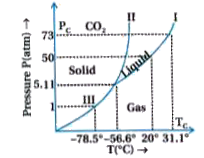
Answer the following questions based on the P - T phase diagram of `CO_(2)` :
(a) `CO_(2)` at 1 atm pressure and temperature `-60^(@)C` is compressed isothermally. Does it go through a liquid phase ?
(b) What happens when `CO_(2)` at 4 atm pressure is cooled from room temperature at constant pressure ?
(c) Describe qualitatively the changes in a given mass of solid `CO_(2)` at 10 atm pressure and temperature `-65^(@)C` as it is heated up to room temperature at constant pressure.
(d) `CO_(2)` is heated to a temperature `70^(@)C` and compressed isothermally. What changes in its properties do you expect to observe ?

Text Solution

Verified by Experts

(a) No, `CO_(2)` is in steam from at 1 atm pressure and `-60^(@)C` temperature.
It its isothermal compression is done i.e. increasing pressure with constant temperature then it directly converts into solid form without coming through liquid. (Sublimation)
(b) `CO_(2)` is in gaseous state at 4 atm pressure and `27^(@)C` temperature.
If it is clled at constant pressure then it directly converts into gaseous state without coming through liquid. It intersects at curve III.
(c) `CO_(2)` is in solid form at 10 atm pressure and `-60^(@)C` temp.
If it is heated at constant pressure then first it comes in liquid form and then in gaseous form because it intersects the fusion and vaporization curve.
(d) It is seen from phase diagram of `CO_(2)` that the above `70^(@)C` temperature it doesn.t have liquid area. Then also it reacts as an ideal gas with increase in pressure.
Promotional Banner

Topper's Solved these Questions

  • THERMAL PROPERTIES OF MATTER

    KUMAR PRAKASHAN|Exercise Section - B (Numericals) Numerical From Textual Exercise (Answer the following : )|4 Videos
  • THERMAL PROPERTIES OF MATTER

    KUMAR PRAKASHAN|Exercise Section - B Numerical From .DARPAN. Based On Textbook|7 Videos
  • THERMAL PROPERTIES OF MATTER

    KUMAR PRAKASHAN|Exercise Section - B|10 Videos
  • SYSTEMS OF PARTICLES AND ROTATIONAL MOTION

    KUMAR PRAKASHAN|Exercise SECTION-F (SECTION-D) QUESTIONS PAPER|1 Videos
  • THERMODYANMICS

    KUMAR PRAKASHAN|Exercise Question Paper|11 Videos

Similar Questions

Explore conceptually related problems

Answer the following questions based on the P-T phase diagram of CO_(2) : CO_(2) at 1 am pressure and temperature - 60^(@) C is compressed isothermally Does it go through a liquid phase ?

Answer the following questions based on the P-T phase diagram of CO_(2) : Describe qualitatively the changes in a given mass of solid CO_(2) at 10 atm pressure and temperature - 65 ^(@) C as it is heated up to room temperature at constant pressure.

Answer the following questions based on the P-T phase diagram of CO_(2) : CO_(2) is heated to a temperature 70^(@) C and compressed Isothermally. What changes in its properties do you expect to observe ?

Answer the following questions based on the P-T phase diagram of CO_(2) : What happens when CO_(2) at 4 atm pressure is cooled from room temperature at constant pressure ?

Answer the following questions based on the P-T phase diagram of carbon dioxide: What are the critical temperature and pressure for CO_(2) ? What is their significance ?

Answer the following questions based on the P-T phase diagram of carbon dioxide: At what temperature and pressure can the solid, liquid and vapour phases of CO_(2) co-exist in equilibrum ?

Answer the following questions based on the P-T phase diagram of carbon dioxide: What is the effect of decrease of pressure on the fusion and boiling point of CO_(2) ?

Answer the following questions based on the P-T phase diagram of carbon dioxide: Is CO_(2) solid, liquid or gas at (a) - 70^(@) C under 1 atm, (b) - 60^(@) C under 10 atm, (c) 15 ^(@) C under 56 atm?

KUMAR PRAKASHAN-THERMAL PROPERTIES OF MATTER-Section - B (Numericals) Numerical From Textual Exercise
  1. A large steel wheel is to be fitted on to a shaft of the same material...

    Text Solution

    |

  2. A hole is drilled in a copper sheet. The diameter of the hole is 4.24 ...

    Text Solution

    |

  3. A steel wire 0.72 m long has a mass of 5.0 xx 10 ^(-3) kg. If the wire...

    Text Solution

    |

  4. A brass rod of length 50 cm and diameter 3.0 mm is joined to a steel r...

    Text Solution

    |

  5. The coefficient of volume expansion of glycerin is 49xx10^(-5)K^(-1). ...

    Text Solution

    |

  6. A 10 kW drilling machine is used to drill a bore in a small aluminium ...

    Text Solution

    |

  7. A copper block of mass 2.5 kg is heated in a furnace to a temperature ...

    Text Solution

    |

  8. In an experiment on the specific heat of a metal, a 0.20 kg block of t...

    Text Solution

    |

  9. Given below are observations on molar specific heats at room temperatu...

    Text Solution

    |

  10. Answer the following questions based on the P-T phase diagram of carbo...

    Text Solution

    |

  11. Answer the following questions based on the P - T phase diagram of CO(...

    Text Solution

    |

  12. A child running a temperature if 101^(@)F is given an antipyrine (i.e....

    Text Solution

    |

  13. A 'thermacole' icebox is cheap and efficient method for storing small ...

    Text Solution

    |

  14. A brass boiler has a base of 0.15m^(2) and thickness 1.0 cm. It boils ...

    Text Solution

    |

  15. Explain why, a body with large reflectivity is a poor emitter.

    Text Solution

    |

  16. Explain why, a brass tumbler feels much colder than a wooden tray on...

    Text Solution

    |

  17. Explain why, an optical pyrometer (for measuring high temperatures) ...

    Text Solution

    |

  18. Explain why, the earth without its atmosphere would be inhospitably ...

    Text Solution

    |

  19. Explain why, heating systems based on circulation of steam are more ...

    Text Solution

    |

  20. A body cools from 80^(@)C to 50^(@)C in 5 minutes Calculate the time i...

    Text Solution

    |
