Home
Class 11
PHYSICS
A Student records the initial length l, ...

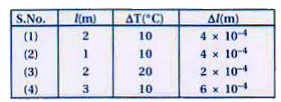
A Student records the initial length l, change in temperature `DeltaT` and change in length `Deltal` of a rod as follows :

If the first observation is correct what can you say about observations 2, 3 and 4.

Text Solution

Verified by Experts

From first observation,
`alpha=(Deltal)/(lDeltaT)`
`=(4xx10^(-4))/(2xx10)`
`=2xx10^(-5)" "^(@)C^(-1)`
From second observation,
`Deltal=alphalDeltaT`
`:.Deltal=2xx10^(-5)xx1xx10`
`=2xx10^(-4)m!=4xx10^(-4)m`
`:.` Thus, the observation is incorrect
From third observation,
`Deltal=alphalDeltaT`
`=2xx10^(-5)xx2xx20`
`=8xx10^(-4)m!=2xx10^(-4)m`
`:.` Thus, the observation is incorrect.
From fourth observation,
`Deltal=alphalDeltaT`
`=2xx10^(-5)xx3xx10`
`=6xx10^(-4)m=6xx10^(-4)m`
Thus, the observation is true.
Promotional Banner

Topper's Solved these Questions

  • THERMAL PROPERTIES OF MATTER

    KUMAR PRAKASHAN|Exercise Section - D NCERT Exemplar Solution (Short Answer Type Questions )|4 Videos
  • THERMAL PROPERTIES OF MATTER

    KUMAR PRAKASHAN|Exercise Section - D NCERT Exemplar Solution (Long Answer Type Questions )|8 Videos
  • THERMAL PROPERTIES OF MATTER

    KUMAR PRAKASHAN|Exercise Section - D NCERT Exemplar Solution (Multiple Choice Questions MCQs) More than one options|1 Videos
  • SYSTEMS OF PARTICLES AND ROTATIONAL MOTION

    KUMAR PRAKASHAN|Exercise SECTION-F (SECTION-D) QUESTIONS PAPER|1 Videos
  • THERMODYANMICS

    KUMAR PRAKASHAN|Exercise Question Paper|11 Videos

Similar Questions

Explore conceptually related problems

The following real numbers have decimal expansions as given below. In each case, decide whether they are rational or not. If they are rational, and of the form (p)/(q) what can you say about the prime factors of q ? (1) 43.123456789 (2) 0.120120012000120000 (3) 43.bar123456789

A brass rod of length 50 cm and diameter 3.0 mm is joined to a steel rod of the same length and diameter. What is the change in length of the combined rod at 250^(@)C , if the original lengths are at 40.0^(@)C ? there a 'thermal stress' developed at the junction ? The ends of the rod are free to expand (Coefficient of linear expansion of brass =2.0xx10^(-5)K^(-1)," steel "=1.2xx10^(-5)K^(-1) ).

A brass rod of length 50 cm and diameter 3.0 mm is joined to a steel rod of the same length and diameter. What is the change in length of the combined rod at 250 ^(@) C . if the original lengths are at 40.0 ^(@) C ? Is there a "thermal stress developed at the junction ? The ends of the rod are free to expand (Co-efficient of linear expansion of brass = 2.0 xx 10^(-5) K^(-1) , " steel " = 1.2 xx 10^(-5) K^(-1)) .

We would like to prepare a scale whose length does not change with temperature. It is proposed to prepare a unit scale of this type whose length remains, say 10 cm. We can use a bimetallic strip made of brass and iron each of different length whose length (both components) would change in such a way that difference between their lengths remain constant. If alpha_("iron")=1.2xx10^(-5)//K and alpha_("brass")=1.8xx10^(-5)//K what should we take as length of each strip ?

Statement- 1 : Temperature of a rod is increased and again cooled to same initial temperature then itsfinal length is equal to original length provided there is no deformation take place. Statement- 2 : For a small temperature change , length of a rod varies as l = l_(0)(1+alphaDeltaT) provided alpha DeltaT ltlt1 . Here symbol have their usual meaning.

Two composite rods made by A & B and C & B materials as shown. When we increase the temperature DeltaT , relation between final lengths of rod becomes L_(1)ltL_(2) . Find the relation between alpha_(A) and alpha_(C) . ltimg src="https://d10lpgp6xz60nq.cloudfront.net/physics_images/ALN_PHY_R01_E09_013_Q01.png" width="80%"gt

One end of rod of length L and cross-sectional area A is kept in a furance of temperature T_(1) . The other end of the rod is kept at at temperature T_(2) . The thermal conductivity of the material of the rod is K and emissivity of the rod is e . It is given that T_(2)=T_(S)+DeltaT where DeltaT lt lt T_(S) , T_(S) being the temperature of the surroundings. If DeltaT prop (T_(1)-T_(S)) , find the proportionality constant. Consider that heat is lost only by radiation at the end where the temperature of the rod is T_(2) .

A long horizontal rod has a bead which can slide along its length and initially placed at a distance L from one end A of the rod. The rod is set in angular motion about A with constant angular acceleration alpha. if the coefficient of friction between the rod and the bead is mu , and gravity is neglected, then the time after which the bead starts slipping is
