We would like to make a vessel whose volume does not change with temperature (take a hint from the problem above). We can use brass and iron `(beta_("vbrass")=6xx10^(-5)//K" and "beta_("viron")=3.55xx10^(-5)//K)` to create a volume of 100 cc. How do you think you can achieve this.
We would like to make a vessel whose volume does not change with temperature (take a hint from the problem above). We can use brass and iron `(beta_("vbrass")=6xx10^(-5)//K" and "beta_("viron")=3.55xx10^(-5)//K)` to create a volume of 100 cc. How do you think you can achieve this.
Text Solution
Verified by Experts
Let, `V_(io)` and `V_(bo)` are volume of iron and brass at `0^(@)C` respectively.
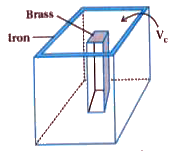
`V_(i),V_(b)` are volume of iron and brass respectively of `DeltaT^(@)C`. `gamma_(i)` and `gamma_(b)` are coefficient of volume expansion of them respectively.
According to question,
`V_(io)-V_(bo)=V_(i)-V_(b)=100" cc"` . . .(1)
`:.V_(i)=V_(io)(1+gamma_(i)DeltaT)` and `V_(b)=V_(bo)(1+gamma_(b)DeltaT)`
`:.` From equation (1),
`V_(i)-V_(b)=V_(io)(1+gamma_(i)DeltaT)-V_(ib)(1+gamma_(b)DeltaT)`
`V_(i)-V_(b)=V_(io)-V_(ib)+V_(io)gamma_(i)DeltaT-V_(ib)gamma_(b)DeltaT`
But `V_(i)-V_(b)=V_(io)-V_(ib)`
`:.V_(io)gamma_(i)DeltaT=V_(ib)gamma_(b)DeltaT`
`:.(V_(io))/(V_(bo))=(gamma_(b))/(gamma_(i))` for midpoint `=(6xx10^(-5))/(3.55xx10^(-5))=(6)/(3.55)`
`:.V_(io)=(6)/(3.55)V_(bo)` . . . (2)
`:.` From equation `V_(io)-V_(ib)=100`,
`(6)/(3.55)V_(bo)-V_(bo)=100`
`:.6V_(bo)-3.55V_(bo)=355`
`:.2.45V_(bo)=355`
`:.V_(io)=144.89" cc"`
`:.V_(io)~~144.9" cc"`
Now, again `V_(io)-V_(bo)=100`
`:.144.89-V_(bo)=100`
`:.144.89-100=V_(bo)`
`:.44.89=V_(b)`
`:.V_(bo)~~44.9" cc"`
`V_(i),V_(b)` are volume of iron and brass respectively of `DeltaT^(@)C`. `gamma_(i)` and `gamma_(b)` are coefficient of volume expansion of them respectively.
According to question,
`V_(io)-V_(bo)=V_(i)-V_(b)=100" cc"` . . .(1)
`:.V_(i)=V_(io)(1+gamma_(i)DeltaT)` and `V_(b)=V_(bo)(1+gamma_(b)DeltaT)`
`:.` From equation (1),
`V_(i)-V_(b)=V_(io)(1+gamma_(i)DeltaT)-V_(ib)(1+gamma_(b)DeltaT)`
`V_(i)-V_(b)=V_(io)-V_(ib)+V_(io)gamma_(i)DeltaT-V_(ib)gamma_(b)DeltaT`
But `V_(i)-V_(b)=V_(io)-V_(ib)`
`:.V_(io)gamma_(i)DeltaT=V_(ib)gamma_(b)DeltaT`
`:.(V_(io))/(V_(bo))=(gamma_(b))/(gamma_(i))` for midpoint `=(6xx10^(-5))/(3.55xx10^(-5))=(6)/(3.55)`
`:.V_(io)=(6)/(3.55)V_(bo)` . . . (2)
`:.` From equation `V_(io)-V_(ib)=100`,
`(6)/(3.55)V_(bo)-V_(bo)=100`
`:.6V_(bo)-3.55V_(bo)=355`
`:.2.45V_(bo)=355`
`:.V_(io)=144.89" cc"`
`:.V_(io)~~144.9" cc"`
Now, again `V_(io)-V_(bo)=100`
`:.144.89-V_(bo)=100`
`:.144.89-100=V_(bo)`
`:.44.89=V_(b)`
`:.V_(bo)~~44.9" cc"`



Topper's Solved these Questions
THERMAL PROPERTIES OF MATTER
KUMAR PRAKASHAN|Exercise Section - E Multiple Choice Questions (MCQs)|30 VideosTHERMAL PROPERTIES OF MATTER
KUMAR PRAKASHAN|Exercise Section - F Question from Module (Sample questions for preparation of competitive exams)|18 VideosTHERMAL PROPERTIES OF MATTER
KUMAR PRAKASHAN|Exercise Section - D NCERT Exemplar Solution (Short Answer Type Questions )|4 VideosSYSTEMS OF PARTICLES AND ROTATIONAL MOTION
KUMAR PRAKASHAN|Exercise SECTION-F (SECTION-D) QUESTIONS PAPER|1 VideosTHERMODYANMICS
KUMAR PRAKASHAN|Exercise Question Paper|11 Videos
Similar Questions
Explore conceptually related problems
We would like to prepare a scale whose length does not change with temperature. It is proposed to prepare a unit scale of this type whose length remains, say 10 cm. We can use a bimetallic strip made of brass and iron each of different length whose length (both components) would change in such a way that difference between their lengths remain constant. If alpha_("iron")=1.2xx10^(-5)//K and alpha_("brass")=1.8xx10^(-5)//K what should we take as length of each strip ?
In a p-n junction diode, the current I can be expressed as I=I_(0)"exp"((eV)/(2k_(B)T)-1) where I_(0) is called the reverse saturation current, V is the voltage across the diode and is positive for forward bias and negative for reverse bias, and I is the current through the diode, k_(B) is the Boltzmann constant (8.6xx10^(-5)eV//K) and T is the absolute temperature. If for a given diode I_(0)=5xx10^(-12) A and T = 300 K, then (a) What will be the forward current at a forward voltage of 0.6 V ? (b) What will be the increase in the current if the voltage across the diode is increased to 0.7 V ? (c ) What is the dynamic resistance? (d) What will be the current if reverse bias voltage changes from 1 V to 2 V ?
Scientists are working hard to develop nuclear fusion reactor Nuclei of heavy hydrogen, _(1)^(2)H , known as deuteron and denoted by D , can be thought of as a candidate for fusion rector . The D-D reaction is _(1)^(2) H + _(1)^(2) H rarr _(2)^(1) He + n+ energy. In the core of fusion reactor, a gas of heavy hydrogen of _(1)^(2) H is fully ionized into deuteron nuclei and electrons. This collection of _1^2H nuclei and electrons is known as plasma . The nuclei move randomly in the reactor core and occasionally come close enough for nuclear fusion to take place. Usually , the temperature in the reactor core are too high and no material will can be used to confine the to plasma for a time t_(0) before the particles fly away from the core. If n is the density (number volume ) of deuterons , the product nt_(0) is called Lawson number. In one of the criteria , a reactor is termed successful if Lawson number is greater then 5 xx 10^(14) s//cm^(2) it may be helpfull to use the following boltzmann constant lambda = 8.6 xx 10^(-5)eV//k, (e^(2))/(4 pi s_(0)) = 1.44 xx 10^(-9) eVm In the core of nucleus fusion reactor , the gas become plasma because of
Scientists are working hard to develop nuclear fusion reactor Nuclei of heavy hydrogen, _(1)^(2)H , known as deuteron and denoted by D , can be thought of as a candidate for fusion rector . The D-D reaction is _(1)^(2) H + _(1)^(2) H rarr _(2)^(1) He + n+ energy. In the core of fusion reactor, a gas of heavy hydrogen of _(1)^(2) H is fully ionized into deuteron nuclei and electrons. This collection of _1^2H nuclei and electrons is known as plasma . The nuclei move randomly in the reactor core and occasionally come close enough for nuclear fusion to take place. Usually , the temperature in the reactor core are too high and no material will can be used to confine the to plasma for a time t_(0) before the particles fly away from the core. If n is the density (number volume ) of deuterons , the product nt_(0) is called Lawson number. In one of the criteria , a reactor is termed successful if Lawson number is greater then 5 xx 10^(14) s//cm^(2) it may be helpfull to use the following boltzmann constant lambda = 8.6 xx 10^(-5)eV//k, (e^(2))/(4 pi s_(0)) = 1.44 xx 10^(-9) eVm Assume that two deuteron nuclei in the core of fusion reactor at temperature energy T are moving toward each other, each with kinectic energy 1.5 kT , when the seperation between them is large enough to neglect coulomb potential energy . Also neglate any interaction from other particle in the core . The minimum temperature T required for them to reach a separation of 4 xx 10^(-15) m is in the range
Scientists are working hard to develop nuclear fusion reactor Nuclei of heavy hydrogen, _(1)^(2)H , known as deuteron and denoted by D , can be thought of as a candidate for fusion rector . The D-D reaction is _(1)^(2) H + _(1)^(2) H rarr _(2)^(1) He + n+ energy. In the core of fusion reactor, a gas of heavy hydrogen of _(1)^(2) H is fully ionized into deuteron nuclei and electrons. This collection of _1^2H nuclei and electrons is known as plasma . The nuclei move randomly in the reactor core and occasionally come close enough for nuclear fusion to take place. Usually , the temperature in the reactor core are too high and no material will can be used to confine the to plasma for a time t_(0) before the particles fly away from the core. If n is the density (number volume ) of deuterons , the product nt_(0) is called Lawson number. In one of the criteria , a reactor is termed successful if Lawson number is greater then 5 xx 10^(14) s//cm^(2) it may be helpfull to use the following boltzmann constant lambda = 8.6 xx 10^(-5)eV//k, (e^(2))/(4 pi s_(0)) = 1.44 xx 10^(-9) eVm Assume that two deuteron nuclei in the core of fusion reactor at temperature energy T are moving toward each other, each with kinectic energy 1.5 kT , when the seperation between them is large enough to neglect coulomb potential energy . Also neglate any interaction from other particle in the core . The minimum temperature T required for them to reach a separation of 4 xx 10^(-15) m is in the range
When an object moves through a fluid, as when a ball falls through air or a glass sphere falls through water te fluid exerts a viscous foce F on the object this force tends to slow the object for a small sphere of radius r moving is given by stoke's law, F_(w)=6pietarv . in this formula eta in the coefficient of viscosity of the fluid which is the proportionality constant that determines how much tangential force is required to move a fluid layer at a constant speed v, when the layer has an area A and is located a perpendicular distance z from and immobile surface. the magnitude of the force is given by F=etaAv//z . For a viscous fluid to move from location 2 to location 1 along 2 must exceed that at location 1, poiseuilles's law given the volumes flow rate Q that results from such a pressure difference P_(2)-P_(1) . The flow rate of expressed by the formula Q=(piR^(4)(P_(2)-P_(1)))/(8etaL) poiseuille's law remains valid as long as the fluid flow is laminar. For a sfficiently high speed however the flow becomes turbulent flow is laminar as long as the reynolds number is less than approximately 2000. This number is given by the formula R_(e)=(2overline(v)rhoR)/(eta) In which overline(v) is the average speed rho is the density eta is the coefficient of viscosity of the fluid and R is the radius of the pipe. Take the density of water to be rho=1000kg//m^(3) Q. Blood vessel is 0.10 m in length and has a radius of 1.5xx10^(-2) m blood flows at rate of 10^(-7)m^(3)//s through this vessel. The pressure difference that must be maintained in this flow between the two ends of the vessel is 20 Pa what is the viscosity sufficient of blood?
When an object moves through a fluid, as when a ball falls through air or a glass sphere falls through water te fluid exerts a viscous foce F on the object this force tends to slow the object for a small sphere of radius r moving is given by stoke's law, F_(w)=6pietarv . in this formula eta in the coefficient of viscosity of the fluid which is the proportionality constant that determines how much tangential force is required to move a fluid layer at a constant speed v, when the layer has an area A and is located a perpendicular distance z from and immobile surface. the magnitude of the force is given by F=etaAv//z . For a viscous fluid to move from location 2 to location 1 along 2 must exceed that at location 1, poiseuilles's law given the volumes flow rate Q that results from such a pressure difference P_(2)-P_(1) . The flow rate of expressed by the formula Q=(piR^(4)(P_(2)-P_(1)))/(8etaL) poiseuille's law remains valid as long as the fluid flow is laminar. For a sfficiently high speed however the flow becomes turbulent flow is laminar as long as the reynolds number is less than approximately 2000. This number is given by the formula R_(e)=(2overline(v)rhoR)/(eta) In which overline(v) is the average speed rho is the density eta is the coefficient of viscosity of the fluid and R is the radius of the pipe. Take the density of water to be rho=1000kg//m^(3) Q. If the sphere in previous question has mass of 1xx10^(-5)kg what is its terminal velocity when falling through water? (eta=1xx10^(-3)Pa-s)
One day in the morning, Ramesh filled up 1/3 bucket of hot water from geyser, to take bath. Remaining 2/3 was to be filled by cold water (at room temperature) to bring mixture to a comfortable temperature. Suddenly Ramesh had to attend to something which would take take some times, say 5-10 minutes before he could take bath. Now he had two options : (1) fill the remaining bucket completely by cold water and then attend to the cork, (2) first attend to the work and fill the remaining bucket just before taking bath. Which option do you think would have kept water warmer ? Explain.
According to Stefan's law of radiation, a black body radiates energy sigmaT^(4) from its unit surface area every second where T is the surface temperature of the black body and sigma=5.67xx10^(-8)W//m^(2)K^(4) is known as Stefan's constant. A nuclear weapon may be thought of as a ball of radius 0.5 m. When detonated, it reaches temperature of 10^(6) K and can be treated as a black body. If surrounding has water at 30^(@)C , how much water can 10% of the energy produced evaporate in 1 s ? [S_(w)=4186.0" J/kg K and "L_(v)=22.6xx10^(5)" J/kg"] .
According to Stefan's law of radiation, a black body radiates energy sigmaT^(4) from its unit surface area every second where T is the surface temperature of the black body and sigma=5.67xx10^(-8)W//m^(2)K^(4) is known as Stefan's constant. A nuclear weapon may be thought of as a ball of radius 0.5 m. When detonated, it reaches temperature of 10^(6) K and can be treated as a black body. Estimate the power it radiates.
KUMAR PRAKASHAN-THERMAL PROPERTIES OF MATTER-Section - D NCERT Exemplar Solution (Long Answer Type Questions )
- We would like to prepare a scale whose length does not change with tem...
Text Solution
|
- We would like to make a vessel whose volume does not change with tempe...
Text Solution
|
- Calculate the stress developed inside a tooth cavity filled with coppe...
Text Solution
|
- A rail track made of steel having length 10 m is clamped on a railway ...
Text Solution
|
- A thin rod having length L(0) at 0^(@)C and coefficient of linear expa...
Text Solution
|
- According to Stefan's law of radiation, a black body radiates energy s...
Text Solution
|
- According to Stefan's law of radiation, a black body radiates energy s...
Text Solution
|
- According to Stefan's law of radiation, a black body radiates energy s...
Text Solution
|