Home
Class 11
PHYSICS
Two masses 8 kg and 12 kg are connected ...

Two masses 8 kg and 12 kg are connected at the two ends of a light inextensible string that goes over a frictionless pulley. Find the acceleration of the masses and the tension in the string when the masses are released.

Text Solution

Verified by Experts
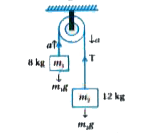
Let `m_(1) = 8 kg m_(2) = 12 kg`
Let tension in string be T

Let common acceleration of system is a
Acceleration of `m_(1)` is in upward direction acceleration of `m_(2)` is in downward direction equation of motion of `m_(1)`
By taking addition of equation (1) and (2) we get common acceleration of system
`(m_(2) - m_(1)) g= (m_(1) + m_(2))a`
`=((12-8)/( 8+12)) xx 10`
`T = m_(1) g + m_(1) ((m_(2)-m_(1))/( m_(1)+ m_(2))) g`
`T= ((2m_(1)m_(2))/( m_(1)+m_(2)))g`
Substituting value
`T= (2xx 8 xx 12)/( 8+ 12) xx 10`
`T= (2xx 960)/( 20)`
`:. T = 96 N`
Let mass of nucleus is m and initial velocity v= 0
initial momentum `vec(p )_(1) =- mV =0`
After disintergration it is divided into two part let mass be `m_(1)` and `m_(2)` and velocity be `vec( v ) _(1)` and `vec(2)` respectively
By law of conservation of linear momentum
`vec(p )_(1) = vec( p)_(f)`
`:. ,m_(2) v_(2) = - m_(1) m_(1)`
Negative sigh shows that velocity of both fragment are in mutually opposite direction
Promotional Banner

Topper's Solved these Questions

  • LAW OF MOTION

    KUMAR PRAKASHAN|Exercise SECTION -B (ADDITIONAL EXERCISE )|17 Videos
  • LAW OF MOTION

    KUMAR PRAKASHAN|Exercise SECTION -B (NUMERICAL FROM DARPAN BASED ON TEXTBOOK)|8 Videos
  • LAW OF MOTION

    KUMAR PRAKASHAN|Exercise SECTION -B (NUMERICAL FROM TEXTUAL ILLUSTRATION)|12 Videos
  • GRAVITATION

    KUMAR PRAKASHAN|Exercise QUESTIONS PAPER Section - D|1 Videos
  • MACHANICAL PROPERTIES OF SOLIDS

    KUMAR PRAKASHAN|Exercise QUESTION PAPER|11 Videos

Similar Questions

Explore conceptually related problems

Two blocks of masses 2.0 kg and 3.0 kg are connected by light inextensible string. The string passes ove an ideal pulley pivoted to a fixed axel on a smooth incline place as shown in the figure. When the blocks are released, find magnitude of their accelerations.

Two masses m_(1) = 4.8 kg and m_(2) = 5 kg tied to a string are hanging over a light frictionless pully. What is the acceleration of masses when they are free to move ?

Two weights w_(1) and w_(2) are suspended from the ends of a light string passing over a smooth fixed pulley. If the pulley is pulled up at an acceleration g , the tension in the string will be

If the string & all the pulleys are ideal, acceleration of mass m is :-

Two bodies A (30 kg) and B (50 kg) tied with a light string are placed on a friction less table. A force F acting at B pulls this ystem with an acceleration of 2ms^(-2) . The tension in the string is:

Two blocks are resting on ground with masses 5 kg and 7 kg. A spring connected them which goes over a massless pulley A. There is no friction between pulley and string A. Find acceleration of centre of mass of the system of two masses (in m//s^(2)

Two particles of masses m and M(Mgtm) are connected by a cord that passes over a massless, frictionless pulley. The tension T in the string and the acceleration a of the particles is

Two masses m_(1) and m_(2) . Which are connected with a light string, are placed over a frictionless pulley. This set up is placed over a weighting machine, as shown. Three combination of masses m_(1) and m_(2) are used, in first case m_(1)=6 kg and m_(2)=2kg in second case m_(1)=5kg and m_(2)=3kg and in third case m_(1)=4kg and m_(2)=4kg .Masses are held stationary initiallly and then released. If the readings of the weighing machine after the release in three cases are W_(1) , W_(2) and W_(3) respectively then :-

Consider the double Atwood's machine as shown in the figure (a) Whatis acceleration of the masses? (b) What is the tension in each string?

Two bodies of mass 4kg and 6kg are attached to the ends of a string passing over a pulley. The 4kg mass is attached to the table top by another string. The tension in this string T_(1) is equal to: Take

KUMAR PRAKASHAN-LAW OF MOTION-SECTION -B (NUMERICAL FROM TEXTUAL EXERCISE)
  1. One end of a string of length l is connected to a particle of mass m a...

    Text Solution

    |

  2. A constant retarding force of 50 N is applied to a body of mass 20 kg ...

    Text Solution

    |

  3. A constant force acting on a body of mass 3.0 kg changes its speed fro...

    Text Solution

    |

  4. A body of mass 5 kg is acted upon by two perpendicular forces 8 N and ...

    Text Solution

    |

  5. The driver of a three-wheeler moving with a speed of 36 km/h sees a ch...

    Text Solution

    |

  6. A rocket with a lift-off mass 20,000 kg is blasted upwards with an ini...

    Text Solution

    |

  7. A body of mass 0.40 kg moving initially with a constant speed of 10 m ...

    Text Solution

    |

  8. A truck starts from rest and accelerates uniformly at 2.0 m s^(-2). A...

    Text Solution

    |

  9. A bob of mass 0.1 kg hung from the ceiling of a room by a string 2 m l...

    Text Solution

    |

  10. A man of mass 70 kg stands on a weighing scale in a lift which is movi...

    Text Solution

    |

  11. Shows the position-time graph of a particle of mass 4 kg. What is the ...

    Text Solution

    |

  12. Two bodies of m asses 10 kg and 20 kg respectively kept on a smooth, h...

    Text Solution

    |

  13. Two masses 8 kg and 12 kg are connected at the two ends of a light ine...

    Text Solution

    |

  14. A nucleus is at rest in the laboratory frame of reference. Show that i...

    Text Solution

    |

  15. Two billiard balls each of mass 0.05 kg moving in opposite directions ...

    Text Solution

    |

  16. A shell of mass 0.020 kg is fired by a gun of mass 100 kg. If the muz...

    Text Solution

    |

  17. A batsman deflects a ball by an angle of 45^(@) without changing its i...

    Text Solution

    |

  18. A stone of mass 0.25 kg tied to the end of a string is whirled round i...

    Text Solution

    |

  19. If, in , the speed of the stone is increased beyond the maximum permis...

    Text Solution

    |

  20. Explain why (a) a horse cannot pull a cart and run in empty space, ...

    Text Solution

    |

