Home
Class 12
PHYSICS
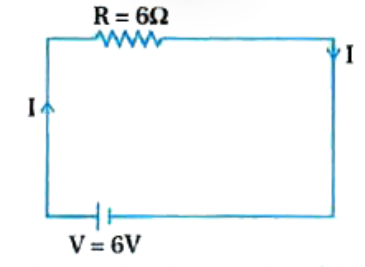
Consider circuit in figure. How much ene...

Consider circuit in figure. How much energy is absorbed by electrons from the initial state of no current (ignore thermal motion) to the of drift velocity ?

Text Solution

Verified by Experts

Current in the circuit I = `(V)/(R) = (6)/(6) = 1 A `
Number density of electron n = `(10^(29))/(m^(3))`
Length of wire of circuit l = 10 cm = 0.1 m Area of cross section A = `(1 mm)^(2)`
`rArr` Current due to electron moving with drift velocity,
`I = "nAv" d^(e) `
`therefore v_(d) = (I)/("nAe") `
` = (1)/(10^(29) xx (10^(-3))^(2) xx 1.6 xx 10^(-19)) `
` = (10^(-5))/(16) (m)/(2) = 0.0625 xx 10^(-5) (m)/(s)`
` = 6.25 xx 10^(-3) (m)/(s)`
`rArr` Energy absorbed in form of K.E.,
K.E. = `(1)/(2) m_(e) v_(d)^(2) xx ` nAl
`= (1)/(2) xx 9.1 xx 10^(-31) xx (6.25 xx 10^(-3))^(2)`
`xx 10^(29) xx 10^(-6) xx 10^(-1)`
`= 177.7 xx 10^(-19)`
`therefore K.E. " " approx 1.78 xx 10^(-17) ` J
Promotional Banner

Topper's Solved these Questions

  • CURRENT ELECTRICITY

    KUMAR PRAKASHAN|Exercise SECTION [D] MULTIPLE CHOICE QUESTIONS (MCQs) (MCQs FROM .DARPAN. BASED ON TEXTBOOK)|118 Videos
  • CURRENT ELECTRICITY

    KUMAR PRAKASHAN|Exercise SECTION [D] MULTIPLE CHOICE QUESTIONS (MCQs) (MCQs ASKED IN COMPETITIVE EXAMS)|21 Videos
  • CURRENT ELECTRICITY

    KUMAR PRAKASHAN|Exercise SECTION C (SHORT ANSWER TYPE QUESTIONS )|6 Videos
  • BOARD'S QUESTION PAPER MARCH-2020

    KUMAR PRAKASHAN|Exercise PART-B SECTION -C|4 Videos
  • DUAL NATURE OF RADIATION AND MATTER

    KUMAR PRAKASHAN|Exercise Section-D (MCQs asked in GUJCET/Board Exam)|1 Videos

Similar Questions

Explore conceptually related problems

How much energy is needed is to releases the electron from the second excited state in the hydrogen atom ?

How much energy is required to send the electron at infinite distance from the n = 3 orbit in He^(+) ?

A car P is moving with a uniform speed 5sqrt3 m//s towards a carriage of mass 9 kg at rest kept on the rails at a point B as shown in figure. The height AC is 120 m. Cannon balls of 1 kg are fired from the car with an initial velocity 100m//s at an angle 30^@ with the horizontal. The first cannon hall hits the stationary carriage after a time t_0 and sticks to it. Determine t_0 . At t_0 , the second cannon ball is fired. Assume that the resistive force between the rails and the carriage is constant and ignore the vertical motion of the carriage throughout. If the second ball also hits and sticks to the carriage, what will be the horizontal velocity of the carriage just after the second impact?

Consider a simple circuit shown in figure stands for a variable resistance R. R can very from R_(0) to infinity. r is internal resistance of the battery (r lt lt R lt lt R_(0) ) . (a) Potential drop across AB is nearly constant as R' is varied. (b) Current through R' is nearly a constant as R' is varied. (c) Current I depends sensitively on R'. (d) I ge (V)/(r + R) always.

A 100g block is connected to a horizontal massless spring of force constant 25.6 N//m . The block is free to oscillate on a horizontal fricationless surface. The block is displced by 3 cm from the equilibrium position, and at t = 0 , it si released from rest at x = 0 , The position-time graph of motion of the block is shown in figure. Let us now make a slight change to the initial conditions. At t = 0 , let the block be released from the same position with an initial velocity v_(1) = 64 cm//s . Position of the block as a function of time can be expressed as

An air-cored solenoid with length 30 cm, area of cross-section 25 "cm"^2 and number of turns 500, carries a current of 2.5 A. The current is suddenly switched off in a brief time of 10^(-3) s. How much is the average back emf induced across the ends of the open switch in the circuit ? Ignore the variation in magnetic field near the ends of the solenoid.

A star like the sun has several bodies moving around it at different distances. Consider that all of them are moving in circular orbits. Letr be the distance of the body from the centre of the star and let its linear velocity be v, angular velocity , omega kinetic energy K, gravitational potential energy U, total energy E and angular momentum I. As the radius r of the orbit increases, determine which of the above quantities increase and which ones decrease. As shown in figure, where a body of mass m is revolving around a star of mass M. Linear velocity of the body,

Figure shows a metal rod PQ resting on the smooth rails AB and positioned between the poles of a permanent magnet. The rails, the rod, and the magnetic field are in three mutual perpendicular directions. A galvanometer G connects the rails through a switch K. Length of the rod =15 cm, B =0.50 T, resistance of the closed loop containing the rod 9.0 m Omega . Assume the field to be uniform. (a) Suppose K is open and the rod is moved with a speed of 12 "cm s"^(-1) in the direction shown. Give the polarity and magnitude of the induced emf. (b) Is there an excess charge built up at the ends of the rods when K is open ? What if K is closed ? (c) With K open and the rod moving uniformly, there is no net force on the electrons in the rod PQ even though they do experience magnetic force due to the motion of the rod. Explain. (d) What is the retarding force on the rod when K is closed ? How much power is required (by an external agent) to keep the rod moving at the same speed (= 12 cm s^(-1) ) when K is closed ? How much power is required when K is open? (f)How much power is dissipated as heat in the closed circuit ? What is the source of this power ? (g) What is the induced emf in the moving rod if the magnetic field is parallel to the rails instead of being perpendicular ?
