Home
Class 12
PHYSICS
What is p-type semiconductor? Name the m...

What is p-type semiconductor? Name the majority and minority carriers in it.

Text Solution

Verified by Experts
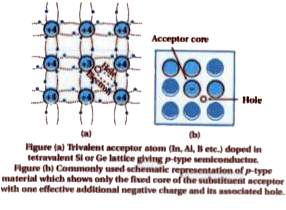
When a crystal of Si or Ge is formed, the trivalent atoms such as Al, B, In etc. are doped with small quantities in it, then the impurity atom is arranged in place of Si or Ge atom and the four Si or Ge atoms around it form a covalent bond with three atoms but fourth bond has an electron deficiency (absence or empty space), so that the hole is obtained, which is outlined in figure (a) and (b).

Since the holes has the property of attracting electrons, so the electron jump from nearest (neighbour) covalent bond in the crystal fills the hole so that the hole from which the electron is gone is now produced hole. Hence the p-type semiconductor gets a hole for conduction.
The trivalent foreign atom becomes effectively negatively charged when it shares fourth electron with neighbouring atom. Therefore, the dopant atom can be treated as core of a negative charge along with its associated hole as shown in figure (b).
Hence, one acceptor atom gives one hole. The total number of holes in the crystal is obtained in two ways. One from the number of impurity atoms which is much higher and second the release of electron from the bond of intrinsic semiconductors at room temperature creates hole whose number is very small.
Hence, in p-type semiconductor majority charge carriers is hole and minority charge carrier is electron.
The charge on hole is considered to be positive. From first letter of the word positive. This semiconductor is called p-type semiconductor.
`therefore` For p-type semiconductor `n_(e ) lt lt n_(h)`
where `n_(e )=` number of free electrons
`n_(h)=` number of hole
n-type or p-type semiconductor are electrically neutral. Because the charge of hole is the same as the charge (negative) at core of ionised atom and the opposite (positive) charge. Hence, charge on hole is positive. From first letter of the english word positive. This semiconductor is called p-type semiconductor.
Promotional Banner

Topper's Solved these Questions

  • SEMICONDUCTOR ELECTRONICS : MATERIALS, DEVICES AND SIMPLE CIRCUITS

    KUMAR PRAKASHAN|Exercise Section-B : Numericals (Numerical From Textual illustrations)|16 Videos
  • SEMICONDUCTOR ELECTRONICS : MATERIALS, DEVICES AND SIMPLE CIRCUITS

    KUMAR PRAKASHAN|Exercise Section-B : Numericals (Numerical From Textual Exercise)|15 Videos
  • SEMICONDUCTOR ELECTRONICS : MATERIALS, DEVICES AND SIMPLE CIRCUITS

    KUMAR PRAKASHAN|Exercise Section-D : Multiple Choice Questions (MCQs) (MCQs asked in Competitive Exams)|129 Videos
  • SAMPLE QUESTION PAPER

    KUMAR PRAKASHAN|Exercise PART-B SECTION-C|5 Videos
  • WAVE OPTICS

    KUMAR PRAKASHAN|Exercise SECTION-D (MULTIPLCE CHOICE QUESTIONS (MCQS)) (MCQS FROM DARPAN BASED ON TEXTBOOK)|239 Videos

Similar Questions

Explore conceptually related problems

What is n-type semiconductor? Name the majority and minority carriers in it.

A p-type semiconductor is

What is impure semiconductor?

n-type semiconductor ………

What are elementary semiconductors?

Explain n and p-type semiconductor based on band theory.

Seperated p-type semiconductor is electrically ………

KUMAR PRAKASHAN-SEMICONDUCTOR ELECTRONICS : MATERIALS, DEVICES AND SIMPLE CIRCUITS -Section-A : Questions - Answers
  1. Why is it required to add impurity in pure semiconductor? Mention it's...

    Text Solution

    |

  2. What is n-type semiconductor? Name the majority and minority carriers ...

    Text Solution

    |

  3. What is p-type semiconductor? Name the majority and minority carriers ...

    Text Solution

    |

  4. Explain n and p-type semiconductor based on band theory.

    Text Solution

    |

  5. Explain recombination coefficient of intrinsic semiconductor and obtai...

    Text Solution

    |

  6. Write four points in distinguishing between p-type semiconductor and n...

    Text Solution

    |

  7. Write the difference between intrinsic and extrinsic semiconductor.

    Text Solution

    |

  8. Which is the primary constitutional unit for diode and transistor?

    Text Solution

    |

  9. How p-n junction diode is formed ? And explain depletion layer and bar...

    Text Solution

    |

  10. What is depletion barrier?

    Text Solution

    |

  11. Write short on semiconductor diode.

    Text Solution

    |

  12. State the methods of connection of p-n junction.

    Text Solution

    |

  13. What is forward bias and reverse bias ?

    Text Solution

    |

  14. When is the p-n junction called reverse bias and explain the change in...

    Text Solution

    |

  15. What is static characteristic of p-n junction and write its types.

    Text Solution

    |

  16. Explain the forward characteristics of the p-n junction diode by drawi...

    Text Solution

    |

  17. Explain the reverse characteristics of p-n junction diode by circuit d...

    Text Solution

    |

  18. What is rectification and rectifier ? Why p-n junction diode is used a...

    Text Solution

    |

  19. Write the principle of rectifier.

    Text Solution

    |

  20. Explain the use of the junction diode as a half wave rectifier by draw...

    Text Solution

    |

