Home
Class 12
PHYSICS
Explain n and p-type semiconductor based...

Explain n and p-type semiconductor based on band theory.

Text Solution

Verified by Experts
In extrinsic semiconductor because of the abundance of majority current carriers the minority carriers produced thermally have more chance of meeting majority carriers and thus getting destroyed and indirectly helps to reduce the intrinsic concentration of minority carriers.
The semiconductor.s energy band structure is affected by doping. In extrinsic semiconductor, additional energy states due to donor impurities `E_(D)` and acceptor impurities `E_(A)` also exist.
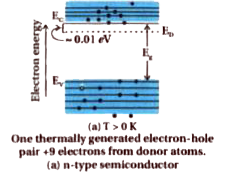
In n-type of Si semiconductor, the donor energy level `E_(D)` is slightly below the bottom `E_(C )` of the conduction band and electrons from this level move into the conduction band with very small of energy.
At room temperature most of donor atoms get ionised but very few `(~10^(12))` atoms of Si get ionised so the conduction band will have most electrons coming from the donor impurities as shown in figure (a).

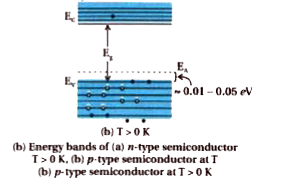
For p-type semiconductor the acceptor energy level `E_(A)` is slightly above the top `E_(V)` of the valence band. With very small supply of energy an electron from the valence band can jump to the level `E_(A)` and ionise the acceptor negatively.
In other words, with very small supply of energy the hole from level `E_(A)` sinks down into the valence band `E_(V)` and electron comes up. This is shown in figure (b).

At room temperature, most of the acceptor atoms get ionised leaving holes in the valence band `E_(V)`.
Thus, at room temperature the density of holes in the valence band is mostly due to impurity in the extrinsic semiconductor.
The above description is grossly approximate and hypothetical it helps in understanding the difference between metals, insulators and semiconductors (extrinsic and intrinsic) in a simple manner.
The energy difference between `E_(V)` and `E_(C )` for C (diamond) is 5.4 eV, for Si is 1.1 eV and for Ge it is 0.7 eV and Sn is also a group IV element but it is a metal because the energy gap in its case is 0 eV.
Promotional Banner

Topper's Solved these Questions

  • SEMICONDUCTOR ELECTRONICS : MATERIALS, DEVICES AND SIMPLE CIRCUITS

    KUMAR PRAKASHAN|Exercise Section-B : Numericals (Numerical From Textual illustrations)|16 Videos
  • SEMICONDUCTOR ELECTRONICS : MATERIALS, DEVICES AND SIMPLE CIRCUITS

    KUMAR PRAKASHAN|Exercise Section-B : Numericals (Numerical From Textual Exercise)|15 Videos
  • SEMICONDUCTOR ELECTRONICS : MATERIALS, DEVICES AND SIMPLE CIRCUITS

    KUMAR PRAKASHAN|Exercise Section-D : Multiple Choice Questions (MCQs) (MCQs asked in Competitive Exams)|129 Videos
  • SAMPLE QUESTION PAPER

    KUMAR PRAKASHAN|Exercise PART-B SECTION-C|5 Videos
  • WAVE OPTICS

    KUMAR PRAKASHAN|Exercise SECTION-D (MULTIPLCE CHOICE QUESTIONS (MCQS)) (MCQS FROM DARPAN BASED ON TEXTBOOK)|239 Videos

Similar Questions

Explore conceptually related problems

A p-type semiconductor is

n-type semiconductor ………

A hole in a p-type semiconductor is ……. in a covalent bond.

Write four points in distinguishing between p-type semiconductor and n-type semiconductor.

In semiconductor the valence band at 0 K is

……as a impurity, when added in Si or Ge P- type semiconductor is obtained.

KUMAR PRAKASHAN-SEMICONDUCTOR ELECTRONICS : MATERIALS, DEVICES AND SIMPLE CIRCUITS -Section-A : Questions - Answers
  1. What is n-type semiconductor? Name the majority and minority carriers ...

    Text Solution

    |

  2. What is p-type semiconductor? Name the majority and minority carriers ...

    Text Solution

    |

  3. Explain n and p-type semiconductor based on band theory.

    Text Solution

    |

  4. Explain recombination coefficient of intrinsic semiconductor and obtai...

    Text Solution

    |

  5. Write four points in distinguishing between p-type semiconductor and n...

    Text Solution

    |

  6. Write the difference between intrinsic and extrinsic semiconductor.

    Text Solution

    |

  7. Which is the primary constitutional unit for diode and transistor?

    Text Solution

    |

  8. How p-n junction diode is formed ? And explain depletion layer and bar...

    Text Solution

    |

  9. What is depletion barrier?

    Text Solution

    |

  10. Write short on semiconductor diode.

    Text Solution

    |

  11. State the methods of connection of p-n junction.

    Text Solution

    |

  12. What is forward bias and reverse bias ?

    Text Solution

    |

  13. When is the p-n junction called reverse bias and explain the change in...

    Text Solution

    |

  14. What is static characteristic of p-n junction and write its types.

    Text Solution

    |

  15. Explain the forward characteristics of the p-n junction diode by drawi...

    Text Solution

    |

  16. Explain the reverse characteristics of p-n junction diode by circuit d...

    Text Solution

    |

  17. What is rectification and rectifier ? Why p-n junction diode is used a...

    Text Solution

    |

  18. Write the principle of rectifier.

    Text Solution

    |

  19. Explain the use of the junction diode as a half wave rectifier by draw...

    Text Solution

    |

  20. Explain the use of junction diode as a full wave rectifier by drawing ...

    Text Solution

    |