A
B
C
D
Text Solution
Verified by Experts
The correct Answer is:
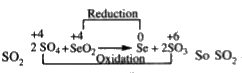 So `SO_(2)` act as reducing agent
 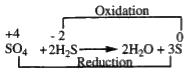 So `SO_(2)` act as oxidising agent


Topper's Solved these Questions
VIA GROUP ELEMENTS
AAKASH SERIES|Exercise PRACTICE SHEET - 2 (Linked Comprehension type questions)|6 VideosVIA GROUP ELEMENTS
AAKASH SERIES|Exercise PRACTICE SHEET - 2 (Match the following questions)|2 VideosVIA GROUP ELEMENTS
AAKASH SERIES|Exercise PRACTICE SHEET - 1 (Integer answer type Questions)|6 VideosVA GROUP ELEMENTS
AAKASH SERIES|Exercise PRACTICE EXERCISE|51 VideosVII GROUP ELEMENTS
AAKASH SERIES|Exercise OBJECTIVE EXERCISE -4|55 Videos
Similar Questions
Explore conceptually related problems
AAKASH SERIES-VIA GROUP ELEMENTS-PRACTICE SHEET - 2 (Single or more than one option questions)
- The product x in the following equation : 2KMnO(4) to K(2)MnO(4) +MnO(...
Text Solution
|
- The oxide which on strong heating evolves oxygen is :
Text Solution
|
- Non-metals combine with oxygen to form usually
Text Solution
|
- A black sulphide when treated with ozone becomes white. The white comp...
Text Solution
|
- Ozone readily dissolves in :
Text Solution
|
- Oxygen does not react with :
Text Solution
|
- Ozone turns benzidine paper :
Text Solution
|
- The number of S-S bonds in sulphur trioxide trimer S(3)O(9) is
Text Solution
|
- When SO(2) is passed through cupric chloride solution :
Text Solution
|
- Oxygen is ozonised until the partial pressures of both gases are same....
Text Solution
|
- At T(K), 100 L of dry oxygen is present in a sealed container. It is s...
Text Solution
|
- In the bleaching action of SO(2)
Text Solution
|
- Which of the following does not have P pi-d pi bonding
Text Solution
|
- In gamma-form of SO(3), the hybridisation of sulphur is
Text Solution
|
- The sulphur oxide SO(2), can acts as
Text Solution
|
- sp^(2) - Hybridisation is involved in the molecule of
Text Solution
|