Home
Class 11
PHYSICS
particles of masses 2M m and M are resec...

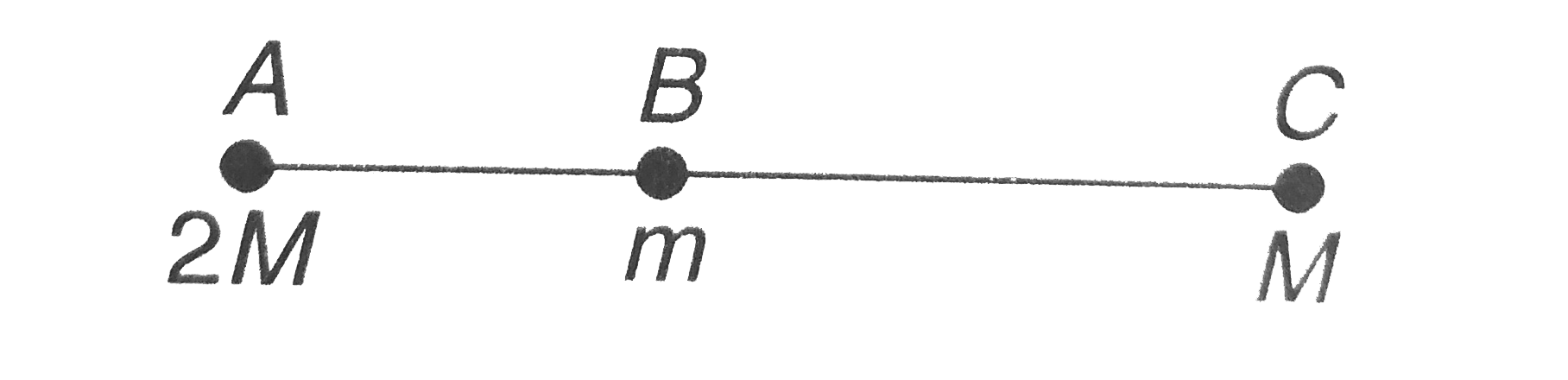
particles of masses 2M m and M are resectively at points A , B and C with ` AB = (1)/(2) (BC)` m is much - much smaller than M and at time ` t=0` they are all at rest as given in figure . As subsequent times before any collision takes palce .

A

`m` will remain at rest

B

`m` will move towards M

C

`m` will move towards 2M

D

`m` will have oscillatory motion

Text Solution

Verified by Experts

The correct Answer is:

C

Force on B due to `A = F_(BA) = (G(2Mm))/((AB)^(2))` towards BA
Force on B due to `C = F_(BC) = (GMm)/((BC)^(2))` towards BC
As, `(BC) = 2AB`
`rArr F_(BC) = (GMm)/((2AB)^(2)) = (GMm)/(4(AB)^(2)) le F_(BA)`
Hence, `m` will move towards BA (i.e., 2M)
Promotional Banner

Topper's Solved these Questions

  • GRAVITATION

    NCERT EXEMPLAR ENGLISH|Exercise Very short Answer type question|11 Videos
  • GRAVITATION

    NCERT EXEMPLAR ENGLISH|Exercise Short Answer type question|6 Videos
  • KINETIC THEORY

    NCERT EXEMPLAR ENGLISH|Exercise Multiple Choice Questions (MCQs)|31 Videos

Similar Questions

Explore conceptually related problems

Particles of masses 2M, m and M are respectively at points A, B and C with sqrt((GM)/(R))(sqrt(2)+1) is much-much smaller than M and at time t=0 , they are all at rest as given in figure At subsequent time before any collision takes place.

Two particle of masses m and 2m are coliding elastically as given in figure. If V_(1) and V_(2) speed of particle just after collision then

A particle A of mass m initially at rest slides down a height of 1.25 m on a frictionless ramp, collides with and sticks to an identical particles B of mass m at rest as shown in the figure. Then, particles A and B together collide elastically with particle G of mass 2m at rest. The speed of particle G after the collision with combined body (A+B) would be (Take, g =10 ms^(-2))

consider a head on collision between two particles of masses m_1 and m_2 . The initial speeds of the particles are u_1 and u_2 in the same direction. The collision starts at t=0 and the particles interact for a time interval /_\t. during the collision the speed of the first particle varies as v(t)=u_1+t//_\ t(v_1-u_1) Find the speed of the second particle as as function of time during the collision.

Two particles of masses m_(1) and m_(2) and velocities u_(1) and alphau_(1)(alpha!=0) make an elastic head on collision. If the initial kinetic energies of the two particles are equal and m_(1) comes to rest after collision, then

A particle of mass m collides elastically with the pan of mass (M = 2m) of a spring balance, as shown in figure. Pan is in equillibrium before collision. Spring constant is k and speed of the particle before collision is v_(0) . Answer the following three questions regarding this collision. Minimum kinetic energy of the particle after collision is

A particle of mass m collides elastically with the pan of mass (M = 2m) of a spring balance, as shown in figure. Pan is in equillibrium before collision. Spring constant is k and speed of the particle before collision is v_(0) . Answer the following three questions regarding this collision. Maximum compression in the spring after the collision the

At time t=0 , a particle is at (-1m, 2m) and at t=2s it is at (-4m,6m) . From this we can conclude that in the given time interval.

Two particles A and B are revolving with constant angular velocity on two concentric circles of radius 1m and 2m respectively as shown in figure. The positions of the particles at t = 0 are shown in figure. The positions of the particles at t=0 are shown in figure. if m_(A)=2kg, m_(B)= 1kg and vec(P)_(A) and vec(P)_(B) are linear momentum of the particle then what is the maximum value of |vec(P)_(A)+vec(P)_(B)| in kg-m/sec in subsequent motion of two particles.

Two particles of masses m_(1) and m_(2) in projectile motion have velocities vec(v)_(1) and vec(v)_(2) , respectively , at time t = 0 . They collide at time t_(0) . Their velocities become vec(v')_(1) and vec(v')_(2) at time 2 t_(0) while still moving in air. The value of |(m_(1) vec(v')_(1) + m_(2) vec(v')_(2)) - (m_(1) vec(v)_(1) + m_(2) vec(v)_(2))|
