

Home
Class 11
CHEMISTRY
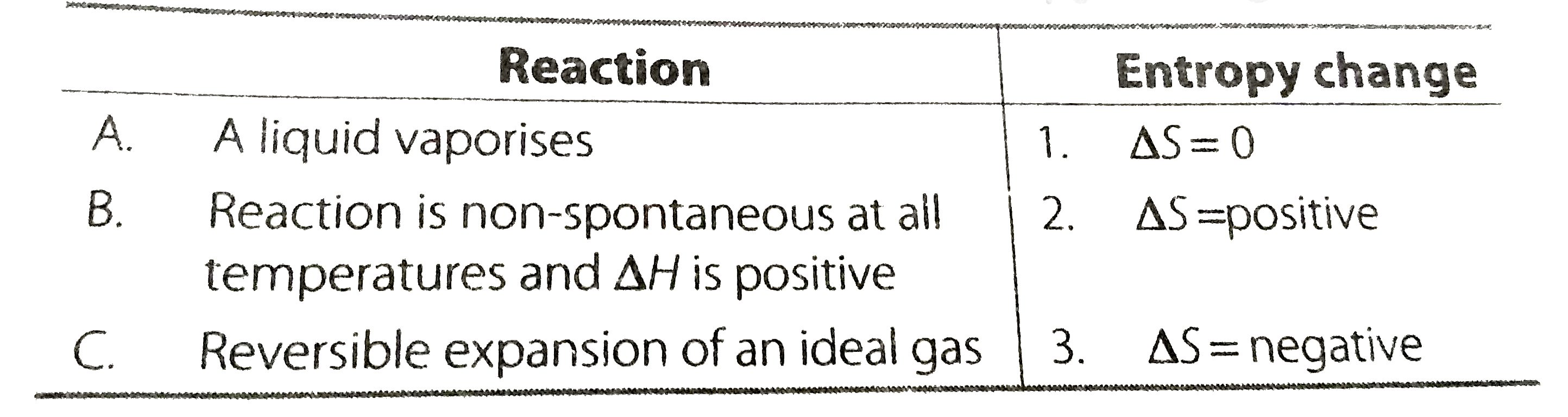
Match the following processes with entro...

Match the following processes with entropy change

Text Solution

Verified by Experts

The correct Answer is:
`A rarr (2), B rarr (3) C rarr (1)`

A. When a liquid vaporises, i.e., liquid `rarr` vapour, entropy increase i.e., `Delta S` = positive
B. When `Delta H =` positive, i.e., energy factor opposes. The process is non-spontaneous at all temperature if entropy factor also opposes the oposes the process, i.e., `Delta S =` negative.
C. In the reversible expansion of an ideal gas, the system remains in equilibrium at every stage. Hence `Delta S = 0`
Promotional Banner

Topper's Solved these Questions

  • THE S-BLOCK ELEMENTS

    NCERT EXEMPLAR ENGLISH|Exercise Long Answer Type Questions|8 Videos

Similar Questions

Explore conceptually related problems

For which of the following processes, entropy change is negative?

Enthalpy change in the following process is A+ e^(-) to A^(-) Delta H= - X kJ//"mole" Which of the following processes has enthalpy change=X kJ/mole ?

Which of the following expression for entropy change of an irreversible process ?

Assertion : If both DeltaH^(@) and DeltaS^(@) are positive then reaction will be spontaneous at high temperature. Reason : All processes with positive entropy change are spontaneous.

The process with negative entropy change is

In which of the following changes does entropy decrease ?

In which of the following change entropy decreases?

Classify the following processes as exothermic or endothermic. Burning of match stick

For the reaction I_(2(g)) hArr I_(2(s)), Delta H= -ve . Then choose the correct statement from the following (A) The process is spontaneous at all temperature (B) The process is accompained by an increase in entropy (C ) The process is accompained by a decrease in entropy (D) The process is accompained by a decrease in enthalpy

The process of evaporation of a liquid is accompanied by: increase in enthalpy decrease in entropy no change in free energy increase in entropy.

NCERT EXEMPLAR ENGLISH-THERMODYNAMICS-Multiple choice questions
  1. The enthalpy of vaporisation of C Cl(4) is 30.5 kJ mol^(-1). Calculate...

    Text Solution

    |

  2. The enthalpy of reaction for the reaction 2H(2) (g) + O(2) (g) rarr ...

    Text Solution

    |

  3. What will be the work done on an ideal gas enclosed in a cyliner, when...

    Text Solution

    |

  4. How will you calculate work done on an ideal gas in a compression, whe...

    Text Solution

    |

  5. Represent the potential energy/enthalpy change in the following proces...

    Text Solution

    |

  6. Enthalpy diagram for a particular reaction is given in figure. Is it p...

    Text Solution

    |

  7. 1.0 mol of a monoatomic ideal gas is expanded from state (1) to state ...

    Text Solution

    |

  8. An ideal gas is allowed to expand against a constant pressure of 2 bar...

    Text Solution

    |

  9. Match the following

    Text Solution

    |

  10. Match the following processes with entropy change

    Text Solution

    |

  11. Match the following parameters with description for spontaneity

    Text Solution

    |

  12. Match the following

    Text Solution

    |

  13. Assertion (A). Combustion of all organic compounds is an exothermic re...

    Text Solution

    |

  14. Assertion (A). Spontaneous process is an irreversible process and may ...

    Text Solution

    |

  15. Assertion (A). A liquid crystallises into a solid and is accompanied b...

    Text Solution

    |

  16. Derive the relationship between Delta H " and " Delta U for an ideal g...

    Text Solution

    |

  17. Extensive properties depends on the quantity of matter but intensive p...

    Text Solution

    |

  18. The lattice enthalpy of an ionic compound is the enthalpy when one mol...

    Text Solution

    |

  19. Delta G is energy availabe to do useful work and is thus a meaure of "...

    Text Solution

    |

  20. Graphically show the total work done in an expansion when the state of...

    Text Solution

    |