Home
Class 11
BIOLOGY
If you are provided with two tubes (A an...

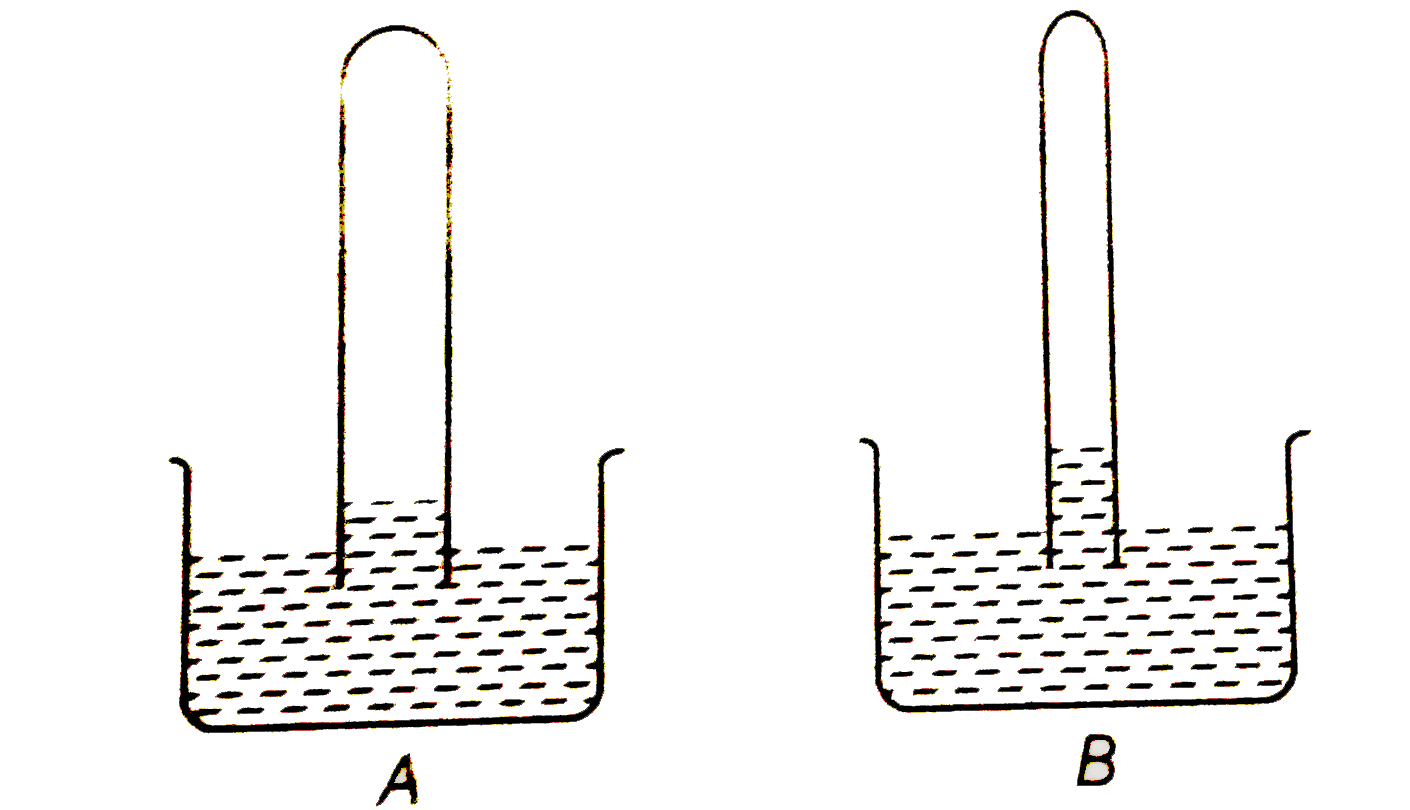
If you are provided with two tubes (A and B), where one is narrow and the other is relatively wider and if both are immersed in a beaker containing water as shown in the figure.

Why does B show higher water rise than A ?

Text Solution

Verified by Experts

The tube B will show higher level than tube A because of the capillary action.
Promotional Banner

Topper's Solved these Questions

  • TRANSPORT IN PLANTS

    NCERT EXEMPLAR ENGLISH|Exercise Long Answer Type Questions|7 Videos
  • TRANSPORT IN PLANTS

    NCERT EXEMPLAR ENGLISH|Exercise Very Short Answer Type Questions|23 Videos
  • THE LIVING WORLD

    NCERT EXEMPLAR ENGLISH|Exercise Long Answer Type Questions|10 Videos

Similar Questions

Explore conceptually related problems

Two coils of wires A and B are mutually at right angles to each other as shown in the figure. If the current in one coil is changed, then in the other coil

A light cylindrical tube 'T' of length l and radius 'r' containing air is inverted in water (density d). One end of the tube is open and the other is closed A block 'B' of density 2d is kept on the tube as shown in the figure. The tube stays in equilibrium in the position shown. (Assume the atmosphere pressure is to be P_(0) ) Assume that density of air is very small than density of block and water. Pick up the correct statement (s)

You are provided with three test tubes A, B and C which contain distilled water, acidic solution and basic solution respectively. If you are given blue litmus paper only, how will you identify the contents of each test tube ?

A glass U-tube is such that the diameter of one limb is 3.0mm and that of the other is 6.0mm. The tube is inverted vertically with the open ends below the surface of water in a beaker. What is the difference between the height to which water rises in the two limbs? Surface tension of water is 0.07Nm^(-1) . Assume that the angle of contact between water and glass is 0^(@) .

two glass bulbs of equal volume are connected by a narrow tube and are filled with a gas at 0(@)C at a pressure of 76cm of mercury. One of the bulbs is then placed in melting ice and the other is placed in a water bath maintained at 62^(@)C .What is the new value of the pressure inside the bulbs? The volume of the connecting tube is neigligible.

You have been provided with three test tubes. One of them contains distilled water and the other two contain an acidic solution and a basic solution, respectively. If you are given only red litmus paper, how will you identify the contents of each test tube?

Two containers A and B are partly filled with water and closed. The volume of A is twice that of B and it contains half the amount of water in B. If both are at the same temperature, the water vapour in the containers will have pressure in the ratio of

Two identical tubes A and B are kept in air and water respetively as shown. If the fundamental frequency of A is f_(0) , then thr fundamental frequency of B is

A beaker is filled with water as shown in figure (a). The bottom surface of the beaker is a concave mirror of large radius of curvature and small aperture. The height of water is h = 40 cm . It is found that when an object is placed 4 cm above the water surface, the image coincides with the object. Now the water level h is reduced to zero but there will still be some water left in the concave part of the mirror as shown in figure (b). The new height of the object h' above the new water surface so that the image again coincides with the object, will be (Refractive index of water = 4//3 )

A narrow capillary tube when dipped in beaker containing water, the rise is 20 cm . If the area of cross section of the bore is reduced to (1//4)^(th) calue , water will rise to a height of

NCERT EXEMPLAR ENGLISH-TRANSPORT IN PLANTS-Short Answer Type Questions
  1. How is it that the intracellular level of K^(+) are higher than extrac...

    Text Solution

    |

  2. Cut pieces of beetroot do not leave the colour in cold water but do so...

    Text Solution

    |

  3. In a girdled plant, when water is supplied to the leaves above the gir...

    Text Solution

    |

  4. Varous types of transport mechanisms are needed to fulfil the mineral ...

    Text Solution

    |

  5. How can plants be grown in limited water supply without compromising o...

    Text Solution

    |

  6. Will the ascent of sap be possible without the cohesion and adhesion o...

    Text Solution

    |

  7. Keep some freshly cut flowers in a solution of food colour. Wait for s...

    Text Solution

    |

  8. When a freshly collected Spirogyra filament is kept in a 10 % potassiu...

    Text Solution

    |

  9. Sugar crystals do not dissolve easily in ice cold water. Explain.

    Text Solution

    |

  10. Salt is applied to tennis lawns to kill weeds. How does salting tennis...

    Text Solution

    |

  11. What is the chemical composition of of xylem and phloem sap ?

    Text Solution

    |

  12. If you are provided with two tubes (A and B), where one is narrow and ...

    Text Solution

    |

  13. What are 'aquaporins' ? How does presence of aquaporins affect osmosis...

    Text Solution

    |

  14. ABA (Abscisic Acid) is called a stress hormone. A. How this hormone ...

    Text Solution

    |

  15. We know that plants are harmed by excess water. But plants survive und...

    Text Solution

    |

  16. Differentiate between diffusion and translocation in plants.

    Text Solution

    |

  17. How is fcilitated diffusion different from diffusion ?

    Text Solution

    |

  18. Explain the mass flow hypothesis of transport in phloem.

    Text Solution

    |

  19. Observe the diagram and answer the following. (a) Are these types...

    Text Solution

    |

  20. Define uniport, symport and antiport. Do they require energy ?

    Text Solution

    |
