Home
Class 10
PHYSICS
Which of the following can make a paral...

Which of the following can make a parallel beam of light from a point source is incident on it ?

A

Concave mirror as well as convex lens

B

Convex mirror as well as concave lens

C

Two plane mirrors placed at `90^(@)`C to each other

D

Concave mirror as well as concave lens

Text Solution

Verified by Experts

The correct Answer is:
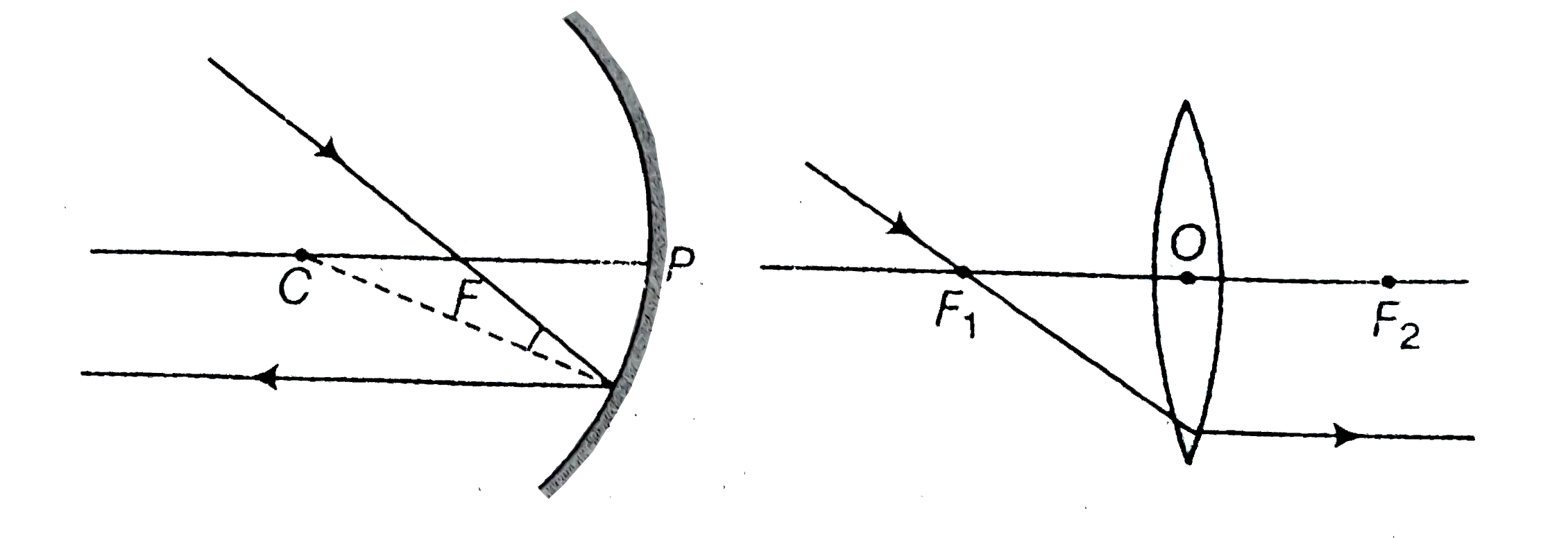
A

A ray passing through the principal focus of a concave mirror or concex lens, after reflection/refraction, will emerge parallel to the principal axis.
Promotional Banner

Topper's Solved these Questions

  • LIGHT : REFLECTION AND REFRACTION

    NCERT EXEMPLAR ENGLISH|Exercise Short Answer Type Questions|10 Videos
  • LIGHT : REFLECTION AND REFRACTION

    NCERT EXEMPLAR ENGLISH|Exercise Long Answer Type Questions|9 Videos
  • ELECTRICITY

    NCERT EXEMPLAR ENGLISH|Exercise Short Answer Type Questions|17 Videos
  • MAGNETIC EFFECTS OF ELECTRIC CURRENT

    NCERT EXEMPLAR ENGLISH|Exercise LONG ANSWER TYPE QUESTIONS|8 Videos

Similar Questions

Explore conceptually related problems

Which of the following is correct for light diverging from a point source ?

For light diverging from a point source

A convex lens of focal length 1.0m and a concave lens of focal length 0.25m are 0.75m apart. A parallel beam of light is incident on the convex lens. The beam emerging after refraction from both lenses is

A concave mirror is used as a reflector in torches, head lights of automobiles etc, to obtain a parallel beam of light. State the position of the source of light on the principal axis to obtain the parallel beam.

In a dark room, a parallel beam of light falls on a plane mirror and another parallel beam of light falls on a white wall. The light reflected by the mirror can be seen only in a certain direction, but the reflected light from the wall can be seen from anywhere. Give reason.

A parallel beam of light falls on a solid tranparent sphere. Q. Which is corret?

A convex lens of focal length 20cm and a concave lens of focal length f are mounted coaxially 5cm apart. Parallel beam of light incident on the convex lens emerges from the concave lens as a parallel beam. Then, f in cm is

In the figure shown a converging lens and a diverging lens of focal lengths 20cm and -5cm respectively are separated by a distance such that a paralel beam of light of intensity 100 watt//m^(2) incident on the converging lens comes out as parallel beam from the diverging lens. Find the intensity of the outgoing beam in watt//m^(2)

L is a lens such that a parallel beam of light I ncident on it, after refraction, converges to a point at a distance x from it and M is a mirror such that a parallel lbeam of light incident on it, after reflection, converges to a point at a distance y from it. Now the lens L and mirror M are placed at a distan 2(x+y) from each other. An object of size 2 cm is kept infront of lens at a distance 2x from it. Find the nature, position , and size of the image that willl be seen by an observer looking toward the mirror through the lens.

A prism is made of glass of unknown refractive index. A parallel beam of light is incident on a face of the prism. By rotating the prism, the minimum angle of deviation is measured to be 40^@ . What is the refractive index of the prism ? If the prism is placed in water (mu = 1.33) , predict the new angle of minimum deviation of the parallel beam. The refracting angle of prism is 60^@ .

