Home
Class 10
PHYSICS
Beams of light are incident through the ...

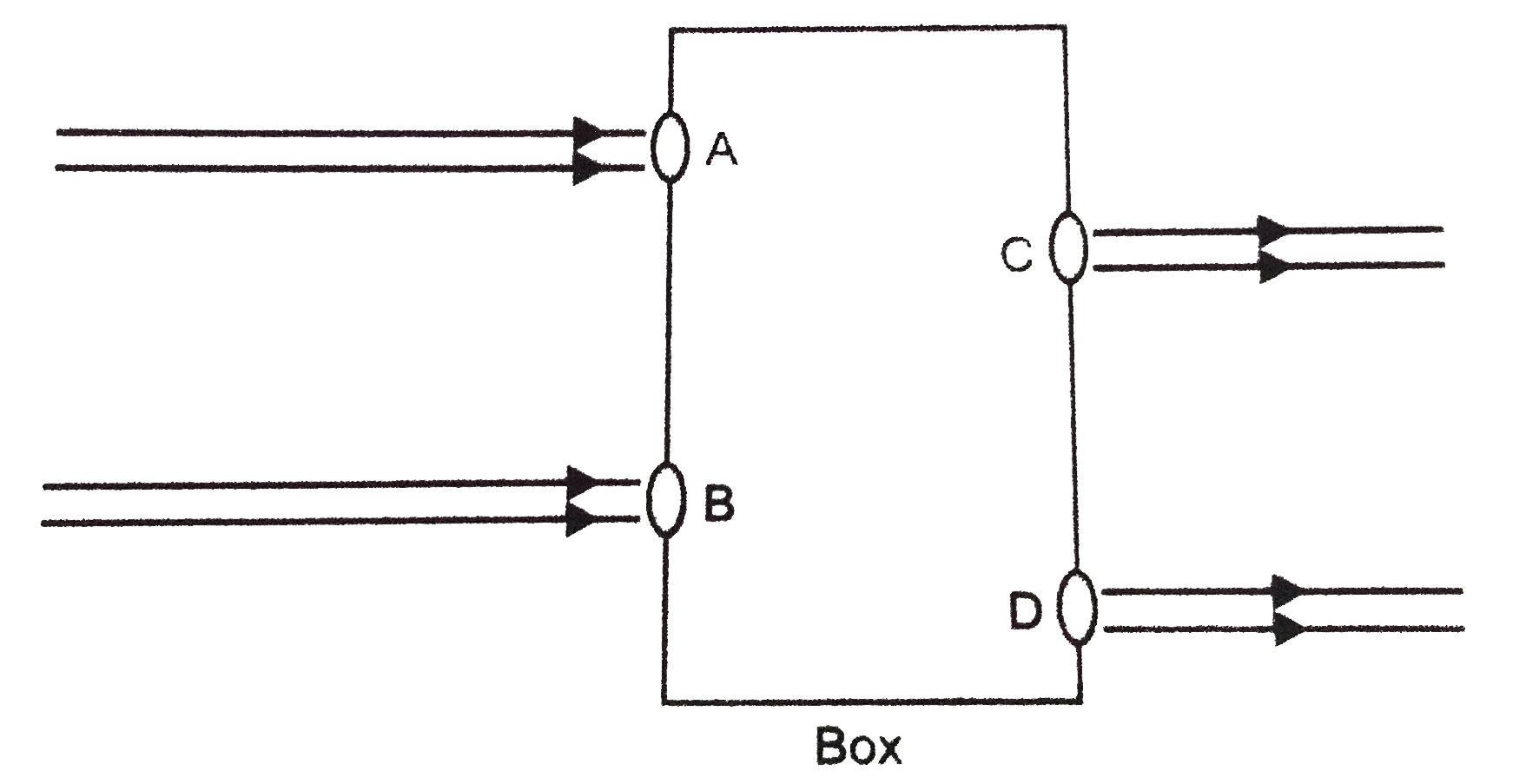
Beams of light are incident through the holes A and B and emerge out of box through the holes C and D respectively as shown in Figure. Which of the following could be inside the box ?

A

A rectangular glass slab

B

A convex lens

C

A concave lens

D

A prism

Text Solution

Verified by Experts

The correct Answer is:

A

Here, the emergent rays are parallel to the direction of the incident ray. Therefore, a rectangular glass slab could be inside toe box as the extent of bending of light ray at the opposite parallel faces AB (air-glass interface) and CD (glass-air interface) of the rectangular glass slab are equal and opposite. This is why the ray emerges parallel to the incident ray.
Promotional Banner

Topper's Solved these Questions

  • LIGHT : REFLECTION AND REFRACTION

    NCERT EXEMPLAR ENGLISH|Exercise Short Answer Type Questions|10 Videos
  • LIGHT : REFLECTION AND REFRACTION

    NCERT EXEMPLAR ENGLISH|Exercise Long Answer Type Questions|9 Videos
  • ELECTRICITY

    NCERT EXEMPLAR ENGLISH|Exercise Short Answer Type Questions|17 Videos
  • MAGNETIC EFFECTS OF ELECTRIC CURRENT

    NCERT EXEMPLAR ENGLISH|Exercise LONG ANSWER TYPE QUESTIONS|8 Videos

Similar Questions

Explore conceptually related problems

A beam of light is incident through the holes on side A and emerges out of the holes on the other face of the box as shown in Figure. Which of the following could be inside the box ?

A ray of light is incident in situation as shown in figure. Which of the following statements is//are true?

Figure shows wavefront P Passing through two systems A and B, and emerging as Q and then as R. Then systems A and B could, respectively, be

A long, straight wire, carrying a current 200A, runs through a cubical wooden box, entering and leaving through holes in the centre of opposite faces (as shown in Fig). The length of each side of the box is 20 cm. Consider an element dl,0.100 cm long of the wire at the centre of the box. Compute the magnitude dB of the magnetic field produced by this element at the point a, b,c,d and e as shown fig. Points a,c, and dare at the centres of the faces of the cube, point b is at the midpoint of one edge, and point e is at a corner. Copy the figure and show the direction and relative magnitudes of field vectors.

Careful measurement of the electric field at the surface of a black box indicates that the net outward flux through the surface of the box is 8.0xx10^(3) Nm^(2)//C (a) what is the net charge inside the box ? (b) If the net outward flux through the surface of the box were zero, could you conclude that there were no charges inside the box ? Why or why not?

Two beams of light are incident normally on water (R.l. = 4/3 ). If the beam 1 passes through a glass (R.l. = 3/2 ) slab of height h as shown in the figure, the time difference for both beams for reaching the bottom is

In the circuit diagram shown in Figure , the potentials of the points B, C and D are respectively -

A closed current carrying circular loop is placed on one face of a cubical box as shown in fig. The magnetic flux through area of the box contained by the loop is phi_1 and the magnetic flux through remaining surface area of the box is phi_2 . Which of the following option is correct

A large , heavy box is sliding without friction down a smooth plane of inclination theta . From a point P on the bottom of the box , a particle is projected inside the box . The initial speed of the particle with respect to the box is u , and the direction of projection makes an angle alpha with the bottom as shown in Figure . Find the distance along the bottom of the box between the point of projection p and the point Q where the particle lands . ( Assume that the particle does not hit any other surface of the box . Neglect air resistance .

A large , heavy box is sliding without friction down a smooth plane of inclination theta . From a point P on the bottom of the box , a particle is projected inside the box . The initial speed of the particle with respect to the box is u , and the direction of projection makes an angle alpha with the bottom as shown in Figure . (a) Find the distance along the bottom of the box between the point of projection p and the point Q where the particle lands . ( Assume that the particle does not hit any other surface of the box . Neglect air resistance .) (b) If the horizontal displacement of the particle as seen by an observer on the ground is zero , find the speed of the box with respect to the ground at the instant when particle was projected .
