Home
Class 10
PHYSICS
Why does a light ray incident on a recta...

Why does a light ray incident on a rectangular glass slab immersed in any medium emerges parallel to itself ? Explain using a diagram.

Text Solution

Verified by Experts
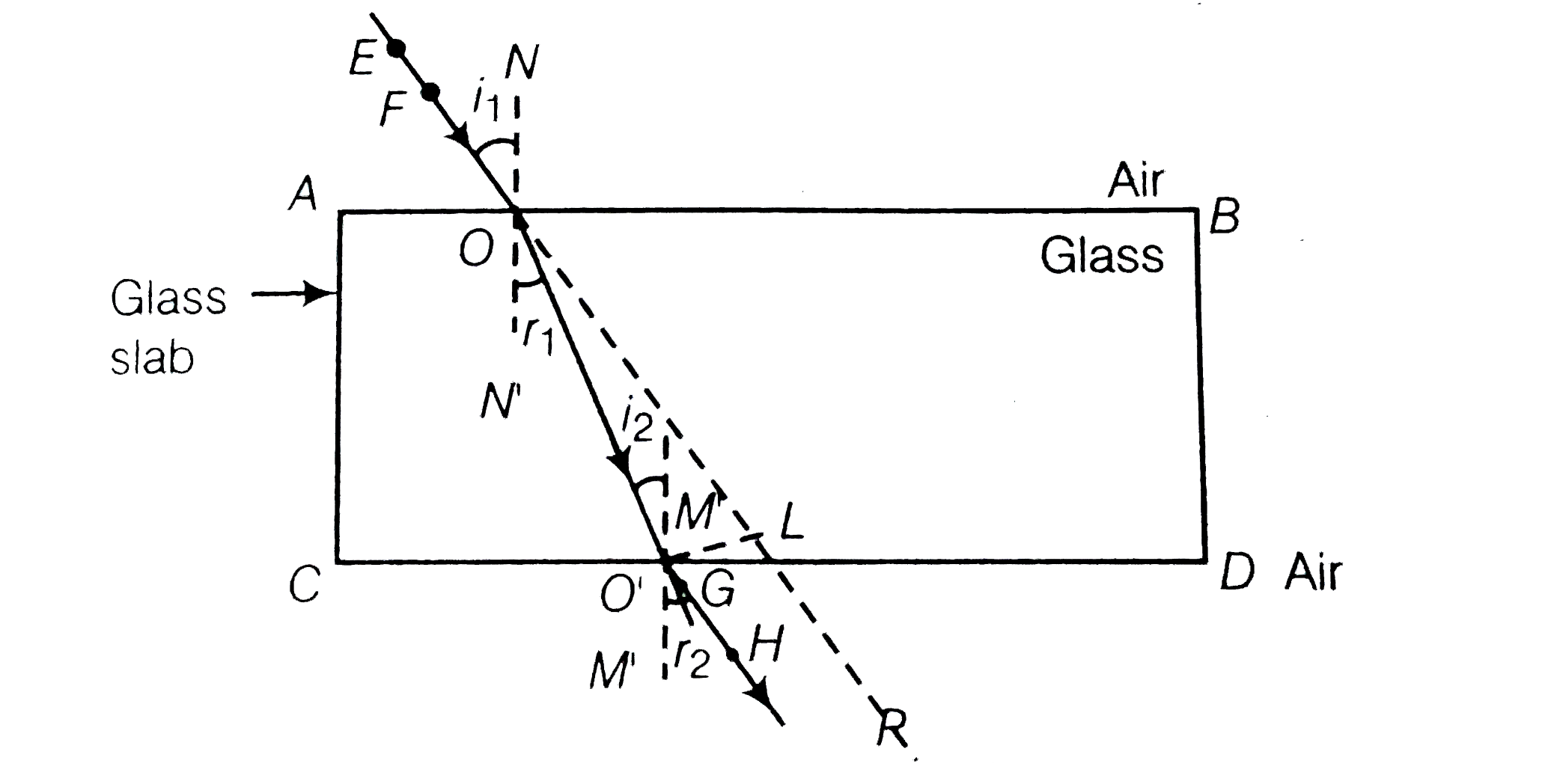
In the given figure, EO is the incident ray, OO' is the refracted ray and O'H is the emergent ray.

The extent of bending of the ray of light at the opposite parallel faces AB (air-glass interface) and CD (glass-air interface) of the rectangular glass slab is equal and opposite. This is why the ray emerges parallel to the incident ray on a rectangular glass slab. However, the light ray is shifted sideward slightly. When glass slab in immersed in any medium the interface AB (medium-glass) and CD glass medium are equal and apposite so, the emergent ray will always be parallel to the incident ray.
Promotional Banner

Topper's Solved these Questions

  • LIGHT : REFLECTION AND REFRACTION

    NCERT EXEMPLAR ENGLISH|Exercise Long Answer Type Questions|9 Videos
  • LIGHT : REFLECTION AND REFRACTION

    NCERT EXEMPLAR ENGLISH|Exercise Long Answer Type Questions|9 Videos
  • ELECTRICITY

    NCERT EXEMPLAR ENGLISH|Exercise Short Answer Type Questions|17 Videos
  • MAGNETIC EFFECTS OF ELECTRIC CURRENT

    NCERT EXEMPLAR ENGLISH|Exercise LONG ANSWER TYPE QUESTIONS|8 Videos

Similar Questions

Explore conceptually related problems

A ray of light incident on glass slab finally emerges out of it. The ray which emerges out is called :

A ray of light incident on an equilateral triangular glass prism of mu = sqrt(3) moves parallel to the base of the prism inside it. What is the angle of incidence for this ray ?

A rays of light is incident on a thick slab of glass of thickness t as shown in figure. The emergent ray is parallel to the incident ray but displaced sideways by a distance d. If the angles are small then d is

In the adjacent diagram, AO is a ray of light incident on a rectangular glass slab. (a) Complete the path of the ray till it emerges out of the slab. (b) In the diagram, mark the angle of incidence (i) and the angle of refraction (r) at the first interface. how is the refractive index of glass related to the angles i and r ? (c) Mark angle of emergence by the letter e. how are the angles i and e related ? (d) Which two rays are parallel to each other ? Name them (e) Indicate in the diagram the lateral displacement between the emergent ray and the incident ray. state one factor that affects the lateral displacement.

A ray of monochromatic light is incident from air on a glass slab. Name the two rays that are parallel to each other.

In the diagram below, PQ is a ray of light incident on a rectangular glass block. Copy the diagram and complete the path of the ray of light through the glass block. In your diagram, mark the angle of incidence by letter 'i' and the angle of emergence by the letter 'e'.

A beam of light composed of red and green ray is incident obliquely at a point on the face of rectangular glass slab. When coming out on the opposite parallel face, the red and green ray emerge form

A light ray is incident on a glass slab, it is partially reflected and partially transmitted. Then the reflected ray is

A ray of light is incident at the glass-water interface at an angle i it emerges finnaly parallel to the surface of water, then the value of mu_(g) would be

A ray of light falls normally on a rectangular glass slab. Draw a ray diagram showing the path of the ray till it emerges out of the slab.

