Home
Class 12
CHEMISTRY
Which of the following will not undergo ...

Which of the following will not undergo aldol condensation ?

A

`CH_(3)-CHO`

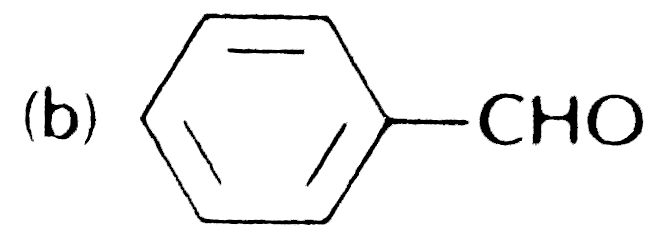
B

C

`CH_(3)-overset(O)overset(||)C-CH_(3)`

D

`CH_(3)-overset(CH_(3))overset(|)underset(CH_(3))underset(|)C-CHO`

Text Solution

AI Generated Solution

The correct Answer is:

To determine which of the given compounds will not undergo aldol condensation, we need to understand the requirement for this reaction. Aldol condensation requires the presence of at least one alpha hydrogen atom attached to the carbon adjacent to the carbonyl group. Let's analyze each option step by step: ### Step 1: Identify the Compounds The given options are: 1. **A**: CH3CHO (Acetaldehyde) 2. **B**: C6H5CHO (Benzaldehyde) 3. **C**: CH3COCH3 (Acetone) 4. **D**: (CH3)2C(CHO) (Tertiary butyl aldehyde) ### Step 2: Analyze Each Compound for Alpha Hydrogen - **Option A: CH3CHO (Acetaldehyde)** - The carbonyl carbon is attached to a methyl group (CH3), which has three alpha hydrogens. - **Conclusion**: It can undergo aldol condensation. - **Option B: C6H5CHO (Benzaldehyde)** - The carbonyl carbon is attached to a phenyl group (C6H5), which does not have any alpha hydrogens because the carbon is fully bonded (4 bonds) with no hydrogens left. - **Conclusion**: It cannot undergo aldol condensation. - **Option C: CH3COCH3 (Acetone)** - The carbonyl carbon is attached to two methyl groups (CH3), each having three alpha hydrogens. - **Conclusion**: It can undergo aldol condensation. - **Option D: (CH3)2C(CHO) (Tertiary butyl aldehyde)** - The carbonyl carbon is attached to two methyl groups and one aldehyde group. The alpha carbon (the one adjacent to the carbonyl) has no hydrogen atoms because it is fully bonded. - **Conclusion**: It cannot undergo aldol condensation. ### Step 3: Final Conclusion From the analysis, we find: - **Option B (Benzaldehyde)** does not have any alpha hydrogen and cannot undergo aldol condensation. - **Option D (Tertiary butyl aldehyde)** also does not have any alpha hydrogen and cannot undergo aldol condensation. Thus, the compounds that will not undergo aldol condensation are **B and D**.

To determine which of the given compounds will not undergo aldol condensation, we need to understand the requirement for this reaction. Aldol condensation requires the presence of at least one alpha hydrogen atom attached to the carbon adjacent to the carbonyl group. Let's analyze each option step by step: ### Step 1: Identify the Compounds The given options are: 1. **A**: CH3CHO (Acetaldehyde) 2. **B**: C6H5CHO (Benzaldehyde) ...
Promotional Banner

Topper's Solved these Questions

  • ALDEHYDE, KETONES AND CARBOXYLIC ACIDS

    NCERT EXEMPLAR ENGLISH|Exercise Short Answer Type Questions|28 Videos
  • ALDEHYDE, KETONES AND CARBOXYLIC ACIDS

    NCERT EXEMPLAR ENGLISH|Exercise Long Answer Type Questions|4 Videos
  • ALCOHOLS, PHENOLS AND ETHERS

    NCERT EXEMPLAR ENGLISH|Exercise All Questions|74 Videos
  • AMINES

    NCERT EXEMPLAR ENGLISH|Exercise LONG ANSWER|3 Videos

Similar Questions

Explore conceptually related problems

Which of the following will undergo aldol condensation ?

Which of the following will not give aldol condensation ?

Which of the following would undergo Aldol condensation ?
