Home
Class 12
CHEMISTRY
tert-Butylbromide reacts with aq. NaOH b...

tert-Butylbromide reacts with aq. NaOH by `S_(N)1` mechanism while n-butylbromide reacts by `S_(N)2` mechanism. Why?

Text Solution

Verified by Experts
Tert. butyl bromide reacts with aq. NaOH as follows
`underset((3^(@) " alkyl halide"))underset("tert Butylbromide")(H_(3)C-underset(CH_(3))underset(|)overset(CH_(3))overset(|)C-Br)overset(S_(N)1)tounderset(("more stable"))underset(3^(@)"carbocation")(H_(3)C-underset(CH_(3))underset(|)overset(CH_(3))overset(|)(C^(+))+Br^(-))`
`H_(3)C-underset(CH_(3))underset(|)overset(CH_(3))overset(|)(C^(+))+OH^(-)toH_(3)C-underset(CH_(3))underset(|)overset(CH_(3))overset(|)C-OH`
tert. butyl bromide when treated with aq. NaOH, it forms tert. corbocation which is more stable intermediate. This intermediate is further attacked by `""^(-)OH` ion.
As tert. carbocation is highly stable so tert butylbromide follow `S_(N)1` mechanism.
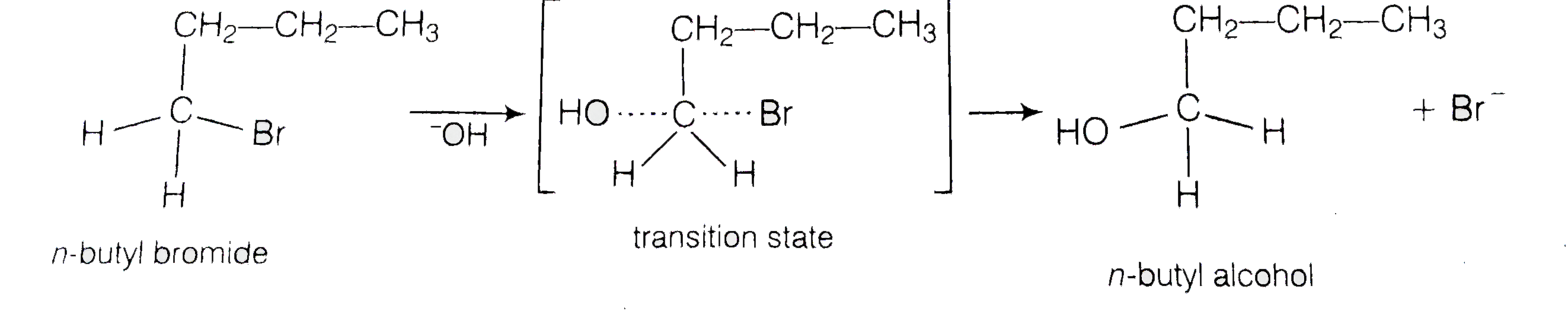
In case of n-nutylbromide,primary carbocation is formed which is least stable so, it does not follow `S_(N)1` mechanism. Here, stearic hindrance is very less so, it follow `S_(N)2` mechanism. In `S_(N)2` mechanism, `""^(-)OH` will attack from backside and a transition state is formed.
The leaving group is then pushed off the eopposite side and the product is formed,
Promotional Banner

Topper's Solved these Questions

  • HALOALKANES AND HALOARENES

    NCERT EXEMPLAR ENGLISH|Exercise Match Type Questions|6 Videos
  • HALOALKANES AND HALOARENES

    NCERT EXEMPLAR ENGLISH|Exercise Assertion & Reason|10 Videos
  • HALOALKANES AND HALOARENES

    NCERT EXEMPLAR ENGLISH|Exercise MCQs (More than one option)|12 Videos
  • GENERAL PRINCIPLE AND PROCESSES OF ISOLATION OF ELEMENTS

    NCERT EXEMPLAR ENGLISH|Exercise Long Answer Type Questions|1 Videos
  • P-BLOCK ELEMENTS

    NCERT EXEMPLAR ENGLISH|Exercise Long Answer Type Questions|3 Videos

Similar Questions

Explore conceptually related problems

For S_(N)1 mechanism which of the following is correct ?

The order of reactivity of halides towards S_(N) 1 mechanism is

Which of the following reaction follows S_N1 mechanism ?

Assertion: Bromoacetic acid reacts with conc. NaOH to form alpha -ethoxy acetic acid. Reason: It is S_(N)1 mechanism.

Which of the following is least reactive towards S_(N) 2 mechanism ?

Consider the equation : CH_3CH_2Cl overset(aq. NaOH)to CH_3CH_2OH Which of these reactions follow S_(N^1) mechanism and which the S_(N^2) mechanism ?

Consider the equation : (CH_3)_3C Cloverset(aq. NaOH)to (CH_3)_3COH Which of these reactions follow S_(N^1) mechanism and which the S_(N^2) mechanism ?

How do polar solvents help in the first step in S_(N)1 mechanism?

(A) tert-Butyl methyl ether on cleavage with HI at 373K gives tert-butyl iodide and methanol. (R ) The reaction occurs by S_(N^(2)) mechanism.

Assertion: Benzyl bromide when kept in acetone water produces benzyl alcohol. Reason: The reaction follows S_(N)2 mechanism.

NCERT EXEMPLAR ENGLISH-HALOALKANES AND HALOARENES-Short Answer Type Questions
  1. Write down the structure and IUPAC name for neo-pentylbromide.

    Text Solution

    |

  2. A hydrocarbon of molecular mass 72 g mol^(-1) gives a single monochlor...

    Text Solution

    |

  3. Name of the alkene which will yield 1-chloro-1-methylcyclohexane by it...

    Text Solution

    |

  4. Which of the following haloalkanes reacts with aqueous KOH most easily...

    Text Solution

    |

  5. Why can aryl halides not be prepared by reaction of phenol with HCl in...

    Text Solution

    |

  6. Which of the following compounds would undergo S(N)1 reaction faster a...

    Text Solution

    |

  7. Allyl chloride is hydrolysed more readily than n-propyl chloride. Why ...

    Text Solution

    |

  8. Why is it necessary to avoid even traces of moisture during the use of...

    Text Solution

    |

  9. How do polar solvents help in the first step in S(N)1 mechanism?

    Text Solution

    |

  10. Write a test to detect the presence of double bond in a molecule.

    Text Solution

    |

  11. Diphenyls are potential threat to the envioronment. How are these prod...

    Text Solution

    |

  12. What are the IUPAC names of the insecticide DDT and benzene hexachlori...

    Text Solution

    |

  13. Elimination reaction (especially beta - elimination) are as common as ...

    Text Solution

    |

  14. How will you obtain monobromobenzene from aniline ?

    Text Solution

    |

  15. Aryl halides are extermely less reactive towards nucleophilic substitu...

    Text Solution

    |

  16. tert-Butylbromide reacts with aq. NaOH by S(N)1 mechanism while n-buty...

    Text Solution

    |

  17. Predict the major product formed when HCl is added to isobutylene, Exp...

    Text Solution

    |

  18. Discuss the nature of C-X bond in the haloarenes.

    Text Solution

    |

  19. How can you obtain iodoethane from ethanol when no other iodine contai...

    Text Solution

    |

  20. Cyanide ion acts as an ambident nucleophille. From which end it acts a...

    Text Solution

    |

