Home
Class 12
CHEMISTRY
Why is NH(2) group of aniline acetylated...

Why is `NH_(2)` group of aniline acetylated before carrying our nitration

Text Solution

Verified by Experts
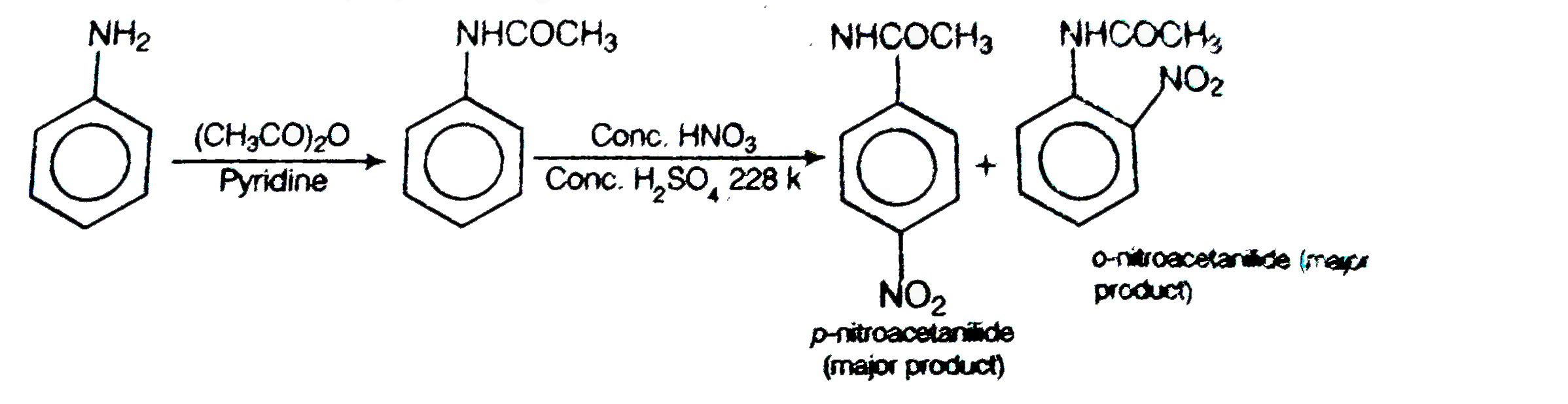
In order to check the activation of benzene ring by amino group, first it is acetylated with acetic anhydride or acetyl chloride in presence to form acetanilide which can be further nitralised easily by the nitrating mixture.
Promotional Banner

Topper's Solved these Questions

  • AMINES

    NCERT EXEMPLAR ENGLISH|Exercise LONG ANSWER|3 Videos
  • AMINES

    NCERT EXEMPLAR ENGLISH|Exercise LONG ANSWER|3 Videos
  • ALDEHYDE, KETONES AND CARBOXYLIC ACIDS

    NCERT EXEMPLAR ENGLISH|Exercise Long Answer Type Questions|4 Videos
  • BIOMOLECULES

    NCERT EXEMPLAR ENGLISH|Exercise Long Answer Type Questions|5 Videos

Similar Questions

Explore conceptually related problems

Why is nitric acid added to sodium extract before adding silver nitrate for testing halogens?

The -NO_(2) group in an aromatic ring deactivates the ortho and para positions for an electrophilic attack. When -NO_(2) group is present at ortho or para positions of a leaving group (Nucleofuge) it activates the ring for nucleophilic attack. The reduction of -NO_(2) group by metal in acid causes its reduction to -NH_(2) group and then the ring becomes strongly activated for a electrophilic attack. The strong activation of -NH_(2) group is moderated by its acylation with CH_(3)COCl to -NHAc group. Deacylation is carried out by hydrolysis with H_(3)O^(+) or OH^(-) . The ring alkylation by using RX//AlX_(3) is not possible in presence of -NO_(2) or -NH_(2) group but is possible in presence of -NHAc group. The product (I) is :

The -NO_(2) group in an aromatic ring deactivates the ortho and para positions for an electrophilic attack. When -NO_(2) group is present at ortho or para positions of a leaving group (Nucleofuge) it activates the ring for nucleophilic attack. The reduction of -NO_(2) group by metal in acid causes its reduction to -NH_(2) group and then the ring becomes strongly activated for a electrophilic attack. The strong activation of -NH_(2) group is moderated by its acylation with CH_(3)COCl to -NHAc group. Deacylation is carried out by hydrolysis with H_(3)O^(+) or OH^(-) . The ring alkylation by using RX//AlX_(3) is not possible in presence of -NO_(2) or -NH_(2) group but is possible in presence of -NHAc group. The product (G) is :

The -NO_(2) group in an aromatic ring deactivates the ortho and para positions for an electrophilic attack. When -NO_(2) group is present at ortho or para positions of a leaving group (Nucleofuge) it activates the ring for nucleophilic attack. The reduction of -NO_(2) group by metal in acid causes its reduction to -NH_(2) group and then the ring becomes strongly activated for a electrophilic attack. The strong activation of -NH_(2) group is moderated by its acylation with CH_(3)COCl to -NHAc group. Deacylation is carried out by hydrolysis with H_(3)O^(+) or OH^(-) . The ring alkylation by using RX//AlX_(3) is not possible in presence of -NO_(2) or -NH_(2) group but is possible in presence of -NHAc group. The product (H) is :

Direct nitration of aniline is not carried out. Explain why?

Why does -NH_2 group directs the incoming group at the ortho and para positions of the ring?

Give reasons for the following (a) Acetylation of aniline reduces its activation effect. (b) CH_(3)NH_(2) is more basic than C_(6)H_(5)NH_(2) . (c) Although -NH_(2) is o/p directing group, yet aniline on nitration gives a significant amount of m-nitroaniline.

Give reasons for the following (a) Acetylation of aniline reduces its activation effect. (b) CH_(3)NH_(2) is more basiic than C_(6)H_(5)NH_(2) . (c) Although -NH_(2) is o/p directing group, yet aniline on nitration gives a significant amount of m-nitroaniline.

Why is NH_(4)Cl essential in the precipitation of group V cations?

In case of meta-attack on aniline (where -NH_(2) group is o-, p- directing) and in case of ortho-attack on nitrobenzene, resonating structures are possible. Which of them are more stable ?

NCERT EXEMPLAR ENGLISH-AMINES-SATQ
  1. What is the role of HNO(3) in the nitrating mixture used for nitration...

    Text Solution

    |

  2. Why is NH(2) group of aniline acetylated before carrying our nitration

    Text Solution

    |

  3. What is the product when C(6)H(5)CH(2)NH(2) reacts with HNO(3)?

    Text Solution

    |

  4. What is the best reagent to convert nitrile to primary amine

    Text Solution

    |

  5. Give the structure of 'A' in the following reaction.

    Text Solution

    |

  6. What is Hinsberg reagent?

    Text Solution

    |

  7. Why is benzene diazonium chloride not stored and is used immediately a...

    Text Solution

    |

  8. Why does acylation of -NH(2) of aniline reduces its activating effect?

    Text Solution

    |

  9. Explain why MeNH(2) is stronger base than MeOH?

    Text Solution

    |

  10. What is the role of pyridine in the acelation reaction of amines?

    Text Solution

    |

  11. Under the reaction condition (acidic, basic) the coupling reaction of ...

    Text Solution

    |

  12. Predict the product of reaciton for aniline with bromine in non-polar...

    Text Solution

    |

  13. Arraange the following compounds in increasing order of dipole moment?...

    Text Solution

    |

  14. What is the structure and IUPAC name of the compound, allyl amine?

    Text Solution

    |

  15. Write down the IUPAC name of

    Text Solution

    |

  16. A compound Z with molecular formula C(3)H(9)N reacts with C(6)H(5)SO(2...

    Text Solution

    |

  17. A primary amine, RNH(2) can be reacted with CH(3)-X to get secondary a...

    Text Solution

    |

  18. Complete the following reaction

    Text Solution

    |

  19. Why is aniline soluble in aqueous HCl?

    Text Solution

    |

  20. Suggest a route by which of the following conversion can be accomplish...

    Text Solution

    |

