Home
Class 9
MATHS
ABCD is a parallelogram in which BC is p...

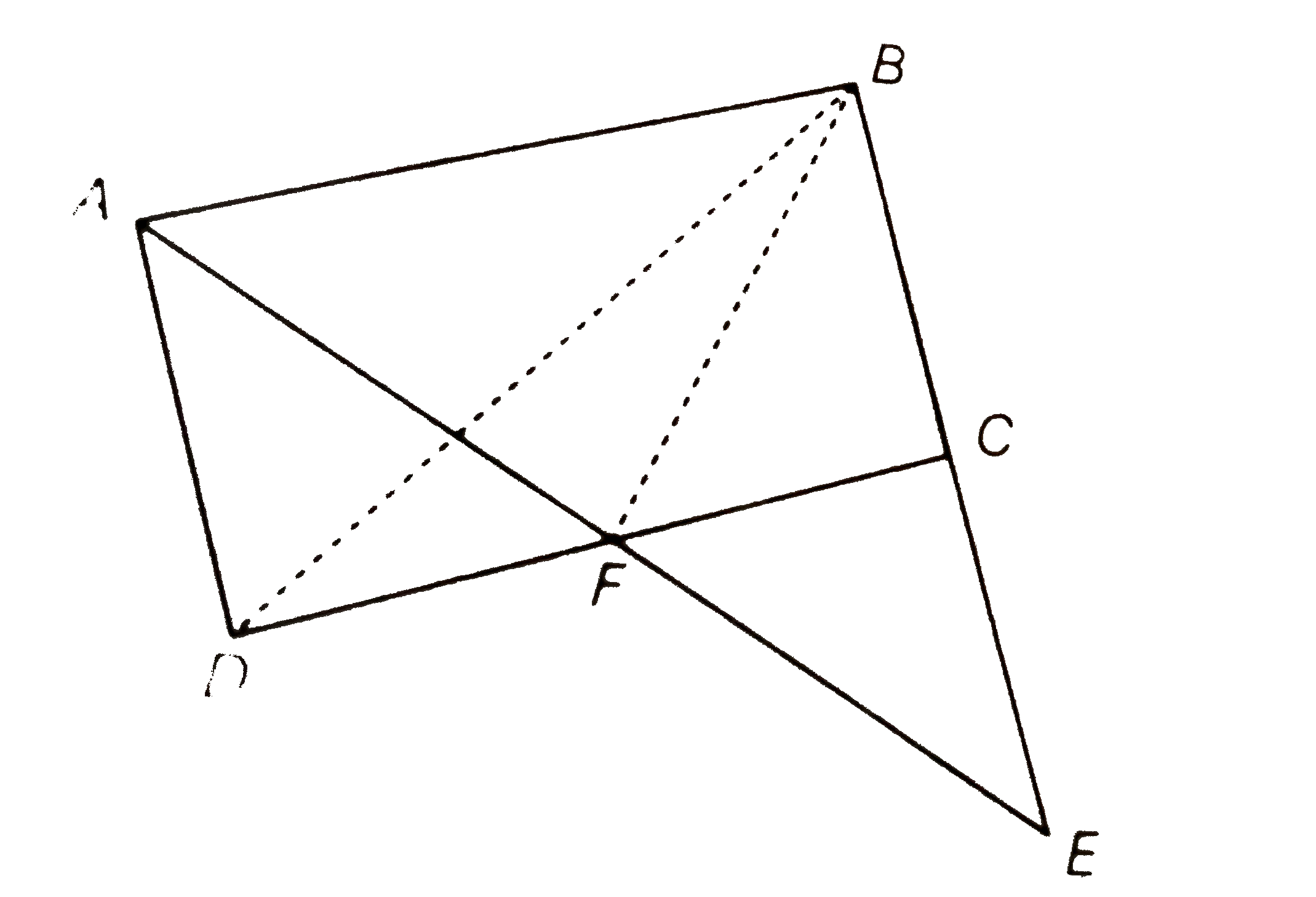
ABCD is a parallelogram in which BC is produced to E such that CE = BC. AE intersects CD at F.

If `ar (DeltaDFB) = 3 cm^(2)`, then find the area of the parallelogram ABCD.

Text Solution

Verified by Experts

Given, ABCD is a parallelogram and CE = BC i.e., C is the mid-point of BE.
Also, `" " ar (DeltaDFB) = 3 cm^(2)`
Now, `DeltaADF` and `DeltaDFB` are on the same base DF and between parallels CD and AB. Then,
`ar(DeltaADF) = ar (DeltaDFB) = 3 cm^(2)" "` ...(i)
In `DeltaABE`, by the converse of mid-point theorem,
`EF = AF" "` [since, C is mid-point of BE] ...(ii)
In `DeltaADF` and `DeltaECF`,
`angleAFD = angleCFE" "` [Vertically opposite angles]
`AF = EF" "` [from Eq. (ii)]
and `" " angleDAF = angleCEF`
[since, `BE || AD` and AE is transversal, then alternate interior angles are equal]
`therefore" "` `DeltaADF ~=DeltaECF" "` [by ASA congruence rule]
Then, `" " ar (DeltaADF) = ar (DeltaCFE)" "` [since, congruent figures have equal area]
`therefore" "` `ar (DeltaCFE) = ar (DeltaADF) = 3 cm^(2)" "` [from Eq. (i)] ...(iii)
Now, in `DeltaBFE`, C is the mid-point of BE then CF is median of
`DeltaBFE`,
`therefore" "` `ar (DeltaCEF) = ar (DeltaBFC)" "` [since, median of a triangle divides it into two triangles of equal area]
`rArr" "` `ar (DeltaBFC) = 3 cm^(2)" "` ...(iv)
Now, `" " ar (DeltaBDC) = ar (DeltaDFB) + ar (DeltaBFC)" "` [from Eqs. (i) and (iv)]
We know that, diagonal of a parallelogram divides it into two congruent triangles of equal areas.
`therefore" "` Area of parallelogram `ABCD = 2 xx "Area of " DeltaBDC`
`= 2 xx 6 = 12 cm^(2)`
Hence, the area of parallelogram ABCD is `12 cm^(2)` .
Promotional Banner

Topper's Solved these Questions

  • Areas of Parallelograms and Triangles

    NCERT EXEMPLAR ENGLISH|Exercise Exercise-9.4 Long Answer Type Questions|10 Videos
  • Areas of Parallelograms and Triangles

    NCERT EXEMPLAR ENGLISH|Exercise Exercise-9.2 Very Short Answer Type Questions|5 Videos
  • CIRCLES

    NCERT EXEMPLAR ENGLISH|Exercise Exercise 10.4|14 Videos

Similar Questions

Explore conceptually related problems

ABCD is a parallelogram in which BC is produced to E such that CE=BC and AE intersects CD at F. If ar.(DeltaDFB)=30cm^(2) , find the area of parallelogram

A B C D is a parallelogram in which B C is produced to E such that C E=B C. A E intersects C D\ at F . Prove that a r\ (\ A D F)=\ a r\ (\ E C F) . If the area of \ D F B=3\ c m^2, find the area of ABCD.

The given figure shows a parallelogram ABCD. E is a point in AD and CE produced meets BA produced at point F. If AE = 4 cm, AF = 8 cm and AB = 12 cm, find the perimeter of the parallelogram ABCD.

In a parallelogram ABCD, point P lies in DC such that DP:PC= 3:2 . If area of DeltaDPB=30sq. cm, ffind the area of the parallelogram ABCD.

ABCD is a parallelogram. Find the ratio of the area of Delta ABC to the area of the parallelogram ABCD.

In the given figure, if the area of parallelogram ABCD is 40 cm^2 , find the area of parallelogram ABEF

In the parallelogram ABCD , the side AB is produced to the point X.so that BX= AB. The line DX cuts BC at E. Prove that : Area ( Delta AED) = 2 xx " area " (Delta CEX).

ABCD is a parallelogram having adjacent sides AB = 35 cm and BC = 28 cm . If the distance between its longer sides is 8 cm , find : (i) the area of the parallelogram (ii) the distance between its shorts sides

ABCD is a parallelogram whose adjacent sides AB = 48 cm and BC = 14 cm . One of its diagonds AC = 50 cm . Find : (i) the area of the parallelogram ABCD. (ii) the distance between the longer sides. (iii) the distance between the shorter sides.

E is a point on the side AD produced of a parallelogram ABCD and BE intersects CD at F. Show that DeltaA B E ~DeltaC F B .
