Home
Class 12
PHYSICS
Consider a light beam incident from air ...

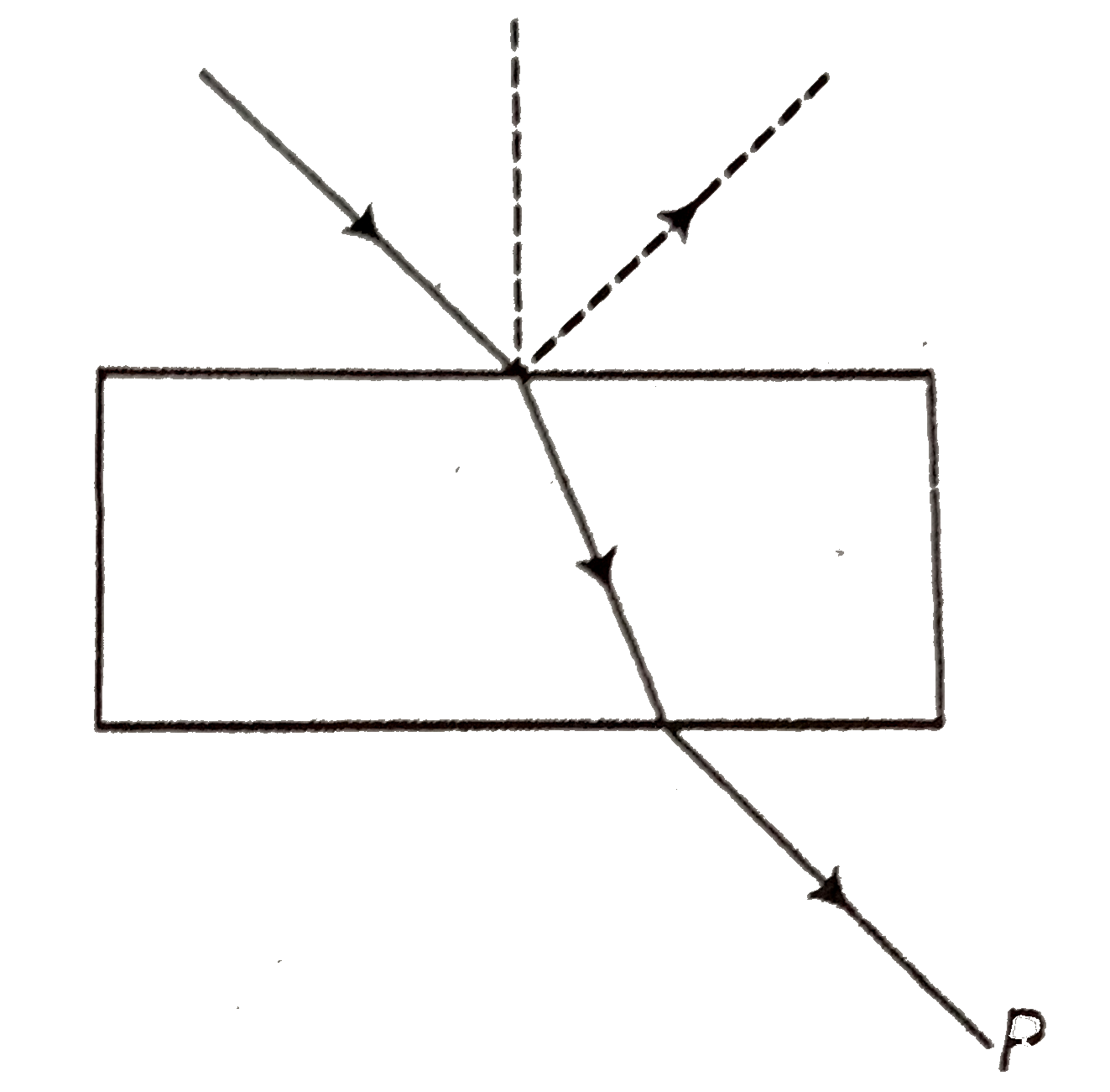
Consider a light beam incident from air to a glass slab at Brewster's angle as shown in figure.
A polaroid is placed in the path of the emergent ray at point P and rotated about an axis passing through the centre and pependicular to the plane of the polaroid.

A

for a particular orientation, there shall be darkness as observed through the polaroid

B

The intensity of light as seen through the polaroid shall be independent of the rotation

C

The intensity of light as seen through the polaroid shall go through a minimum but not zero for two orientations of the polaroid

D

The intensity of light as seen through the polaroid shall go through a minimum for four orientations of the polaroid

Text Solution

Verified by Experts

The correct Answer is:
C

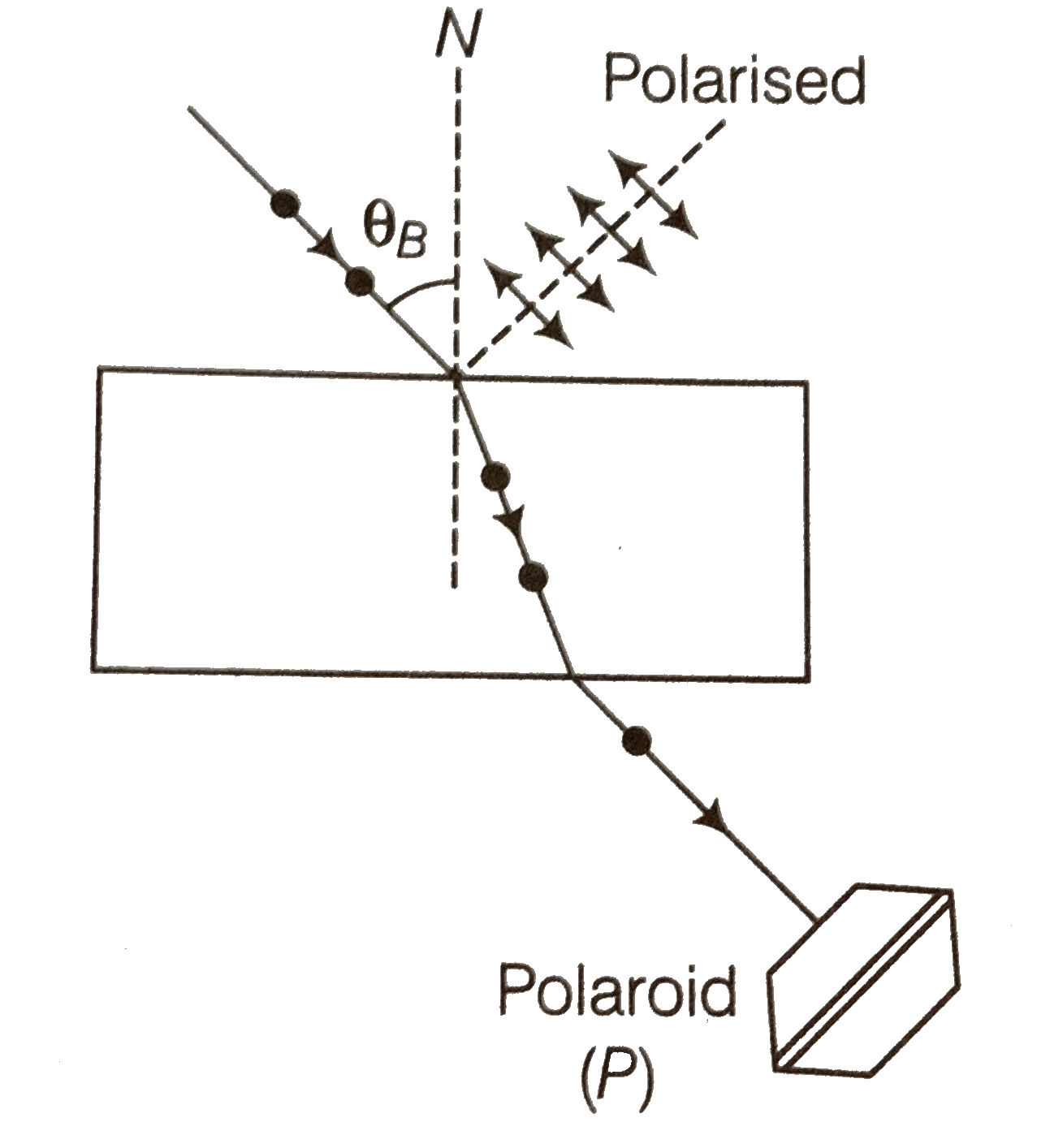
(c) Consider the diagram the light beam incident from air to the glass slab at Brewster's angle `(i_(p))`. The incident ray is unpolarised and is represented by dot (.).
The reflected light is plane polarised represented by arrows.
As the emergent ray is unpolarised, hence intensity cannot be zero when passes through polaroid.
Promotional Banner

Topper's Solved these Questions

  • WAVE OPTICS

    NCERT EXEMPLAR ENGLISH|Exercise Very short Answer Type Questions.|6 Videos
  • WAVE OPTICS

    NCERT EXEMPLAR ENGLISH|Exercise Short answer type Questions|3 Videos
  • SEMICONDUCTOR ELECTRONICS: MATERIAL,DEVICES AND SIMPLE CIRCUIT

    NCERT EXEMPLAR ENGLISH|Exercise Multiplel choice questions|26 Videos

Similar Questions

Explore conceptually related problems

Consider is light beam incident from air to a glass slab at Brewster.s angle as shown in Fig. A Polaroid is placed in the path of the emergent ray at point P and rotated about an axis passing through the centre and perpendicular to the plane of the polaroid.

White light is incident on the interface of glass and air as shown in figure. If green ligth is just totally internally reflected then the emerging ray in air contains

White light is incident on the interface of glass and air as shown in figure. If green ligth is just totally internally reflected then the emerging ray in air contains

A short pulse of white light is incident from air to a glass slab at normal incidence. After travelling through the slab, the first color to emerge is.

A short pulse of white light is incident from air to a glass slab at normal incidence. After travelling through the slab, the first colour to emerge is.

A uniform semicircular disc of mass 'm' and radius 'R' is shown in the figure. Find out its moment of inertia about. (a) axis 'AB' ( shown in the figure 0 which passes through geometrical centre and lies in the plane of the disc (b) axis 'CD' which passes through its centre of mass and it is perpendicular to the plane of the disc.

A rays of light is incident on a thick slab of glass of thickness t as shown in figure. The emergent ray is parallel to the incident ray but displaced sideways by a distance d. If the angles are small then d is

Light incidence on a sphere of refractive index sqrt3 placed in a air as shown in Figure. Find the angle (theta) in degree between emergent ray and reflected ray.

A ray of light AO is vacuum is incident on a glass slab at angle 60^@ and refracted at angle 30^@ along OB as shown in the figure.The optical path light ray from A to B is :

One side of a glass slab is silvered as shown in the figure. A ray of light is incident on the other side at angle of incidence 45^@. Refractive index of glass is given as sqrt2 . The deflection suffered by the ray when it comes out of the slab is

