Home
Class 10
PHYSICS
A student carries out an experiment and ...

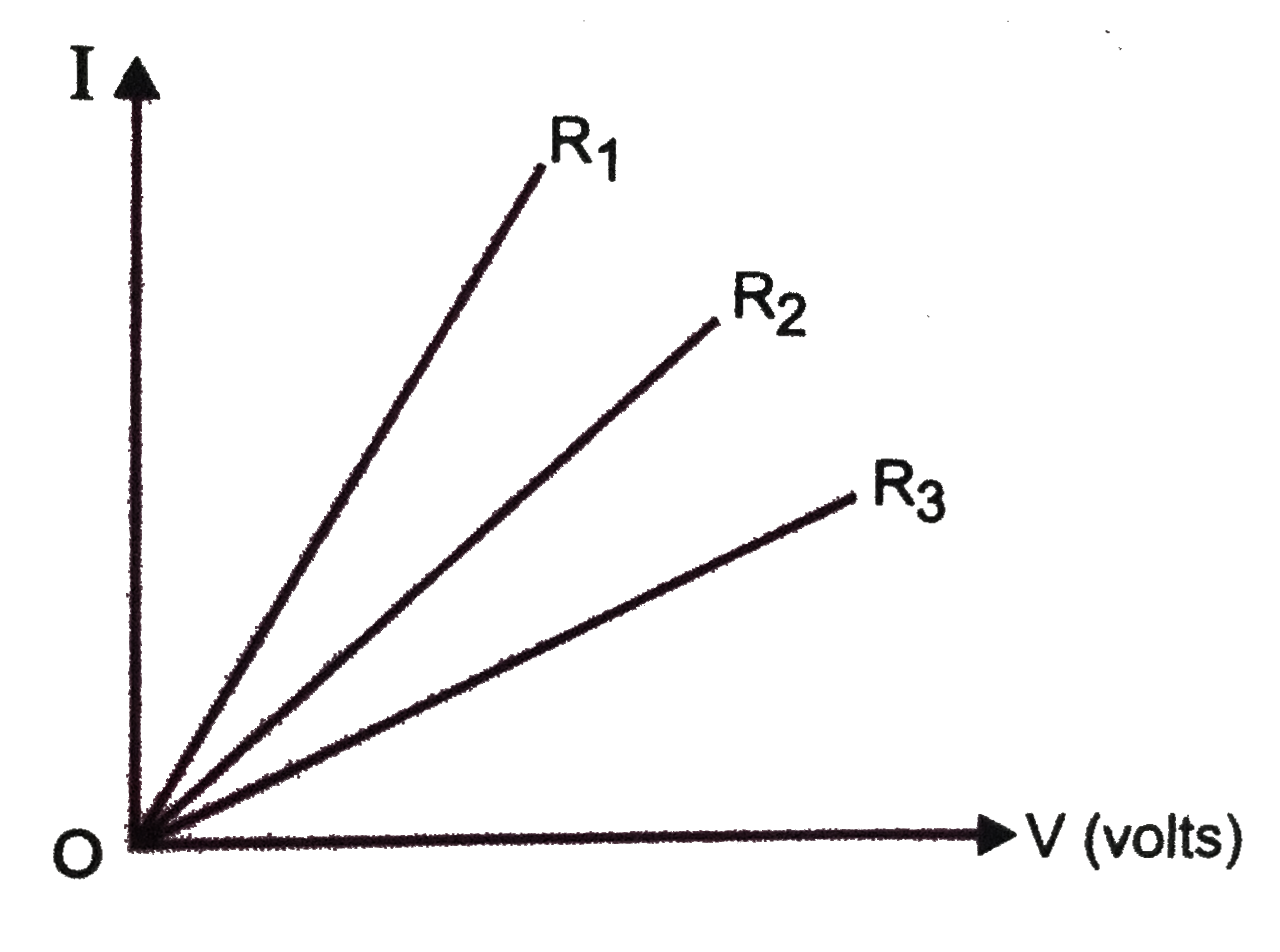
A student carries out an experiment and plots the `V-I` graphs of three samples of nichrome wire with resistances `R_1,R_2 and R_3` respectively, (Fig. 3.41). Which of the following is true ?

A

`R_(1) = R_(2) = R_(3)`

B

`R_(1) gt R_(2) gt R_(3)`

C

`R_(3) gt R_(2) gt R_(1)`

D

`R_(2) gt R_(3) gt R_(1)`

Text Solution

Verified by Experts

The correct Answer is:
C

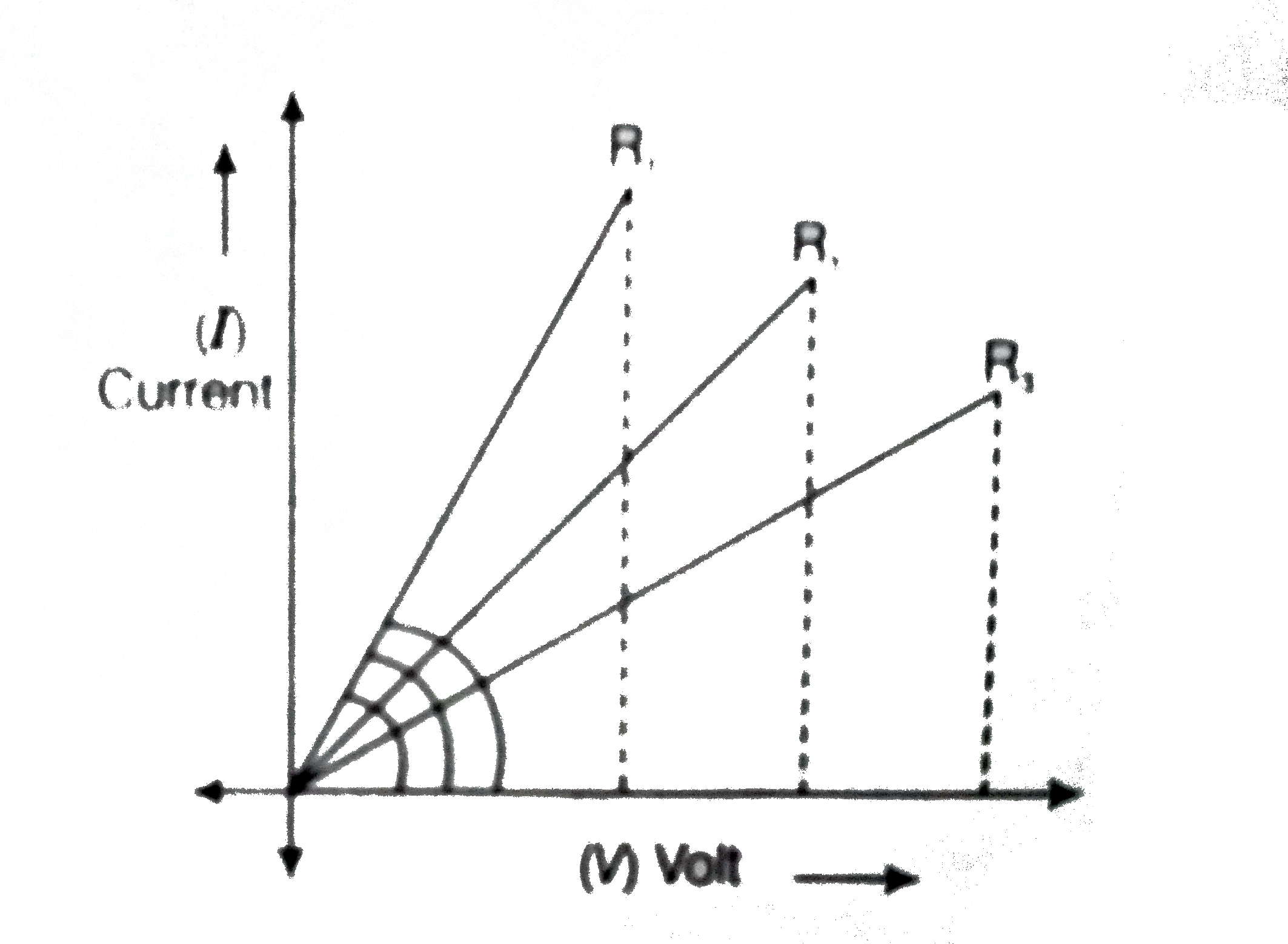
While performing an experiment, a student plot V - I graph of three samples of nichrome wire with resistances `R_(1), R_(2) "and" R_(3)`. And we know that slope of V and I tells about the resistance and (slope of V and I) `prop (1)/("Resistance")`
i.e.,

So, `R_(3) gt R_(2) gt R_(1)`
Promotional Banner

Topper's Solved these Questions

  • ELECTRICITY

    NCERT EXEMPLAR ENGLISH|Exercise Short Answer Type Questions|17 Videos
  • LIGHT : REFLECTION AND REFRACTION

    NCERT EXEMPLAR ENGLISH|Exercise Long Answer Type Questions|9 Videos

Similar Questions

Explore conceptually related problems

For the batteries shown in fig. R_1, R_2 and R_3 are the internal resistance of E_1, E_2, and E_3, respectively Then, which of the following is / are correct?

In the given circuit, if I_1 and I_2 be the current in resistances R_1 and R_2 , respectively, then .

In the situation shown, resistance R_(1),R_(2) and R_(3) are in the ratio 3:2:1 , then

Two students perform experiments on series and parallel combinations of two given resistors R_1 and R_2 and plot the following V -1 graphs [Fig. 5.24.]. Which of the graphs is/are correctly labeled in terms of the words 'series' and 'parallel'? Justify your answer.

Six wires each of resistance r form a tetrahedron. The equivalent resistance between corners 1-2 and 1-3 are respectively

In the, Ohm's law experiment ot find resistance of unknown resistor R, the arrangement is as shown. The resistance measured is given by R_("measured")=(V)/(i)V= voltage reading of voltmeter. i=current reading of ammeter. The ammeters and the voltmeter used are not ideal, and have resistance R_(A) and R_(V) respectively. For arrangement shown, the meausred resistance is

Write the expressions for the equivalent resistance R of three resistors R_1, R_2 , and R_3 joined in (a) parallel, and (b) series.

Find the emf ( V ) and internal resistance (R) of a single battery which is equivalent toa parallel combination of two batteries of emf V_1 and V_2 and internal resistances r_1 and r_2 respectively, with polrities as shown in figure

A potential divider is used to given outputs of 2V and 3V form a 5V source, as shown in fig. Which combination of resistance R_1, R_2, and R_3 gives the correct voltages?

NCERT EXEMPLAR ENGLISH-ELECTRICITY-Short Answer Type Questions
  1. A student carries out an experiment and plots the V-I graphs of three ...

    Text Solution

    |

  2. A child has drawn the electric circuit to study Ohm's law as shown in ...

    Text Solution

    |

  3. Three 2 Omega resistors, A, B and C are connected as shown in figure. ...

    Text Solution

    |

  4. Should the resistance of an ammeter be low or high ? Give reason.

    Text Solution

    |

  5. Draw a circuit diagram of an electric circuit containing a cell, a key...

    Text Solution

    |

  6. How does use of a fuse-wire protect electrical appliances ?

    Text Solution

    |

  7. What is electrical resistivity ? In a series electrical circuit compri...

    Text Solution

    |

  8. What is the commercial unit of electrical energy ? Represent it in ter...

    Text Solution

    |

  9. (a) A current of 1 A flows in a series curcuit containing an electric ...

    Text Solution

    |

  10. Why is parallel arrangement used in domestic wiring ?

    Text Solution

    |

  11. B1,B2 and B3 are three identical bulbs connected as shown in (fig. 3.4...

    Text Solution

    |

  12. Three incandecent bulbs of 100 W each are connected in series in an el...

    Text Solution

    |

  13. State Ohm's law ? How can it be verified experimentally ? Does it hold...

    Text Solution

    |

  14. What is electrical resistivity ? How does it depend om temperature. Gi...

    Text Solution

    |

  15. How will you infer with the help of an experiment that the same curren...

    Text Solution

    |

  16. How will you conclude that the same potential difference (voltage) exi...

    Text Solution

    |

  17. What is Joule's heating effect ? How can it be demonstrated experiment...

    Text Solution

    |

  18. Find out the folowing in the electric circuit given in (Fig. 3.48). ...

    Text Solution

    |

