Home
Class 10
PHYSICS
Three 2 Omega resistors, A, B and C are ...

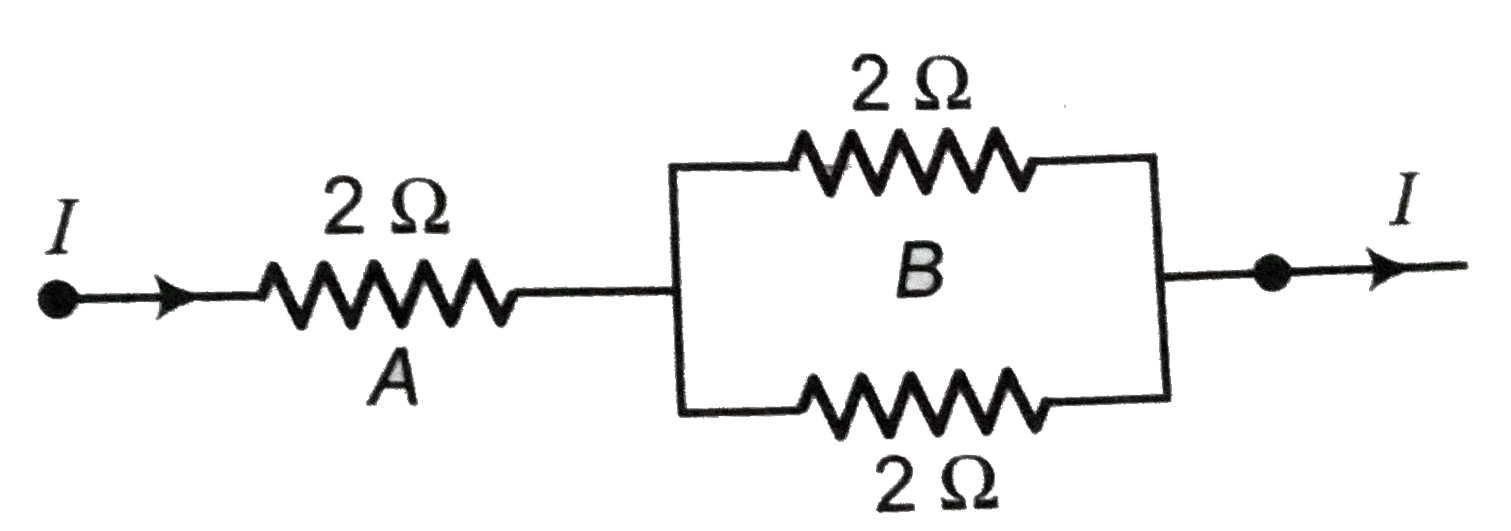
Three `2 Omega` resistors, A, B and C are connected as shown in figure. Each of them dissipates energy and can with stand a maximum power of 18 W without melting. Find the maximum current that can flow through the three resistors ?

Text Solution

Verified by Experts

Resistance, `R = 2 Omega`
Maximum power, `P_(max) = 18 W`
Maximum current, `I_(max) =` ?
`P = I^(2)R`
`rArr " " I= sqrt((P)/(R)) = sqrt((18)/(2)) = 3A= I_(max)`
Maximum current that can flow through `2 Omega` resistor is `3A`. This current divides along B and C because in parallel combination, voltage across B and C remain same and hence, `I prop (1)/(R)`.
Since, B and C have same resistance `2 Omega` each, therefore, same current i.e., `(3)/(2) = 1.5 A` flows through B and C.
Promotional Banner

Topper's Solved these Questions

  • ELECTRICITY

    NCERT EXEMPLAR ENGLISH|Exercise Short Answer Type Questions|17 Videos
  • LIGHT : REFLECTION AND REFRACTION

    NCERT EXEMPLAR ENGLISH|Exercise Long Answer Type Questions|9 Videos

Similar Questions

Explore conceptually related problems

Find the currents through the three resistors shown in Figure

Three 200Omega resistors are connected as shown in figure. Any of these resistors breaks down if the rate of heat dissipation in it exceeds 50 W. Then, the maximum rate of total heat dissipation in the three resistors together is __________ W.

Three resistors of 2 Omega , 3 Omega and 4 Omega are connected in series

Three 200 Omega resistors are connected as shown in figure. The maximum power that can be dissipated in any one of the resistor is 50 W. Find the total power in watts dissipated in the circuit for maximum voltage across the terminals A and B.

In the circuit shown in fig. 7.24 , all the resistors are rated at a maximum power of 1.00 W . What is the maximum emf epsilon that the battery can have without burning up any of the resistors?

Three electric bulbs of 200 W, 200 W and 400 W are connected as shown in figure. The resultant power of the combination is

Three resistances are connected to form a T-shape as shown in the figure. Then, the current in the 4Omega resistor is

In the circuit diagram shown in find the current through the 1Omega resistor.

Each of three resistors in fig. 7.12 has a resistance of 2 Omega and can dissipate a maximum of 18 W without becoming excessively heated. Find the maximum power the circuit can dissipate.

In the circuit, 8 resistors of 2 Omega and 8 resistors of 4 Omega are connected as shown in the figure. The current in the branch AB is

NCERT EXEMPLAR ENGLISH-ELECTRICITY-Short Answer Type Questions
  1. A child has drawn the electric circuit to study Ohm's law as shown in ...

    Text Solution

    |

  2. Three 2 Omega resistors, A, B and C are connected as shown in figure. ...

    Text Solution

    |

  3. Should the resistance of an ammeter be low or high ? Give reason.

    Text Solution

    |

  4. Draw a circuit diagram of an electric circuit containing a cell, a key...

    Text Solution

    |

  5. How does use of a fuse-wire protect electrical appliances ?

    Text Solution

    |

  6. What is electrical resistivity ? In a series electrical circuit compri...

    Text Solution

    |

  7. What is the commercial unit of electrical energy ? Represent it in ter...

    Text Solution

    |

  8. (a) A current of 1 A flows in a series curcuit containing an electric ...

    Text Solution

    |

  9. Why is parallel arrangement used in domestic wiring ?

    Text Solution

    |

  10. B1,B2 and B3 are three identical bulbs connected as shown in (fig. 3.4...

    Text Solution

    |

  11. Three incandecent bulbs of 100 W each are connected in series in an el...

    Text Solution

    |

  12. State Ohm's law ? How can it be verified experimentally ? Does it hold...

    Text Solution

    |

  13. What is electrical resistivity ? How does it depend om temperature. Gi...

    Text Solution

    |

  14. How will you infer with the help of an experiment that the same curren...

    Text Solution

    |

  15. How will you conclude that the same potential difference (voltage) exi...

    Text Solution

    |

  16. What is Joule's heating effect ? How can it be demonstrated experiment...

    Text Solution

    |

  17. Find out the folowing in the electric circuit given in (Fig. 3.48). ...

    Text Solution

    |
