Home
Class 12
MATHS
Explain why the experiment of tossing a ...

Explain why the experiment of tossing a coin three times is said to have Binomial distribution.

Text Solution

Verified by Experts
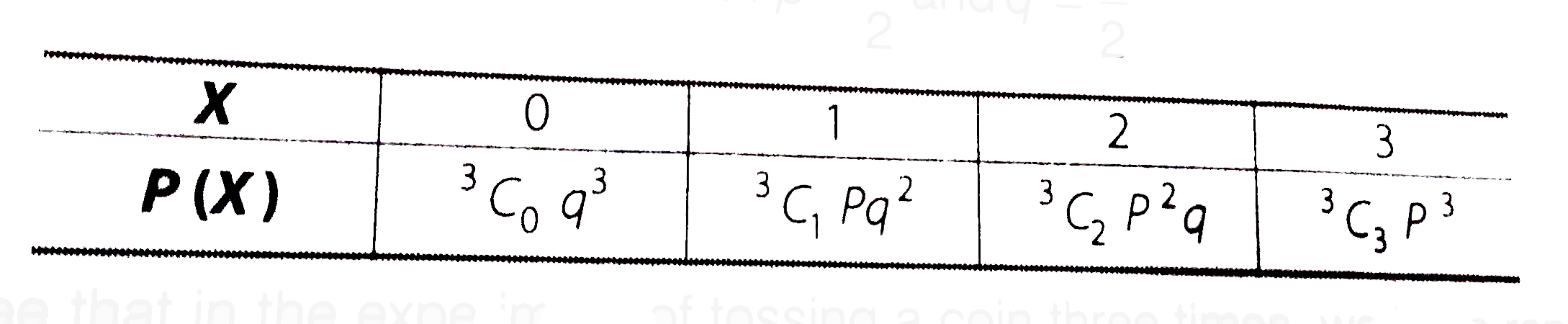
We know that a random variable X taking values 0,1,2,…….n is saidd to have a binomial distribution with parameteres n and P, if its probability distribution is given by
`P(X=r)=""^(n)C_(r)p^(r )q^(n-r)`
q=1-p
r=0,1,2,……..,n
Similaly in an experiment of tossing a coin three times, we have been n=3 and random variable X can take values r=0, 1, 3 and 3 with `p=1/2` and `q=1/2`

So, we see that in ithe experiment of tossing a coin three times, we have random variable X which can take value 0,1,2 and 3 with parameters n=3 and `P+1/2`.
Therefore, it is said to have a Binomial distribution.
Promotional Banner

Topper's Solved these Questions

  • PROBABILITY

    NCERT EXEMPLAR ENGLISH|Exercise Long Answer Type Questions|15 Videos
  • PROBABILITY

    NCERT EXEMPLAR ENGLISH|Exercise Objective Type Questions|38 Videos
  • MATRICES

    NCERT EXEMPLAR ENGLISH|Exercise Solved example|101 Videos
  • RELATIONS AND FUNCTIONS

    NCERT EXEMPLAR ENGLISH|Exercise Fillers|15 Videos

Similar Questions

Explore conceptually related problems

Write the sample space for the experiment of tossing a coin four times.

Find the probability of getting tail each time in three tosses of a coin.

Find the number of possible outcomes of tossing a coin four times.

Consider the random experiment of tossing three coins. If X denote, the number of tails in the sample space, exhibit X.

A coin is tossed until a head appears or the tail appears 4 times in succession. Find the probability distribution of the number of tosses.

An experiment consists of tossing a coin and then tossing it second time if head occurs. If tail occurs on the first toss, then a die is tossed once. Find the sample space.

Find the mean number of heads in three tosses of a fair coin.

Find the mean number of heads in three tosses of a fair coin.

Describe the sample space for the indicated experiment : A coin is tossed and then a die is rolled only in case a head is shown on the coin.

The probability of getting exactly two heads when tossing a coin three times is

